
teadolly

24 posts

Japan in July: Hot. Lost. Amazed. And Completely in Love. Part 4

2026-08-01_21-05-09_IMG_5795

When Tokyo Got Too Hot: Getting Creative Indoors

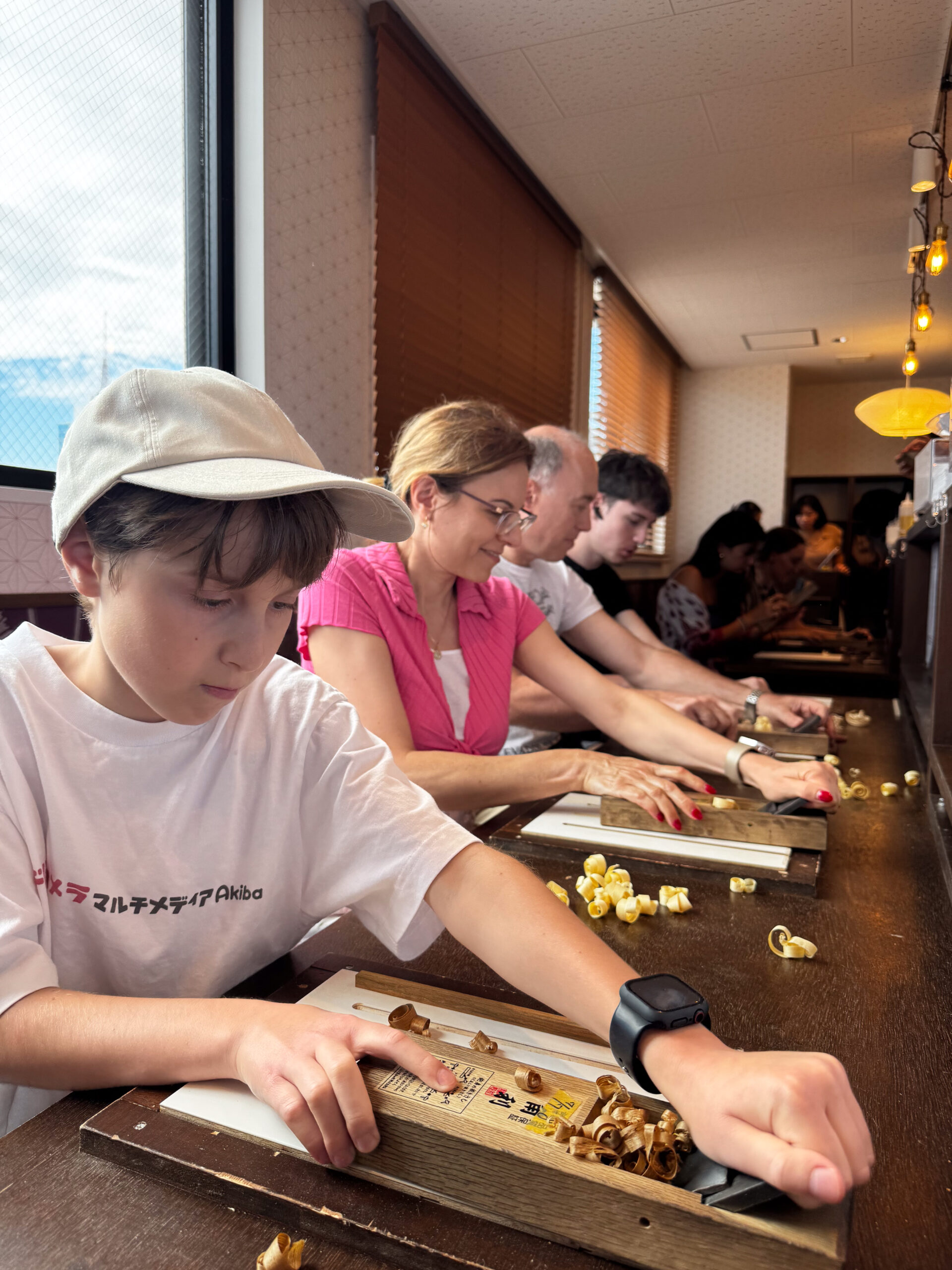
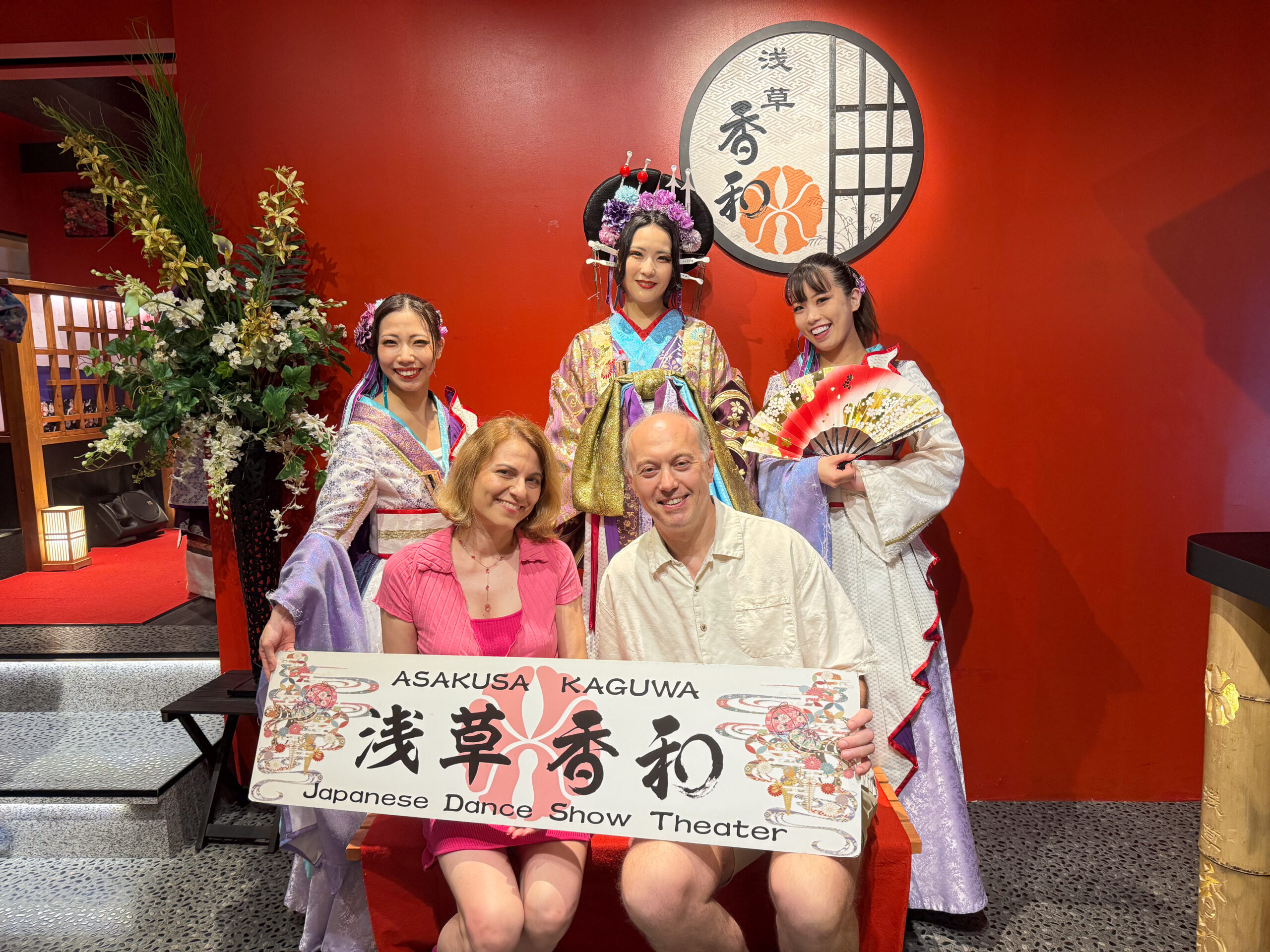
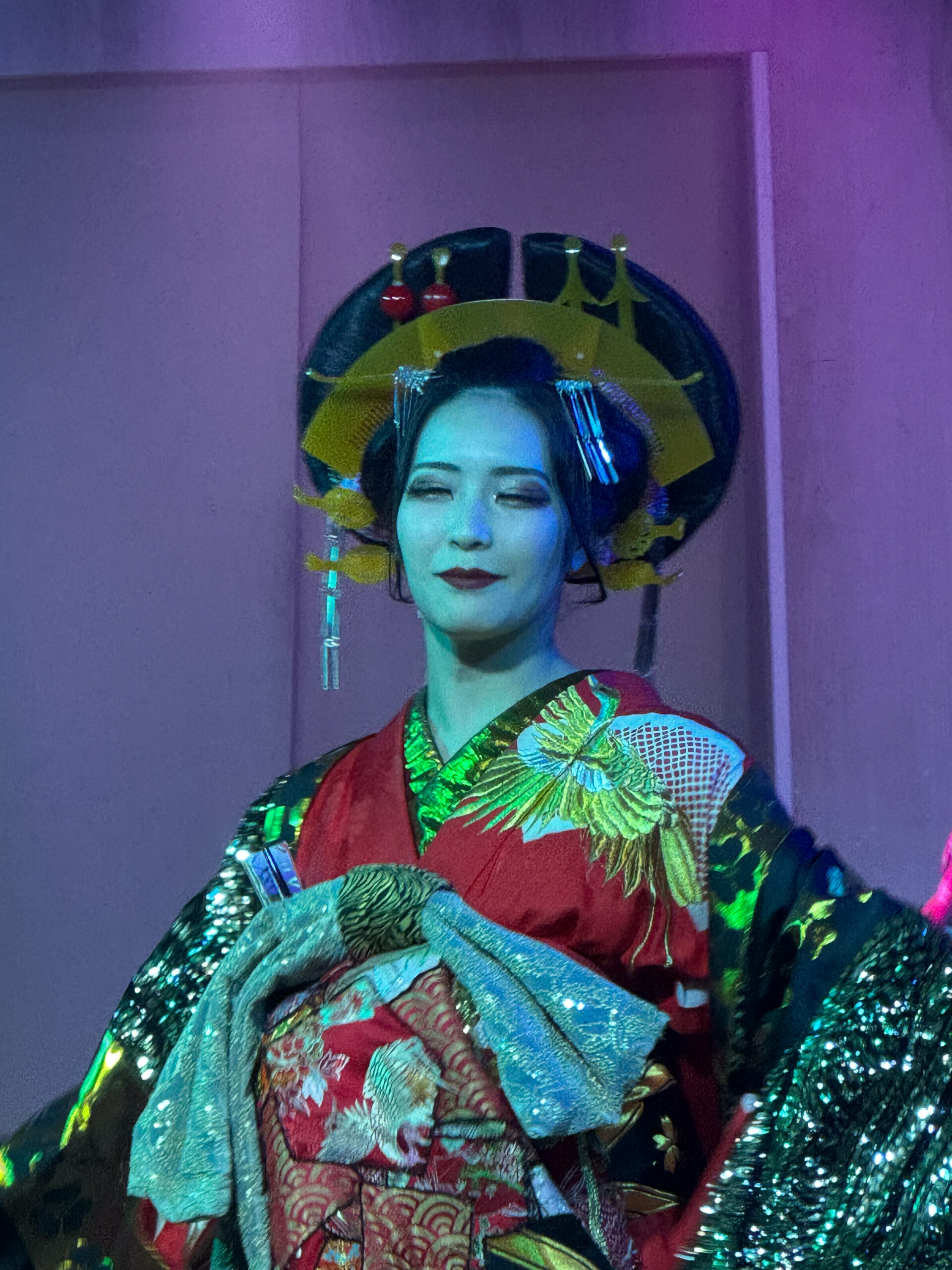
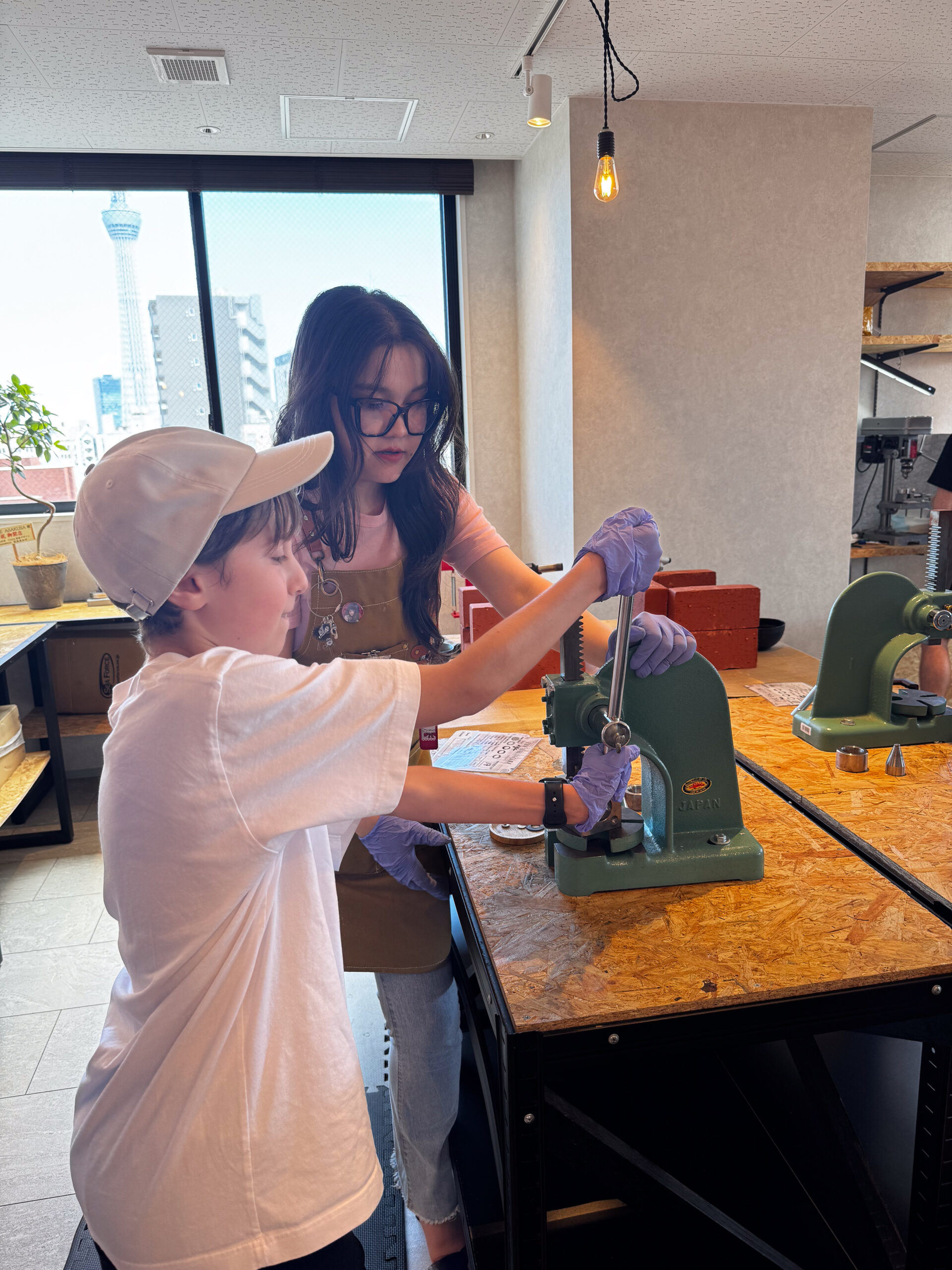
By our last few days in Tokyo, we had learned an important survival strategy: when it’s 36°C outside, find something to do indoors! I booked several activities through GetYourGuide, and because I kept using the same app, I even picked up some discounts along the way. We made rings out of Japanese coins in Asakusa and carved our own wooden chopsticks using a traditional hand plane—two of my favorite souvenirs because we actually made them ourselves. We had also booked a traditional geisha tea ceremony, but it was cancelled because of the extreme heat. Instead, we ended up at a cabaret theater in Asakusa—and honestly, it was such a fun alternative. Male and female performers in spectacular costumes told a dramatic historical story involving samurai and a young woman being sold into a brothel, with incredibly expressive acting, dance, and music. Before the show, the performers came to our table to introduce themselves and give us their cards, and afterward we even got to take photos with them. Sometimes Plan B in Japan turned out to be just as memorable as Plan A.
Anime Everywhere: Skytree, Solamachi, and Our Shibuya PARCO Quest

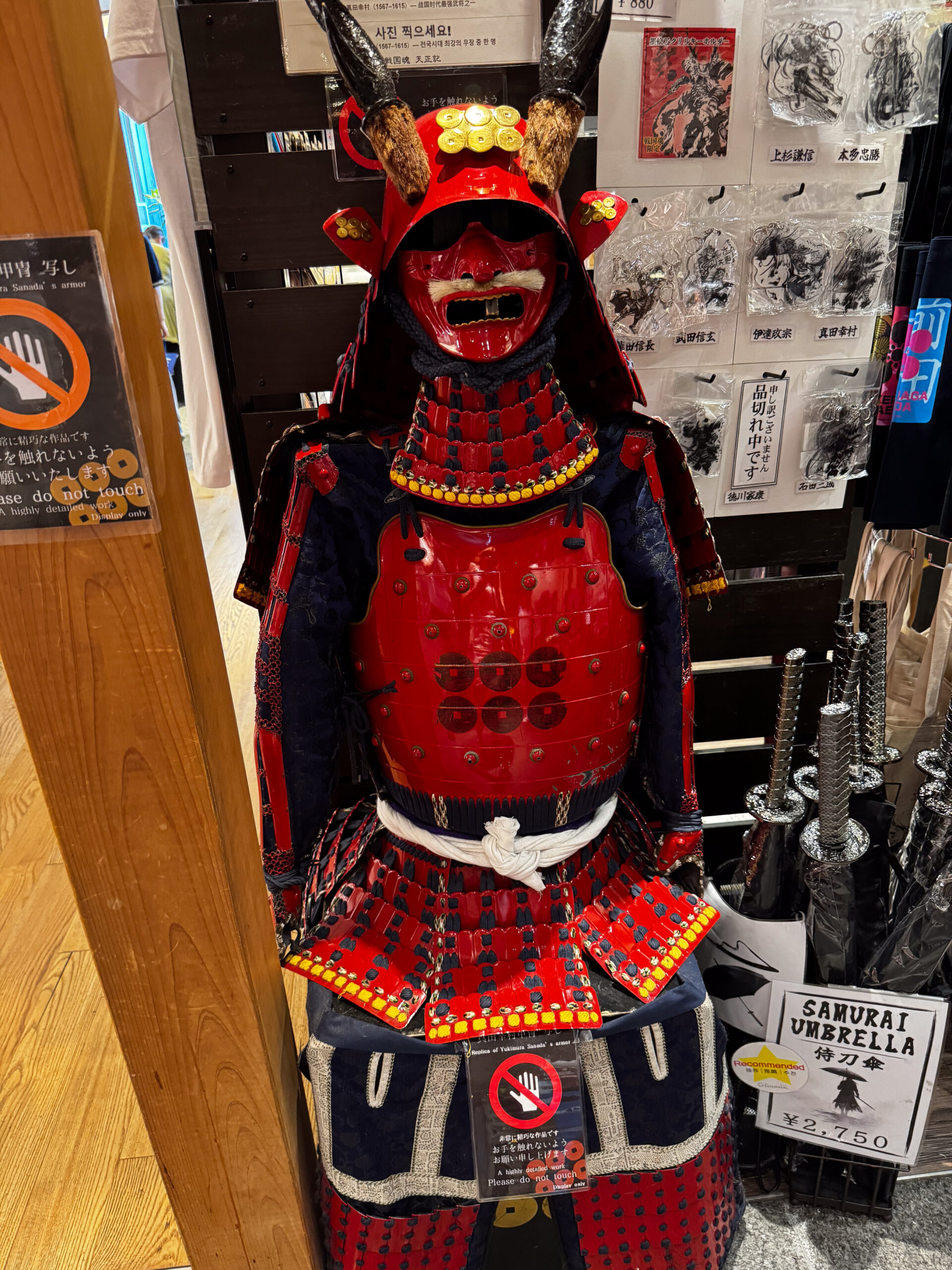
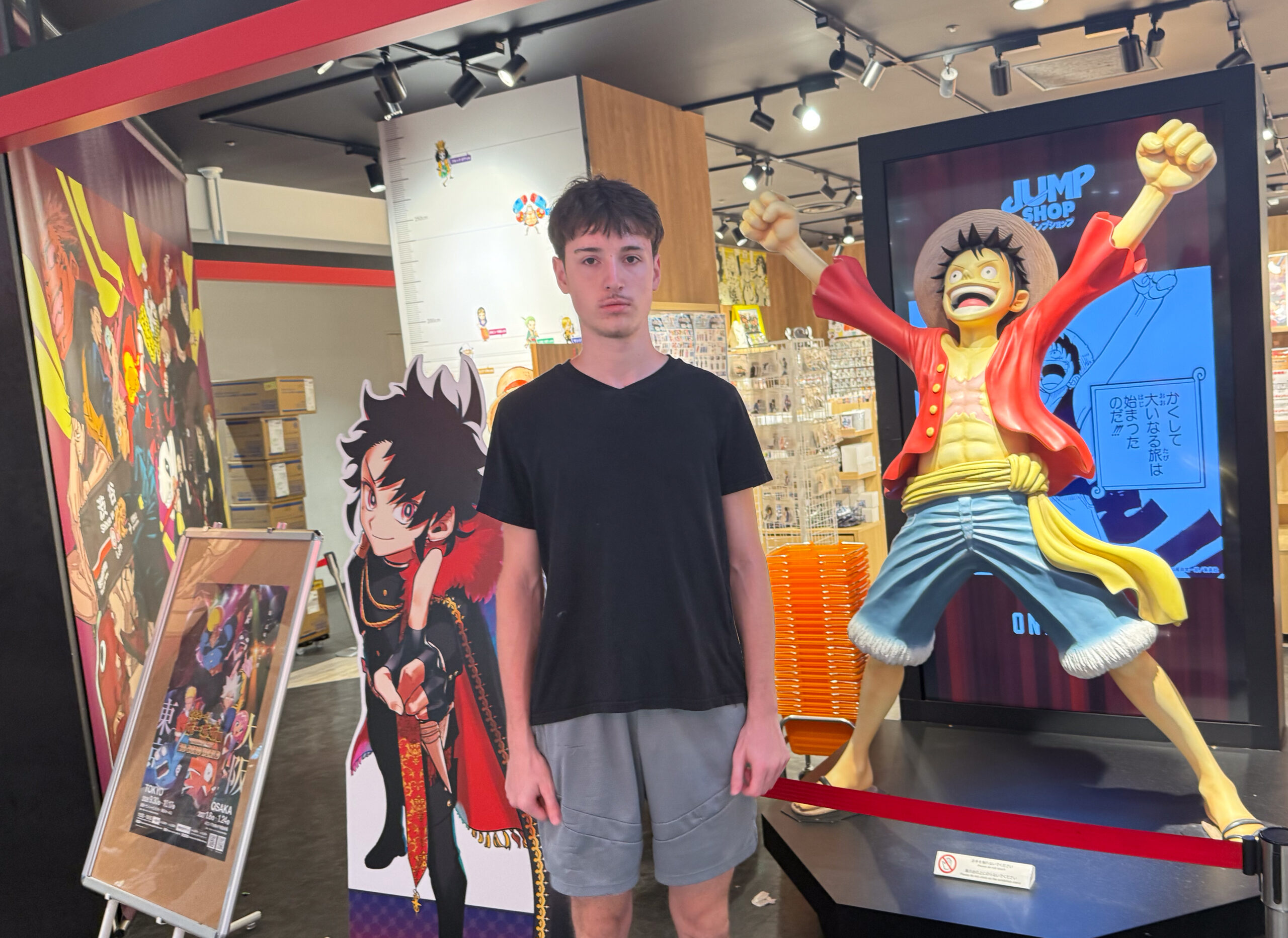
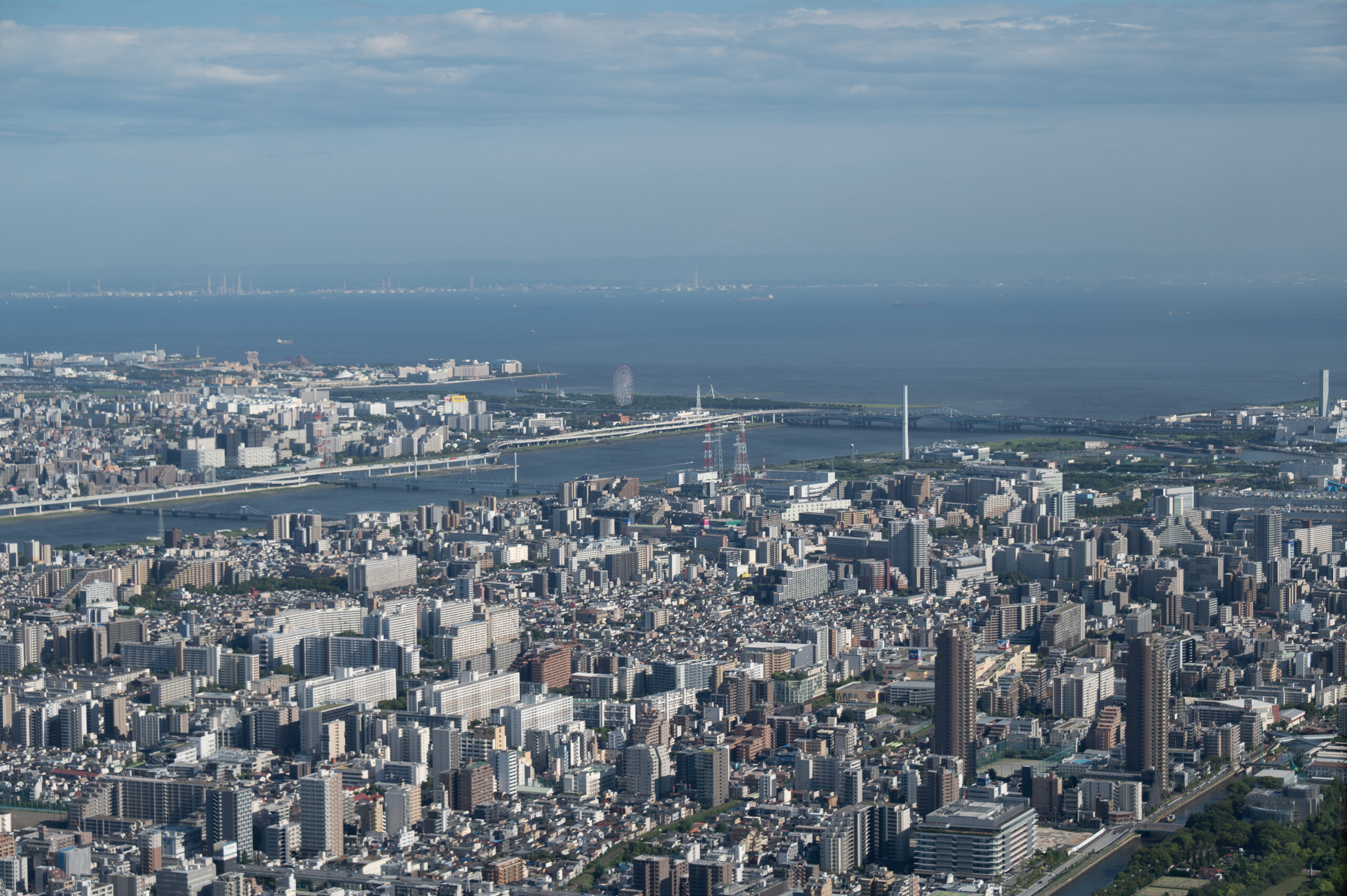
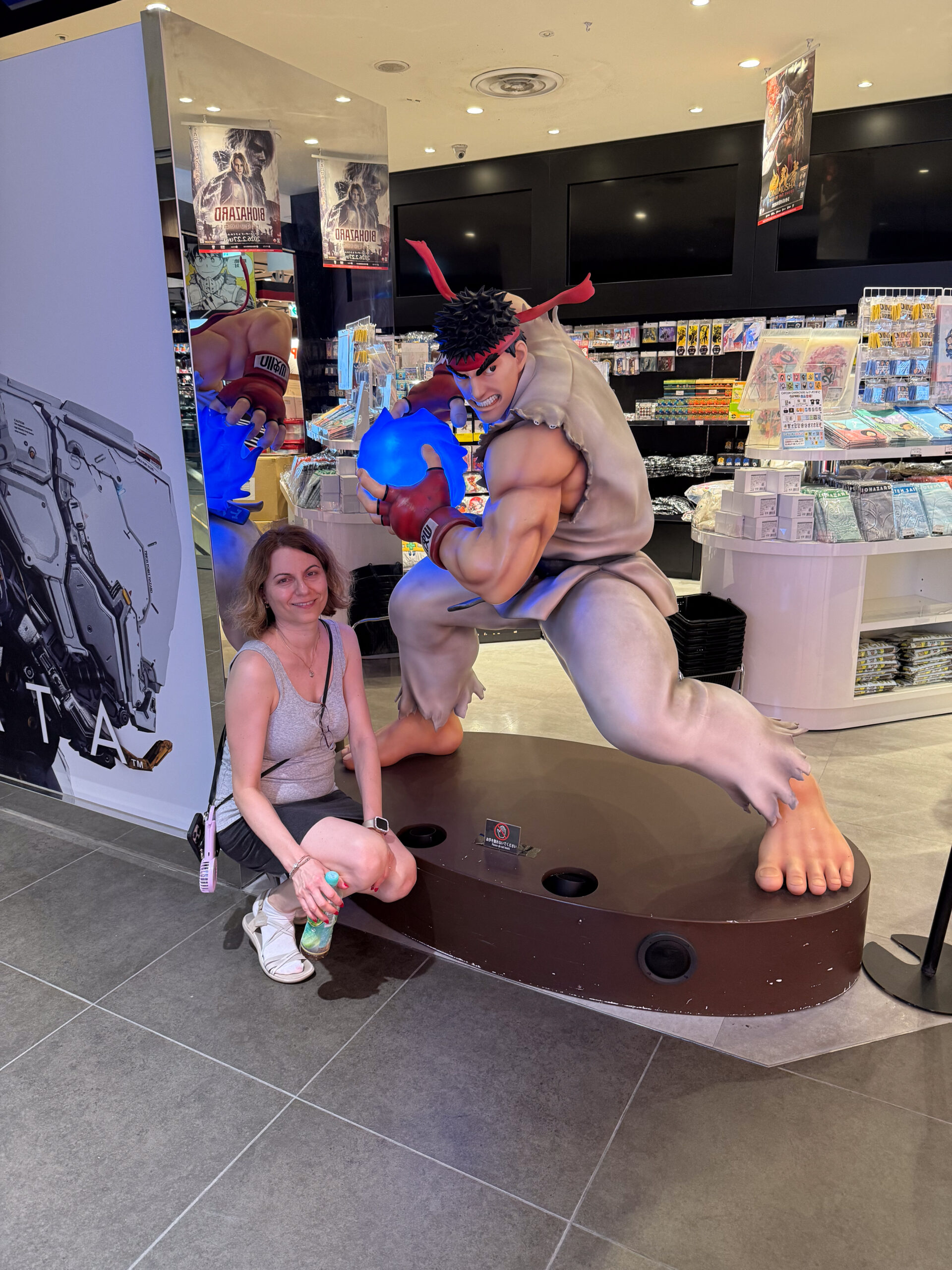
Later, we visited Tokyo Skytree, the tallest tower in the world. One thing you quickly notice in Japan is the love of mascot and anime collaborations. At the top of Skytree, the observation deck had been taken over by a collaboration with a popular character. Fans carried plushies around and posed them against the Tokyo skyline. You see these collaborations everywhere—from gachapon capsule-toy machines to pop-up cafes. It’s such a fun cultural quirk. Right underneath Skytree is Tokyo Solamachi, a huge shopping and entertainment complex that almost feels like a little town designed for kids—and adults who still behave like kids around their favorite characters. It’s packed with shops, cafes, restaurants, and character stores, including a large Pokémon Center. Everywhere we turned, there seemed to be another Disney, anime, or cartoon character waiting for a photo, so naturally we kept stopping to pose with them. You could easily spend hours at Skytree without ever actually leaving the building.
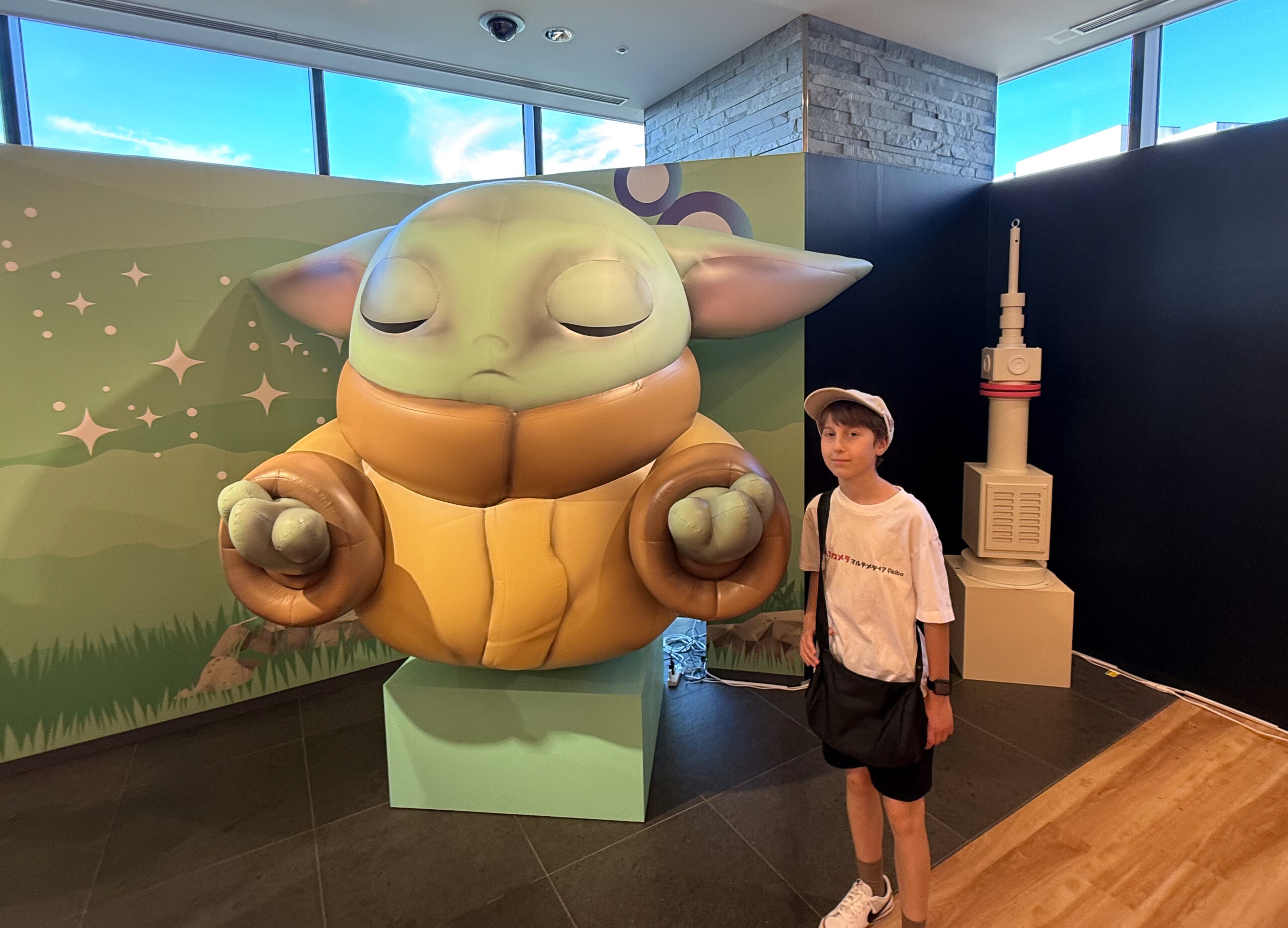
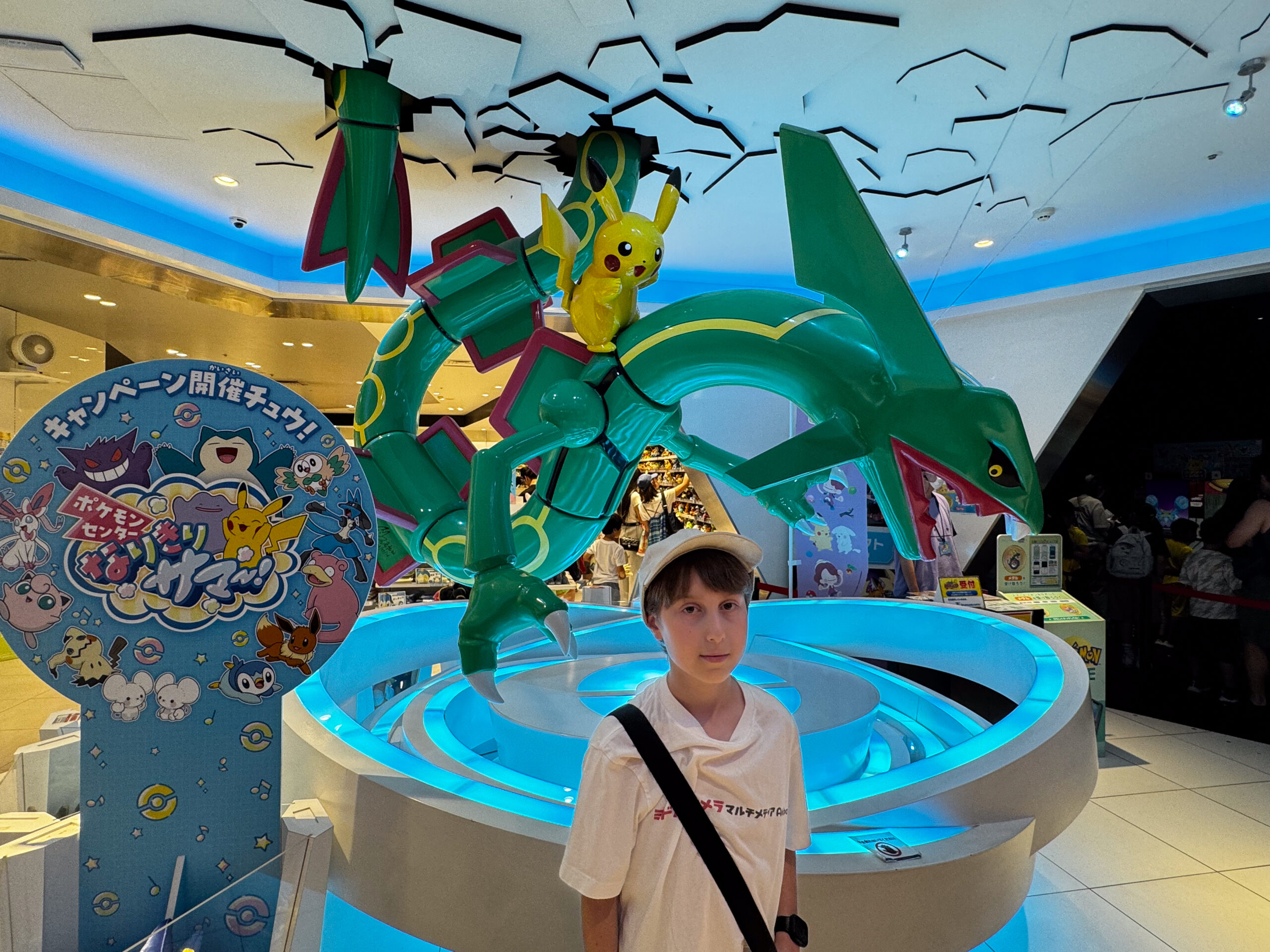
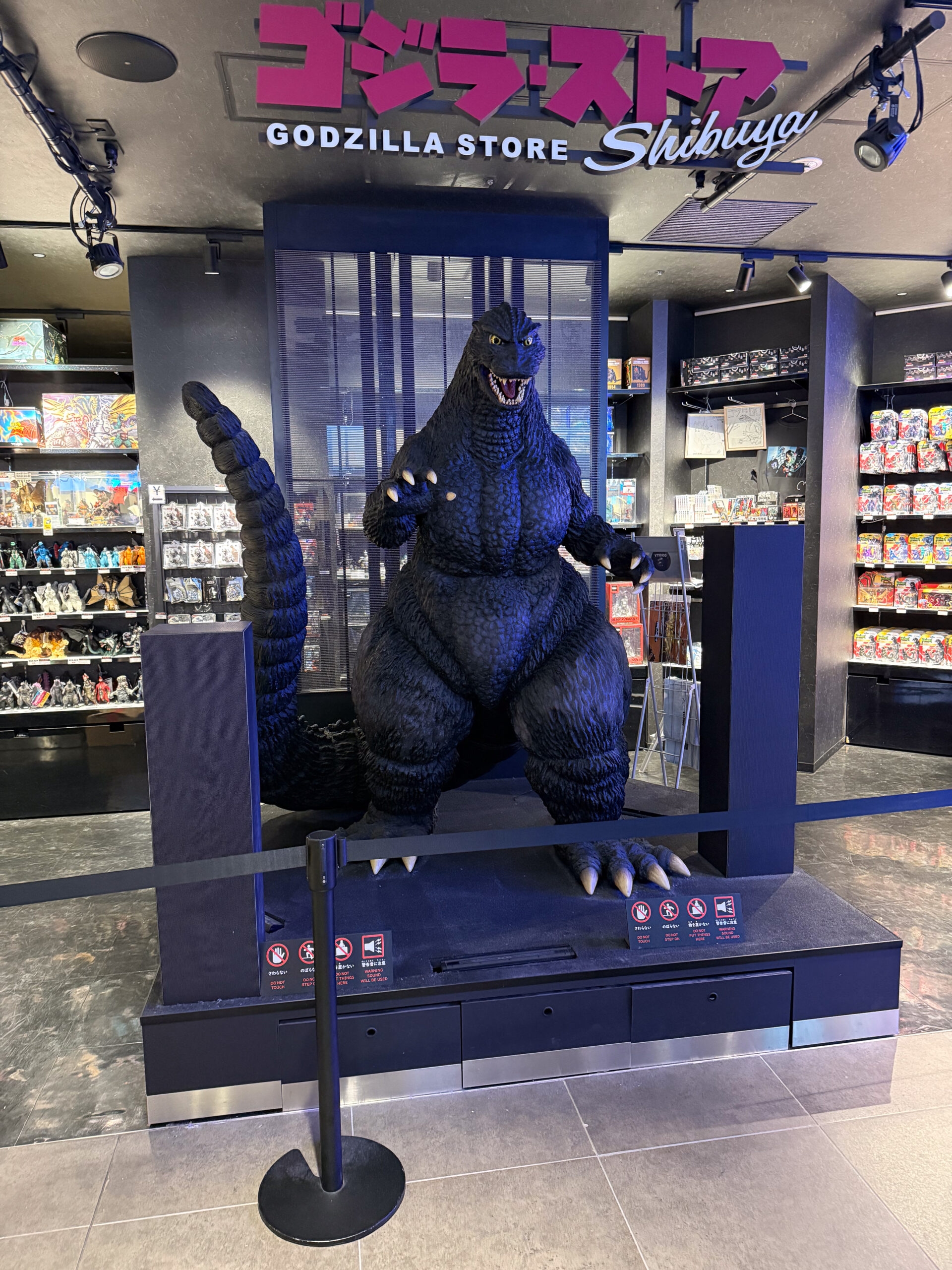
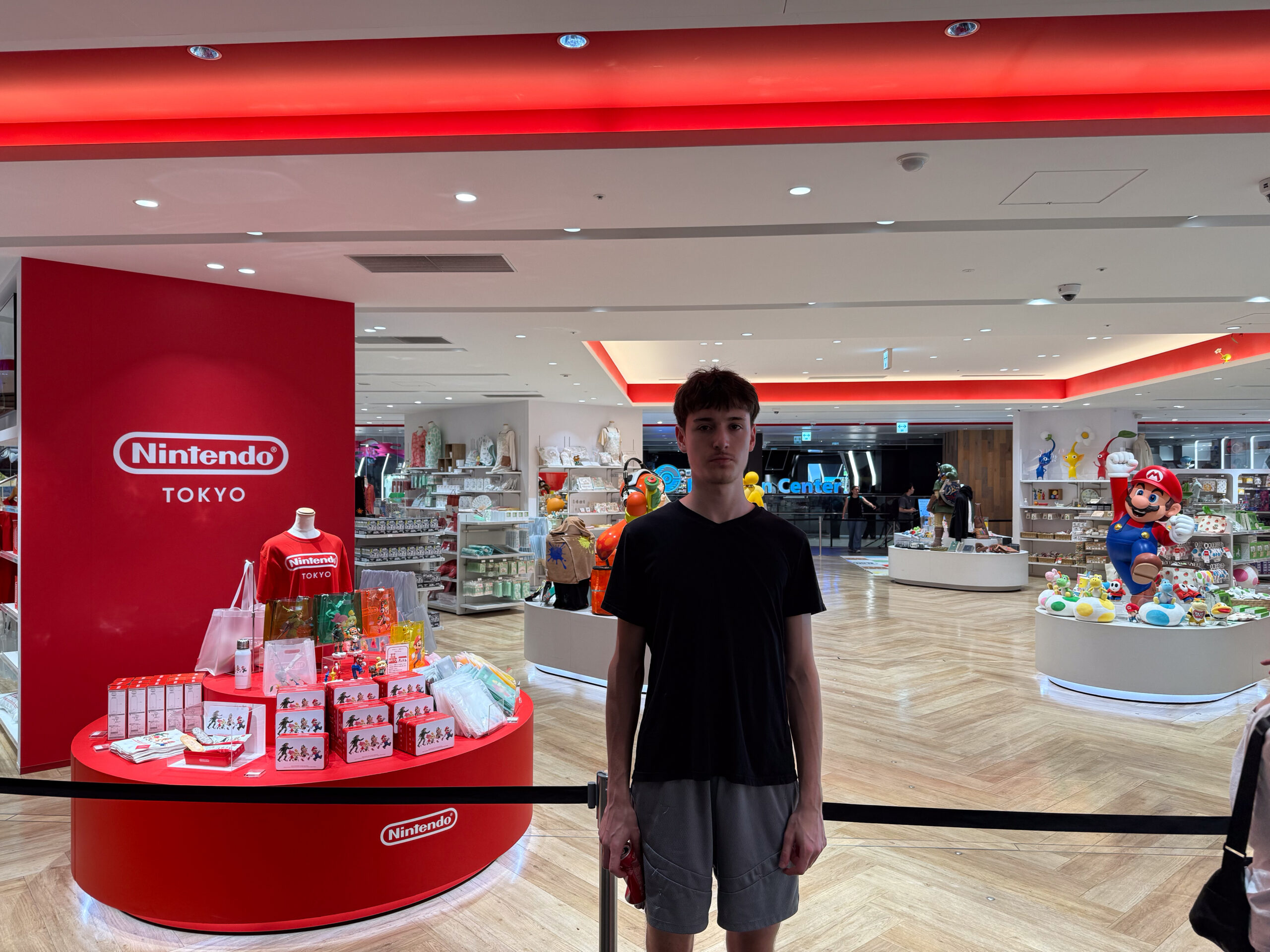
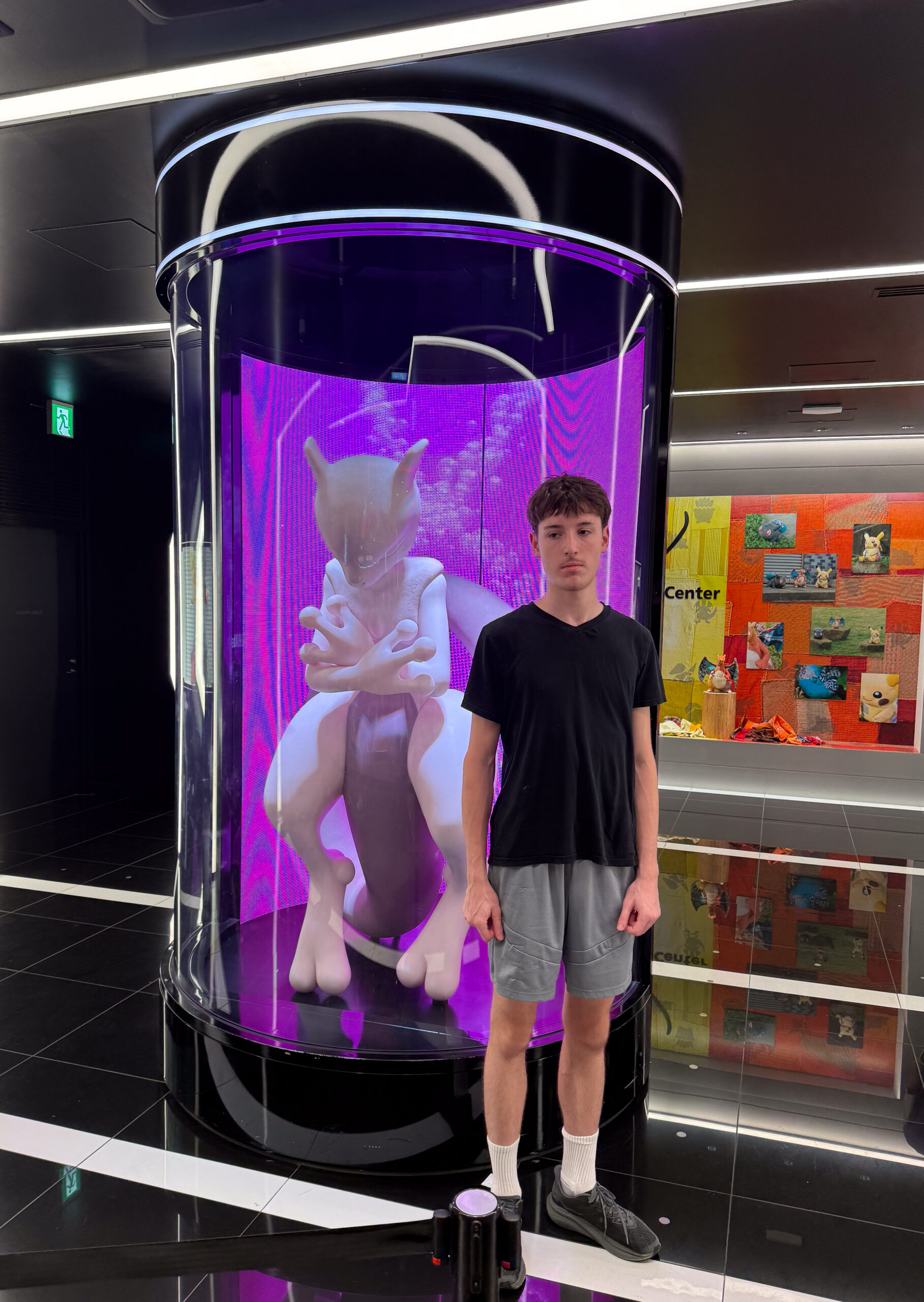
We found another paradise for anime and gaming fans on the sixth floor of Shibuya PARCO, home to a huge Pokémon Center, the Nintendo Store, and larger-than-life characters everywhere. Alex desperately wanted to go, but after lingering over omurice at a tiny restaurant one evening, we arrived at Shibuya Station with only about 30 minutes left before the floor closed at 9 p.m. Google Maps claimed PARCO was about a 10-minute walk away. In Shibuya, apparently, “10 minutes” is more of a philosophical concept.

Between construction, enormous crowds, underground passages, escalators, tiny streets, and at least one or two trips across Shibuya Crossing, getting there became another Tokyo navigation quest. Alex somehow led the way while I told Andrew to think of it as our evening fitness program. We raced up and down escalators, through tunnels and across streets—and finally reached PARCO at exactly 9 p.m., just as everything closed. Mission failed! But at least we managed to sneak in a few photos with Alex’s favorite characters before leaving. Sometimes in Tokyo, simply reaching your destination is the attraction.
Donki: Shopping in Japanese Lilliput

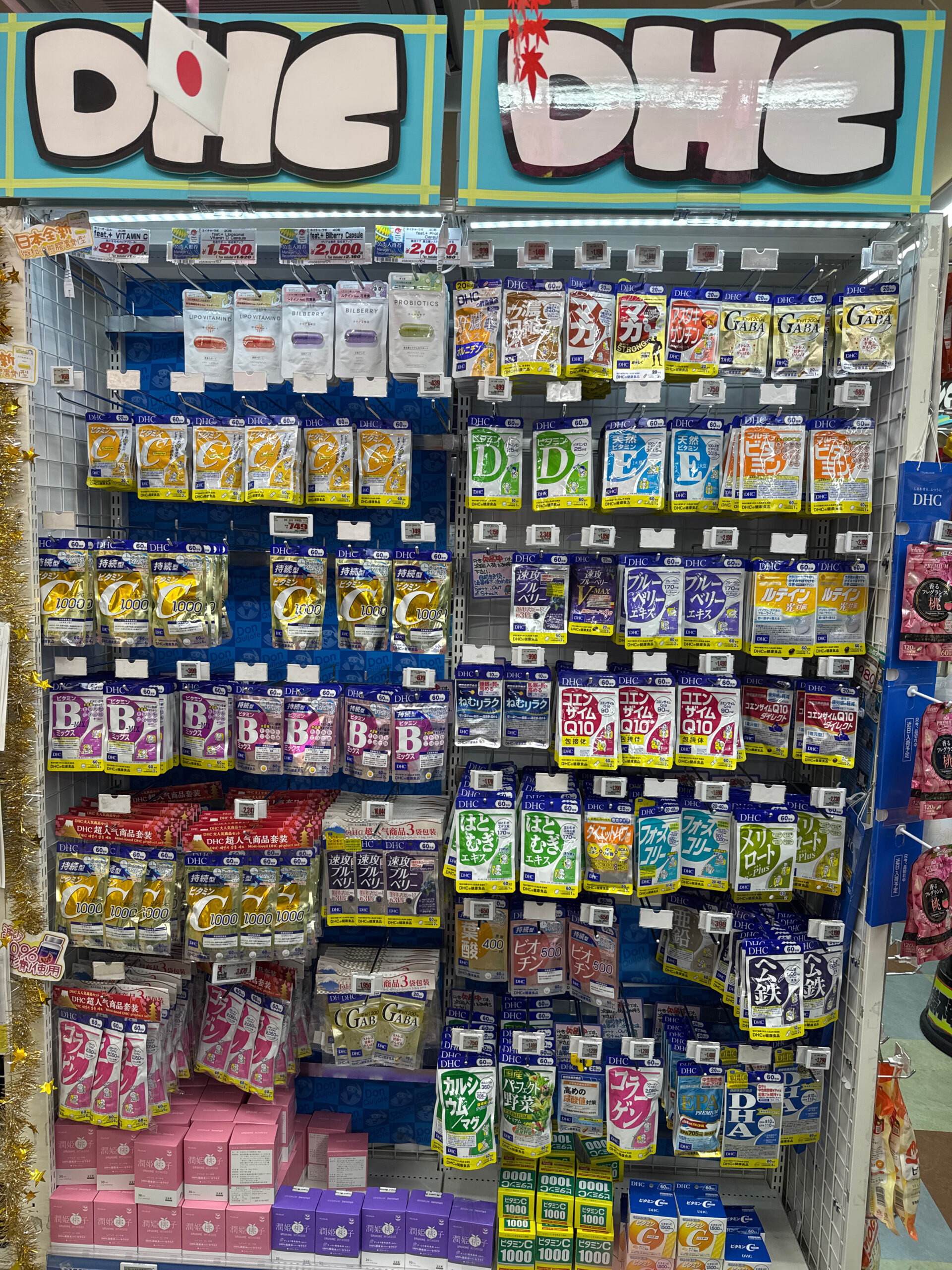
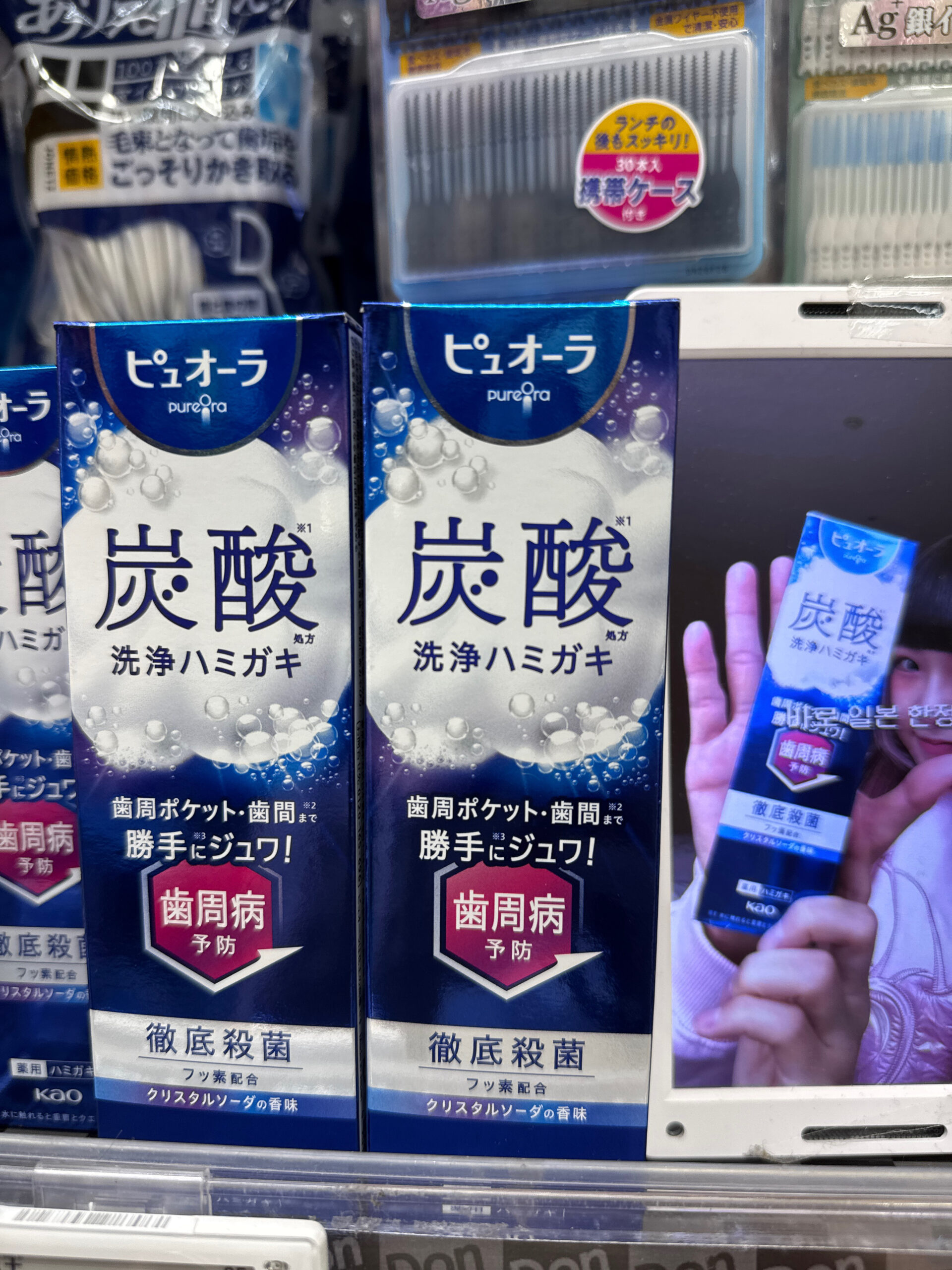
With only a few days left, it was finally time for our massive souvenir-shopping expedition at Don Quijote—or “Donki,” as everyone calls it. Imagine a discount department store, pharmacy, souvenir shop, beauty store, grocery store, and general explosion of Japanese consumer culture, all squeezed into one chaotic, multi-level labyrinth. You can find almost anything there, and somehow every aisle convinces you that you desperately need something you had never heard of five minutes ago.

To me, Donki felt like a Japanese Walmart transported into Lilliput from *Gulliver’s Travels*. There seems to be a Walmart-sized variety of products packed into a fraction of the space. Even the advertising is miniature: tiny screens sit right on the shelves, playing tiny Japanese commercials demonstrating the products beside them. I had never seen anything like it.

And the beauty aisles are a universe of their own. Japan seems to have invented a product for every beauty problem imaginable—and quite a few problems I had never imagined existed. There are endless varieties of sunscreens, hair masks, acne treatments for every possible skin type, powders you apparently put on your face before bed, and even tiny keychain-sized gels for keeping your bangs perfectly in place. I stocked up on sunscreens and hair products, along with matcha chocolates, desserts, and all kinds of little discoveries I suddenly couldn’t live without.

At one point, I picked up a face mask I remembered seeing recommended on social media. A saleswoman spotted me and immediately became very concerned. “No, no, no!” Apparently, I had chosen a mask intended for younger skin and morning use. She took it away and showed me the mask she was absolutely convinced was right for me—which, coincidentally, cost about five times more. She looked so genuinely worried about my skincare choices that I almost felt irresponsible for having selected the first one. Needless to say, my suitcase was considerably heavier on the way home.

Shinjuku: The Human Tsunami, City Lights, and the Giant 3D Cat

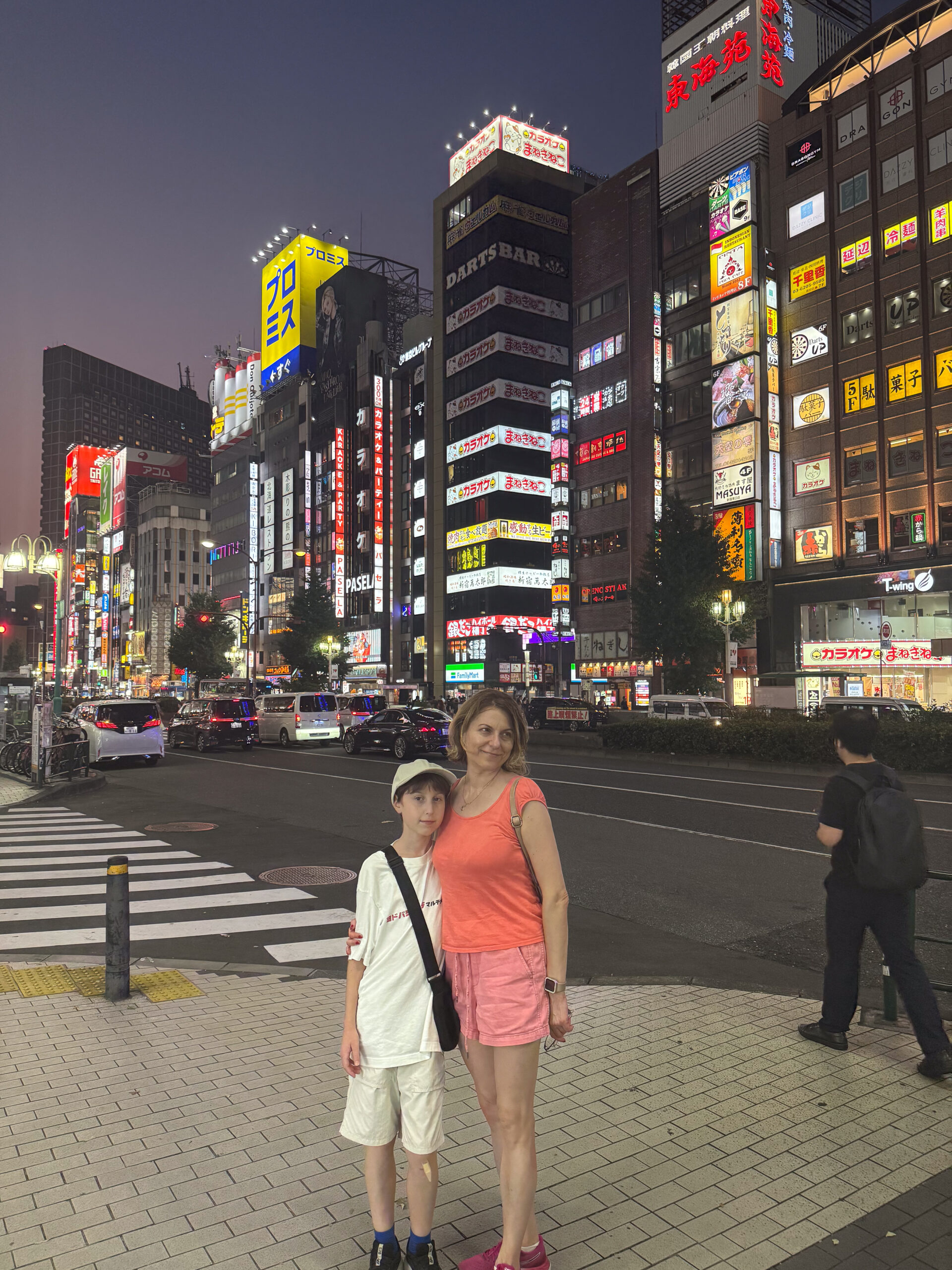
Almost at the end of our trip, the epicenter of the commuter anthill called our names once again: Shinjuku Station. We had already passed through it earlier to catch the Fuji Excursion train to Lake Kawaguchiko. Shinjuku holds the Guinness World Record as the world’s busiest railway station, and once you’ve been inside, that is very easy to believe.

Here is a fun detail I have to add: every time a train arrives at many stations, you hear a cheerful little melody. Honestly, some of them reminded me of the joyful music slot machines play in a casino when you hit the jackpot. After surviving the labyrinth of Tokyo transit, hearing that little jingle really did feel like a reward for successfully completing another navigation quest.

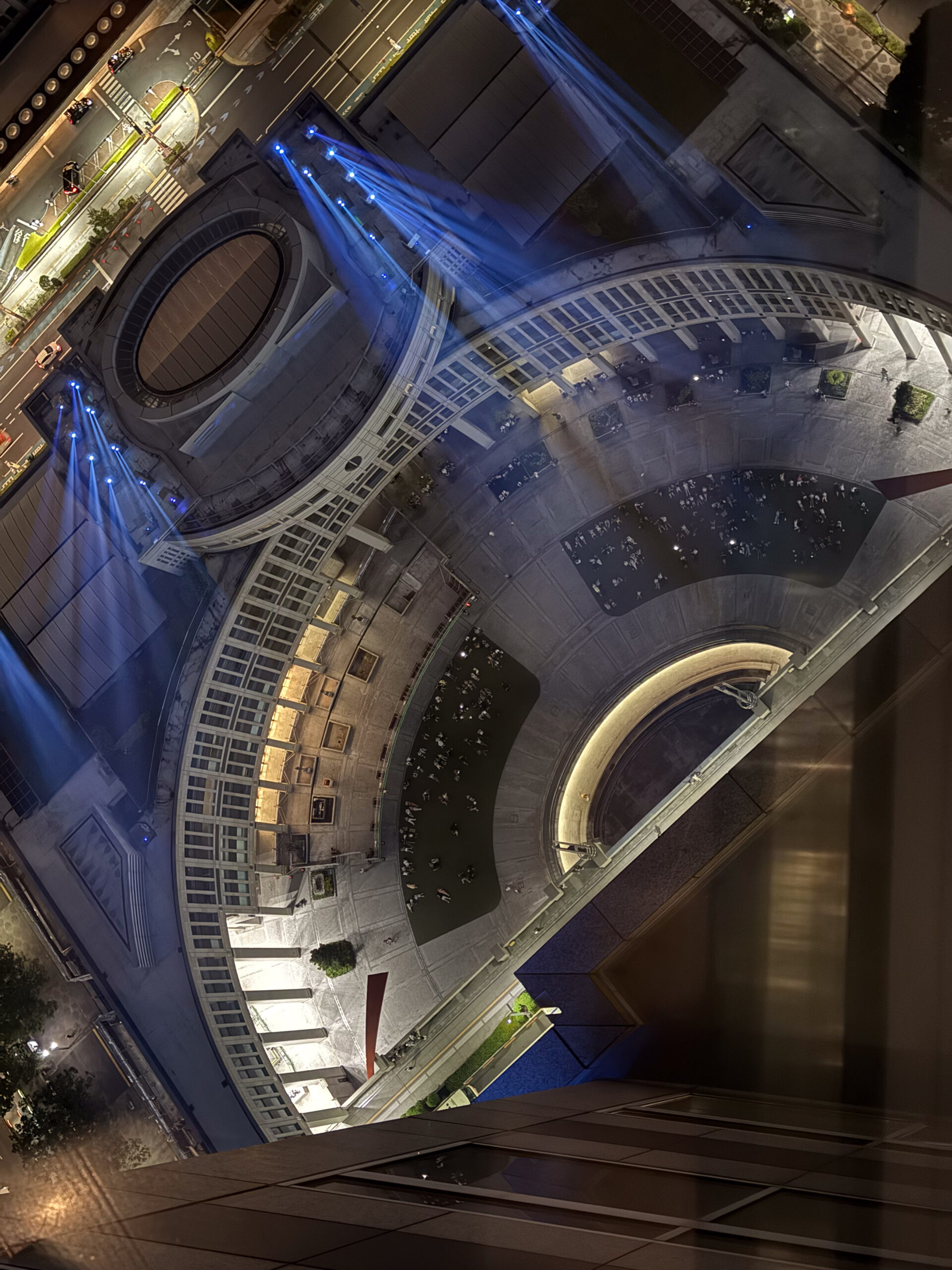
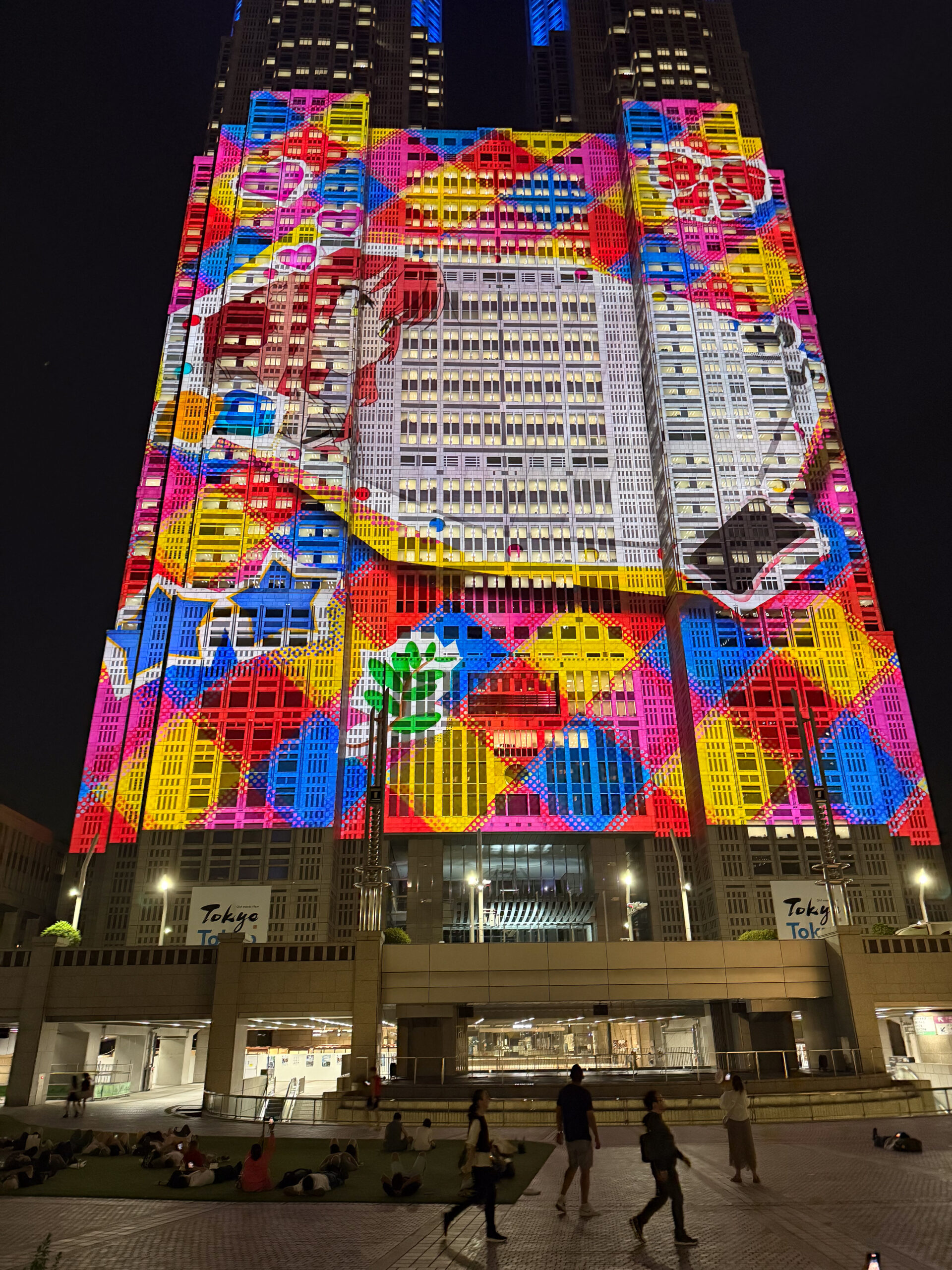
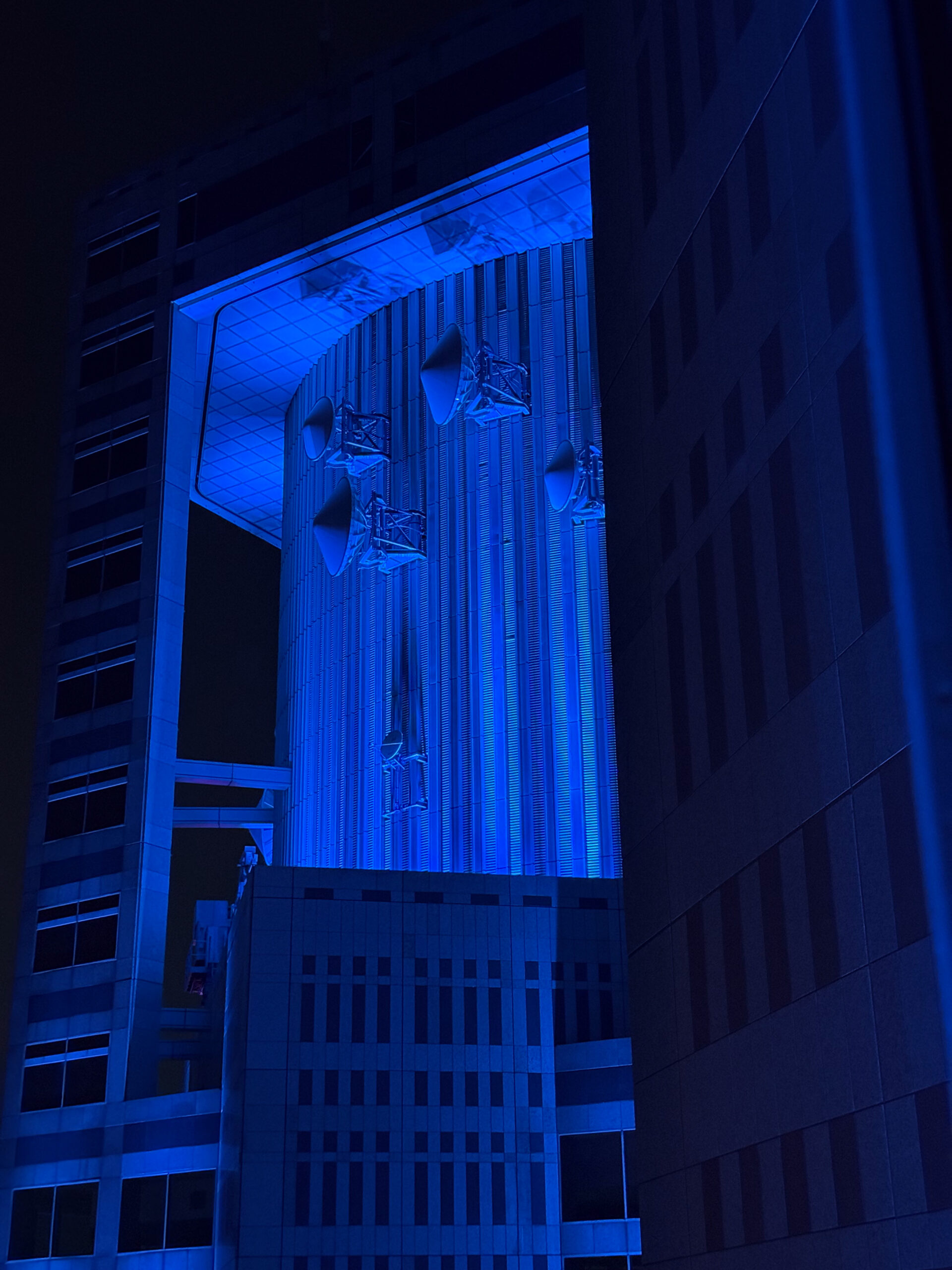
We headed back to Shinjuku to watch the “TOKYO Night & Light” show at the Tokyo Metropolitan Government Building. During the day it is a government building where bureaucrats work; at night it becomes a tourist attraction. We stood in line for about half an hour to go up to the free observation deck on the 45th floor, which offered an incredible view over the city.

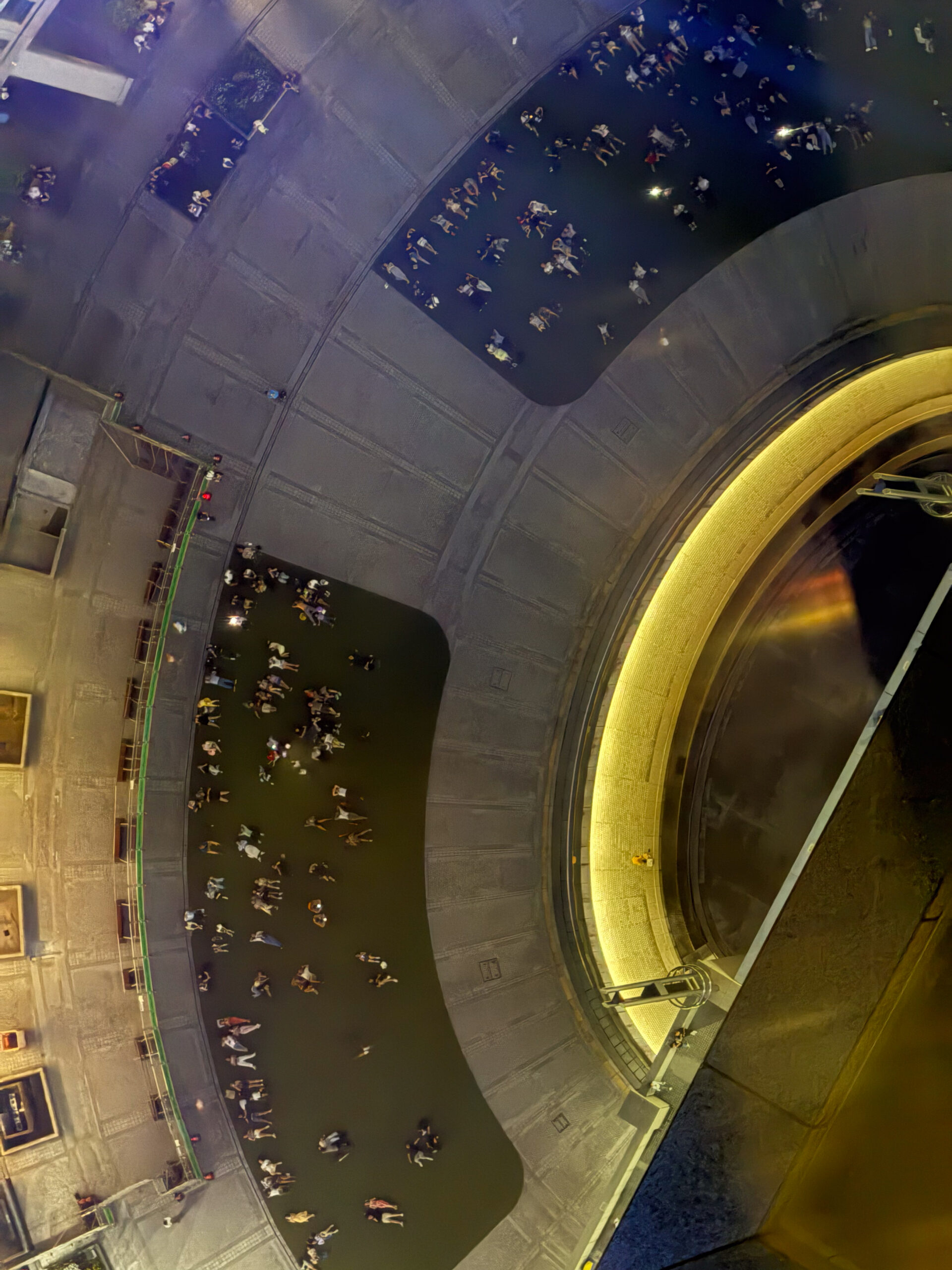
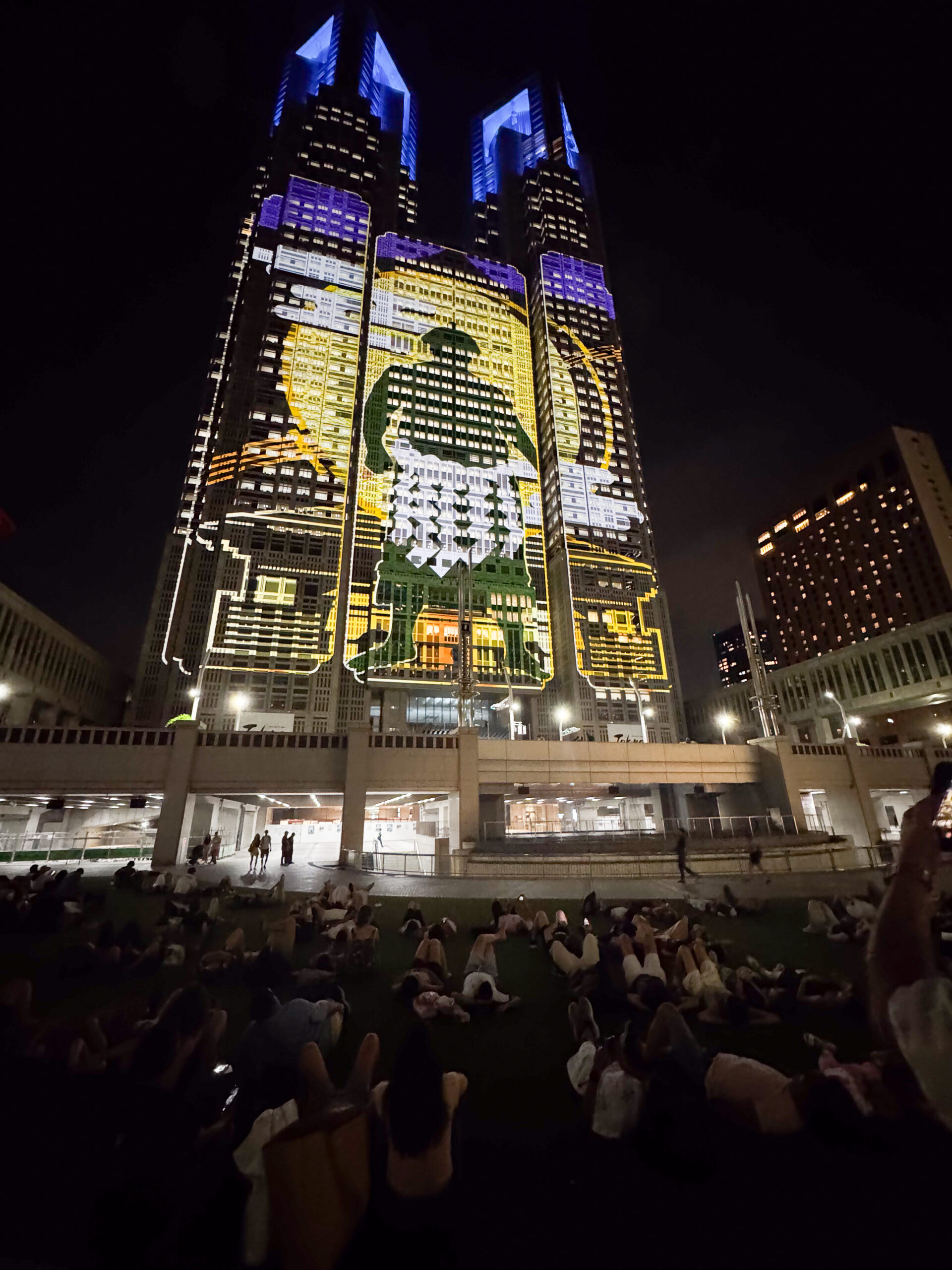
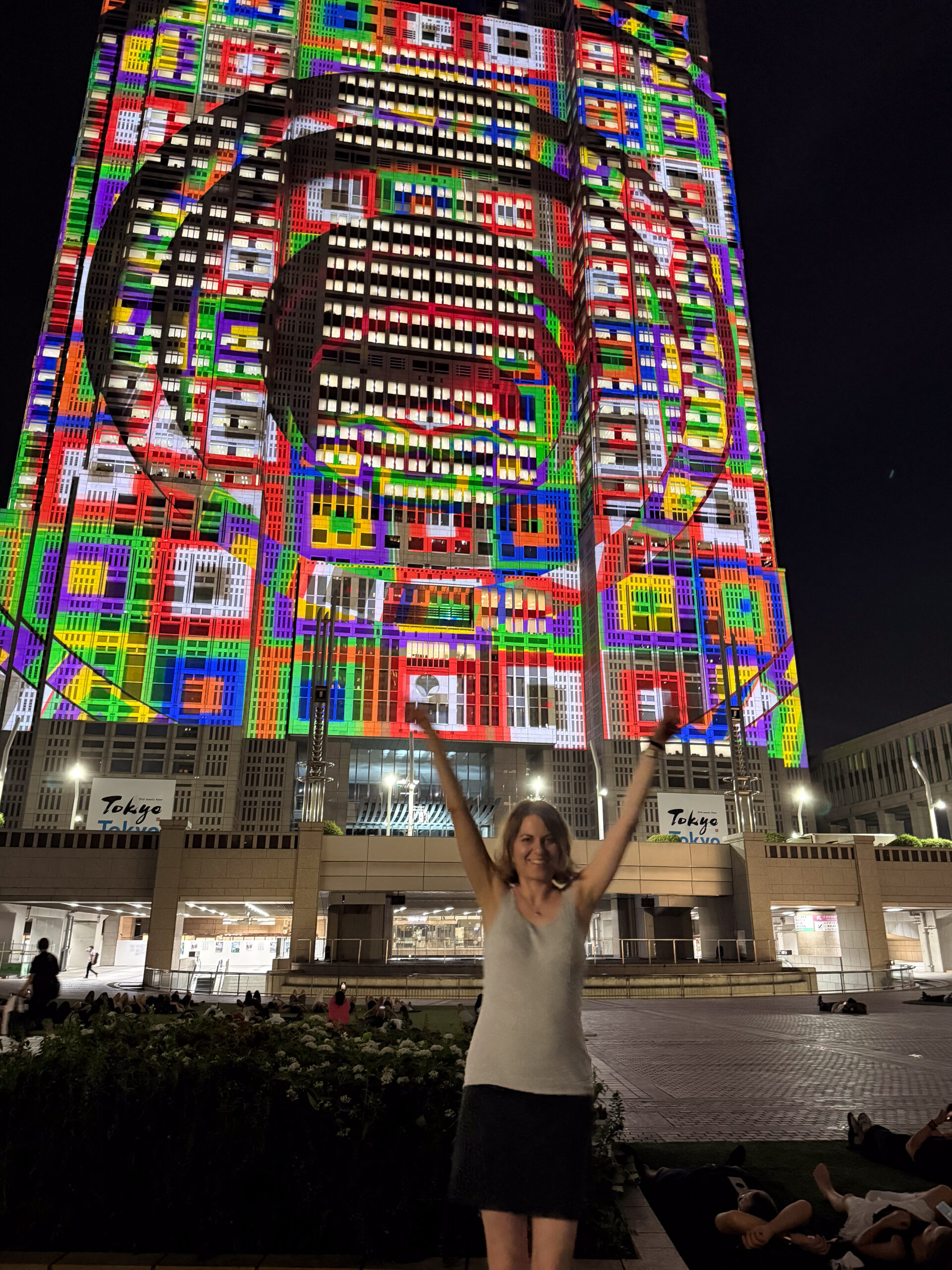
But the main action was happening below. People were lying right on special green mats to watch a huge projection-mapping show across the building’s facade. It holds a Guinness World Record for the largest permanent architectural projection display. The scale was incredible, and seeing an ordinary government building transformed into a giant moving screen felt very, very Tokyo.
After the show, we headed toward the eastern side of Shinjuku and had to cross the giant underground station again. We were hit by another human tsunami. The station was not only overcrowded but incredibly noisy, full of young people talking and laughing. 

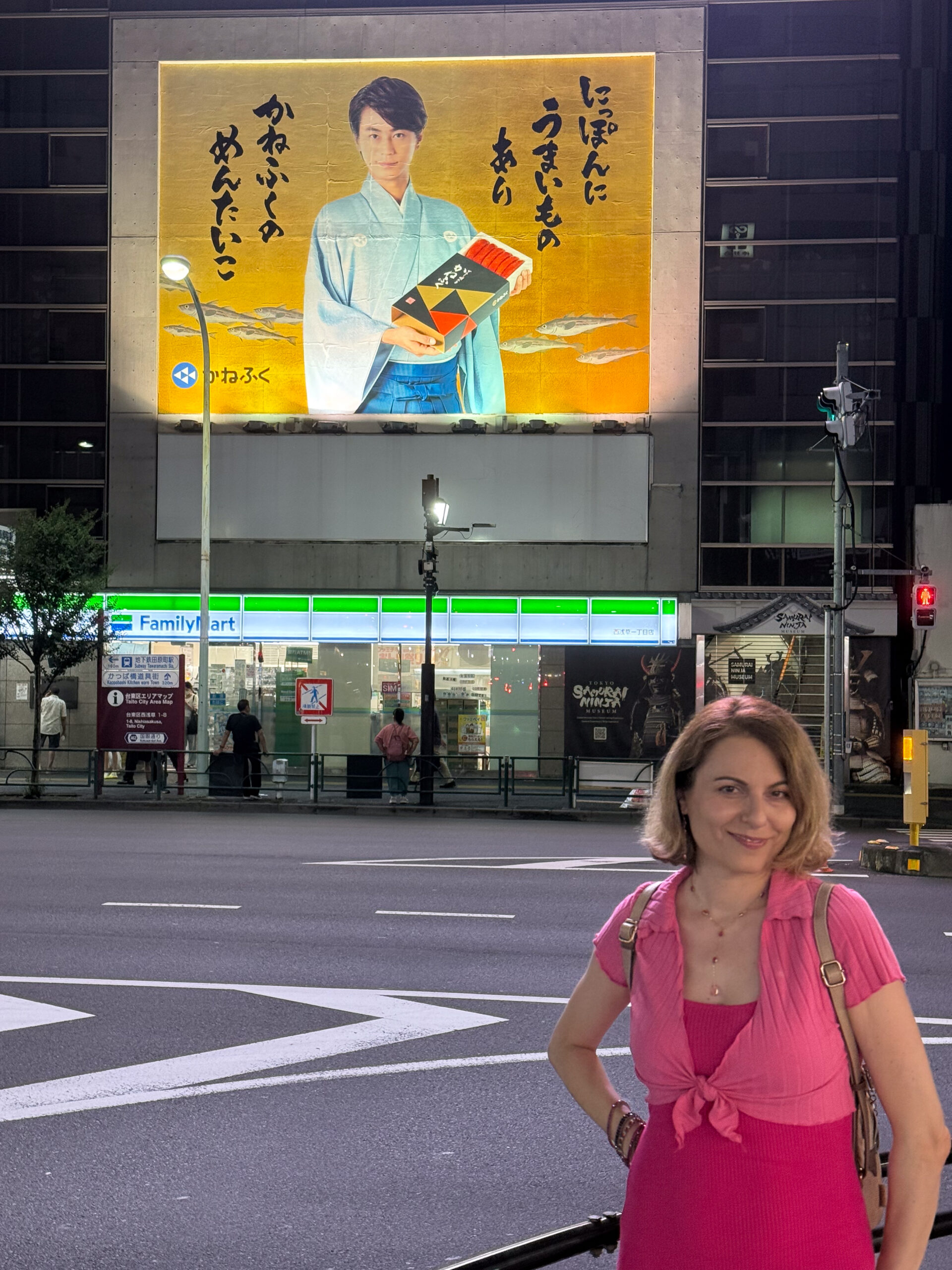
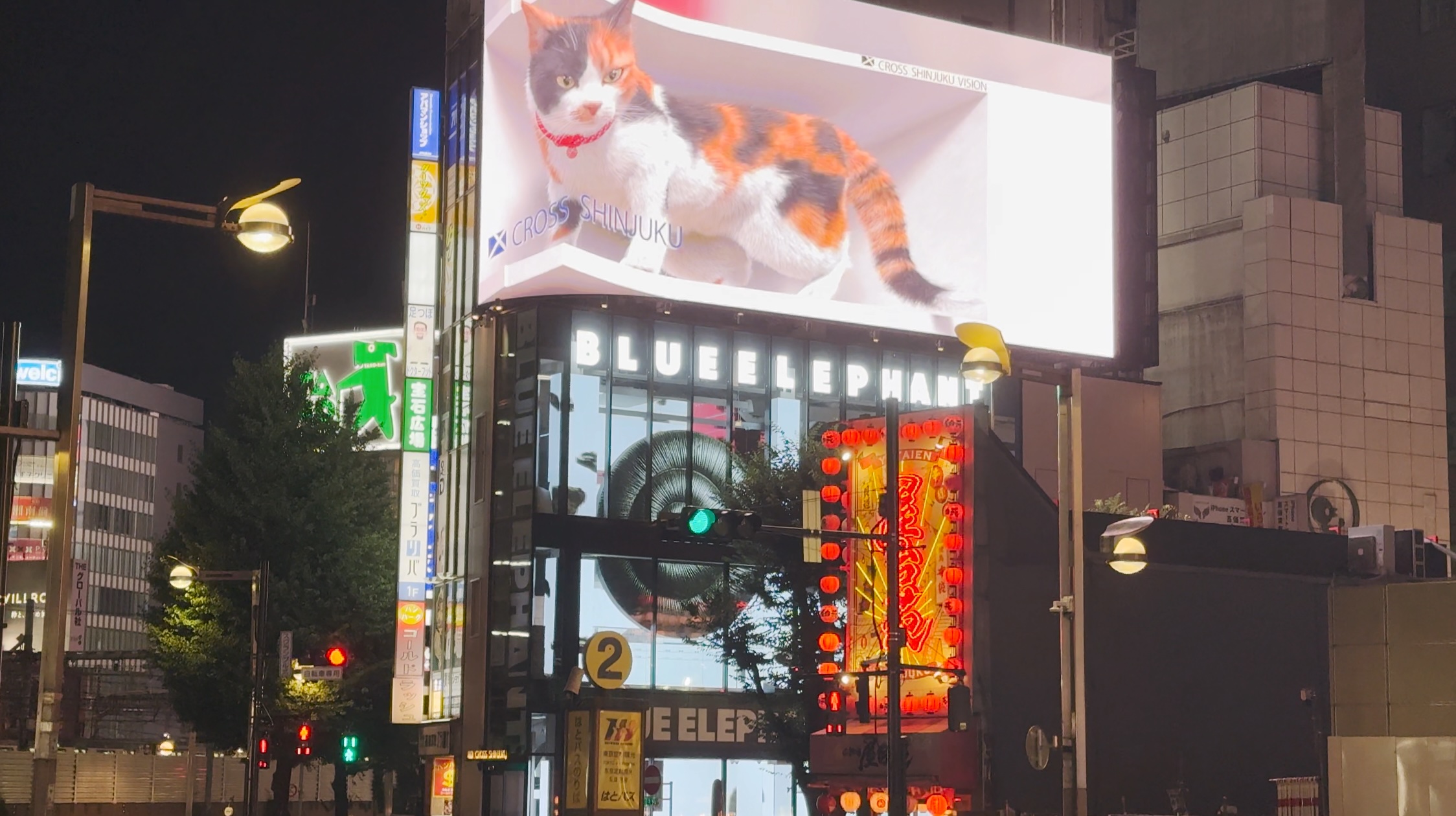
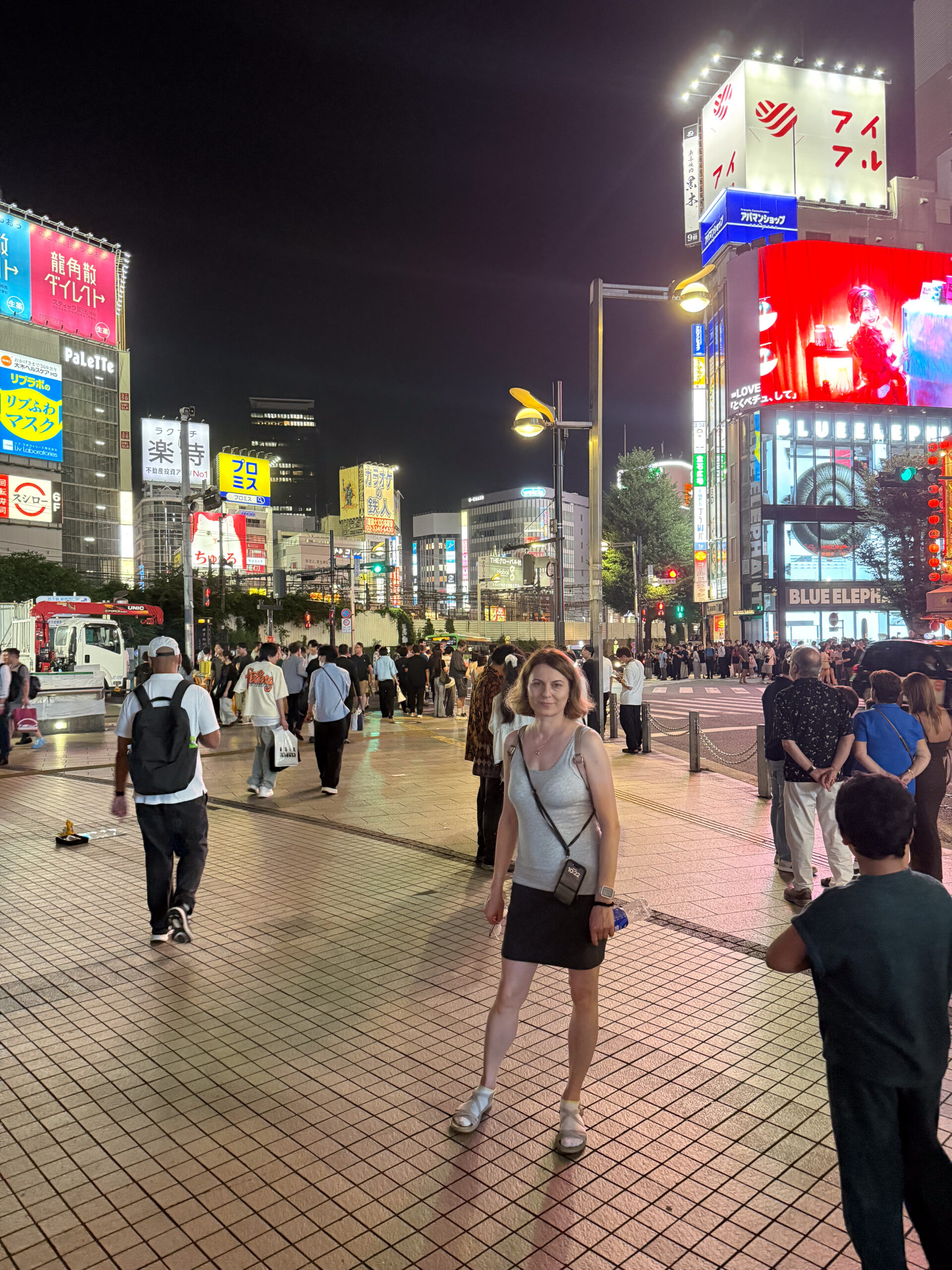
We somehow found the right exit, stepped outside—and immediately lost our bearings again, even though we were only steps away from the famous Cross Shinjuku Vision billboard.

Some local young guys approached us and asked us to take a picture of them. I snapped the photo and asked if they knew where the 3D billboard was. They hesitated and asked, “Where are you from?” “Canada,” we said. They got excited. “Canada! Vancouver?” “No, Toronto.”

And that was about as far as our shared vocabulary went. This happened to us quite a few times in Japan: people genuinely wanted to help, but communicating in English could be difficult, and asking for directions sometimes left us even more confused. Google Translate became indispensable, especially its camera function for signs and menus.

Thanks to Apple Maps, we finally found the giant 3D cat. It really is amazing—it looks like it is about to jump right down into the street. I was so curious about the cost of advertising there that I looked it up later. Even relatively small packages cost serious money, while major campaigns on Japan’s premium 3D screens can run into millions of yen. Truly a golden cat.
Reflections on Summer Travel in Japan

I am writing this two weeks after we returned from our trip. Right now, Japan is dealing with massive rainfall, and some areas have experienced serious flooding. I’m very grateful to our travel agent, Irina, who recommended that we go in the last few weeks of July rather than later in the summer.

If you have to travel with teenagers and don’t want to go in the winter because they would miss school, summer may be your only realistic option. I would still choose July over August, but you absolutely have to be prepared for the heat. The smartest approach for us was mixing outdoor sightseeing with museums and other places with AC—and, of course, using amazing food as motivation to keep the teenagers happy and satisfied.

Japan was overwhelming, exhausting, sweltering, and confusing—and I wouldn’t change a single second of it.
Japan in July: Hot. Lost. Amazed. And Completely in Love. Part 3

Kamakura: Our Mini-Kyoto and the Pacific Downpour

Traveling with teenagers is a unique experience. While I know people pay thousands for guided group tours that hit every temple in Kyoto, that wasn’t going to work for us. Teens like to sleep in, and their favorite activity is hitting up convenience stores to buy mountains of food.

Sasha really wanted to go to Kyoto, but Gemini actually talked me out of it. If Tokyo was a hot pot, the humidity in Kyoto sounded like the fiery pits of hell. After all the subway chaos, we didn’t have the energy for another massive transit day in the heat. Instead, we took Gemini’s advice and went to Kamakura, which is often described as a mini-Kyoto right on the coast.
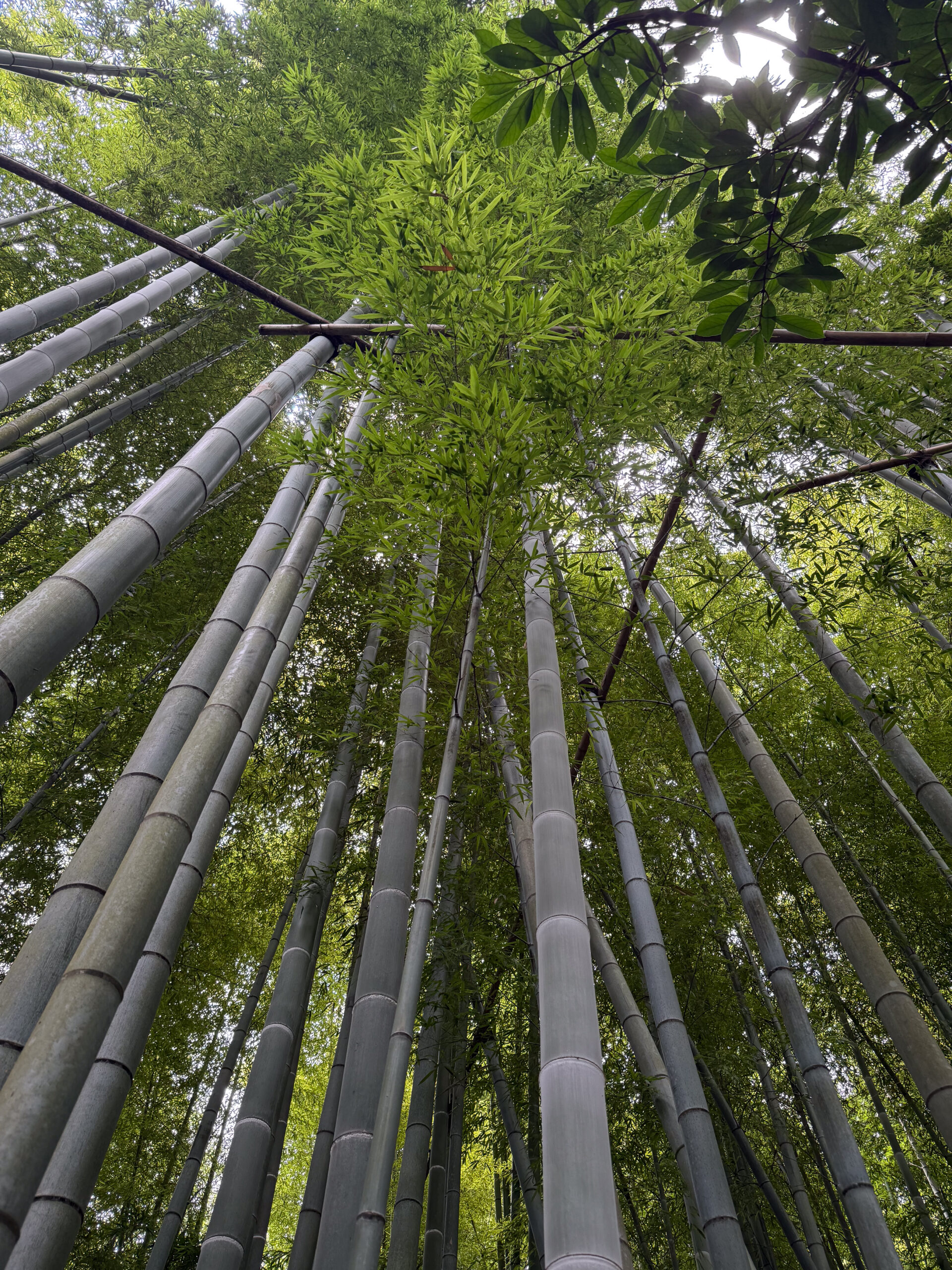
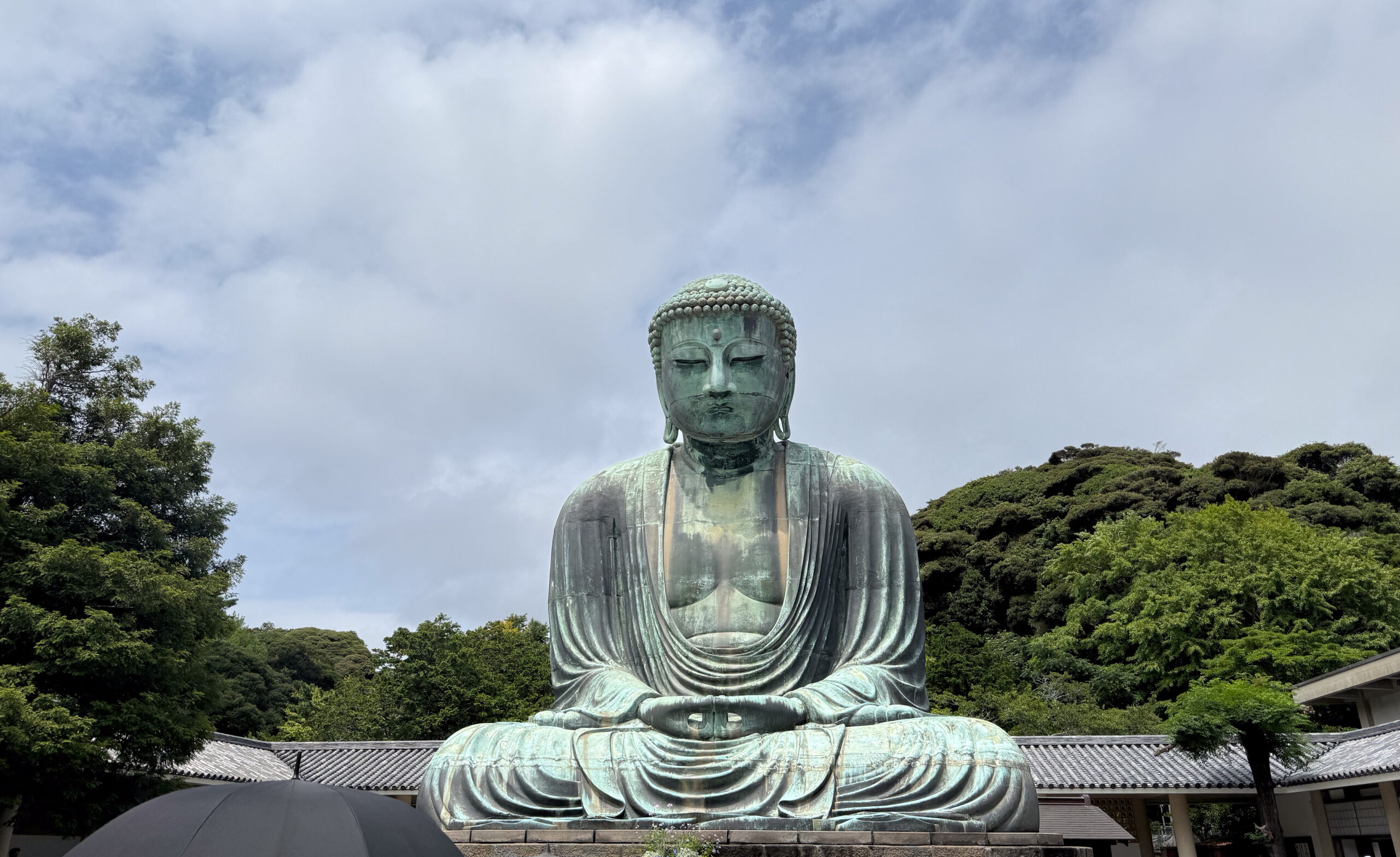
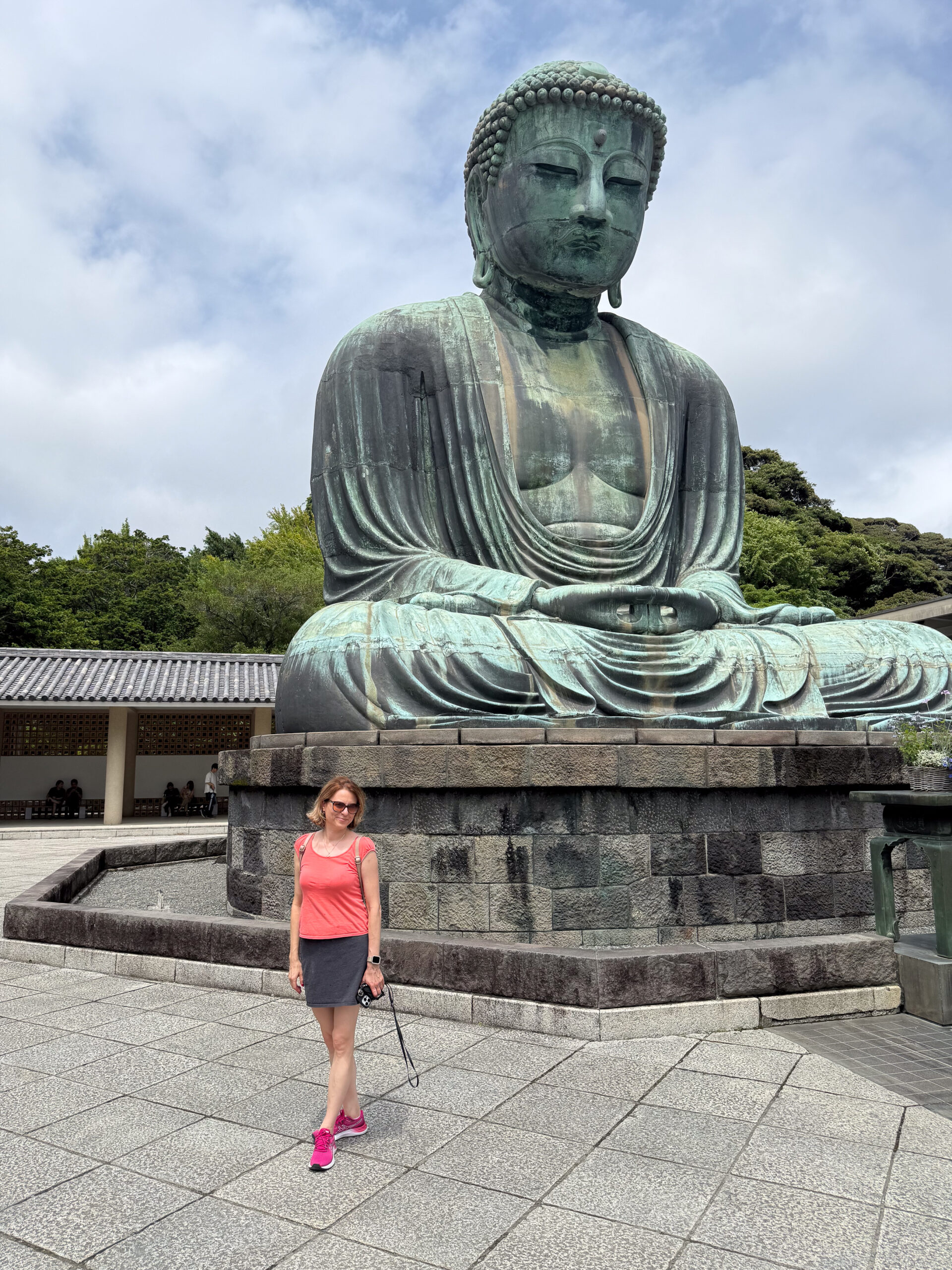
We visited a beautiful bamboo forest and took an Uber from Kamakura station to the Great Buddha. A quick note on Ubers in Japan: ours felt more like a luxury taxi. The driver wore a full suit and definitely did not rush. The app said he was arriving, but it took another 15 minutes of circling before he finally found us.

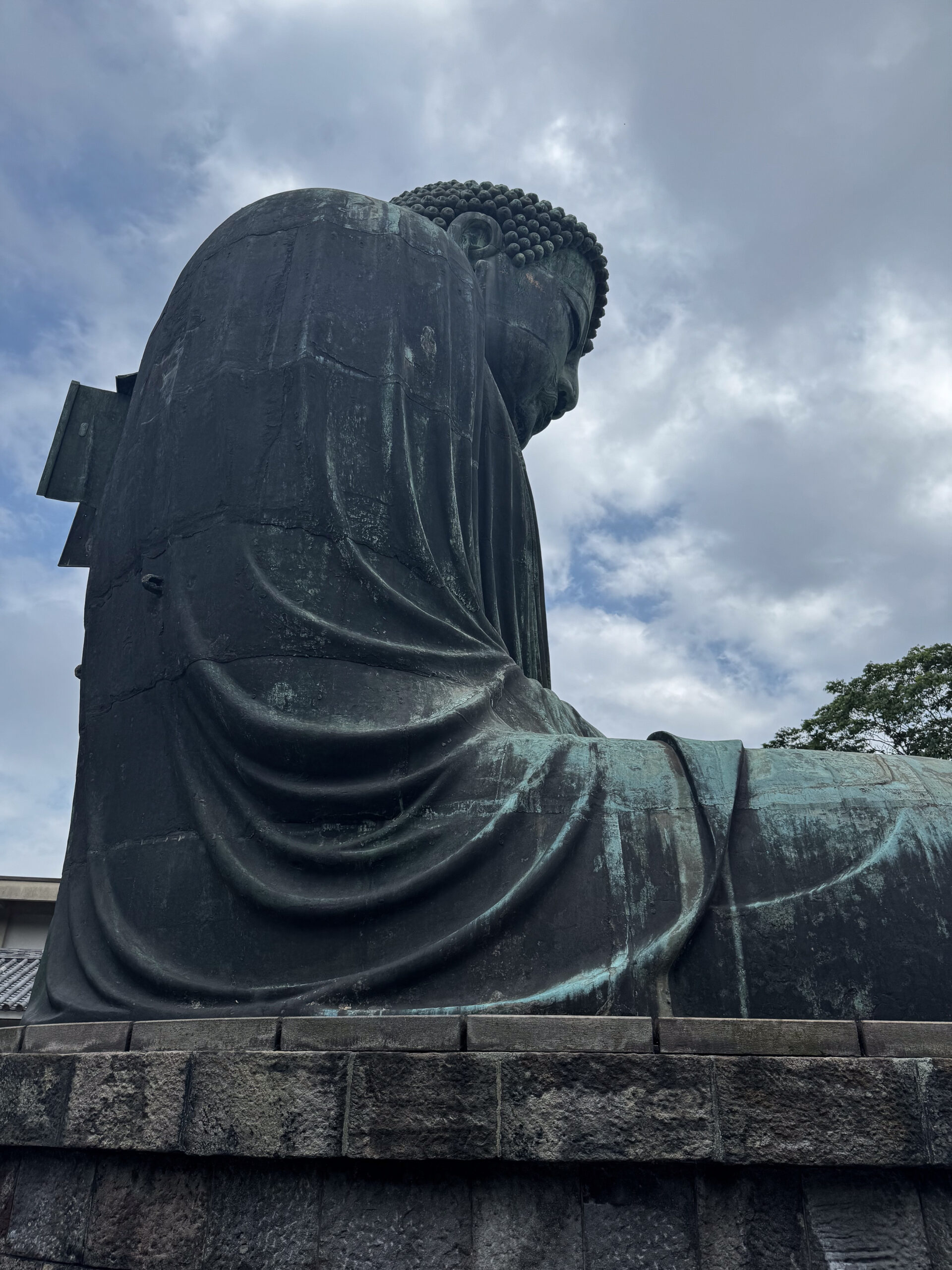
The Great Buddha is a massive hollow bronze statue that you can actually walk inside, though we skipped the interior because I could only imagine how hot it was in there.

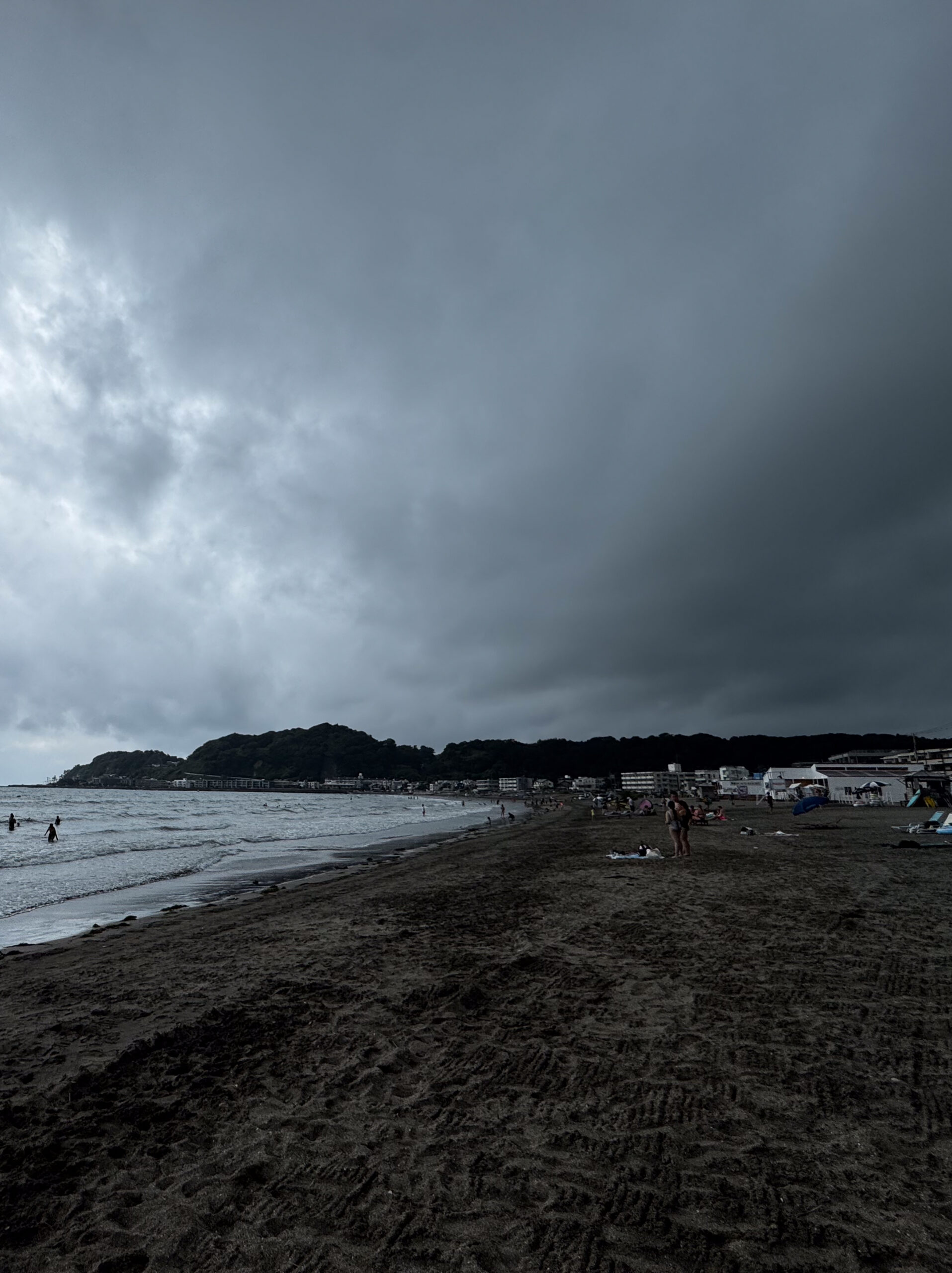
My main goal in Kamakura was hitting the beach to put that hard-won swimsuit to use in the Pacific Ocean for the very first time. I had grand expectations, but the beach itself was a bit rugged. The sand is dark and volcanic-looking, so when wet it looks a lot like mud. But the water was incredibly warm and clean, and we had a blast jumping in the waves.

Then came the rain. We knew a storm was supposed to hit around 3:00 PM and brought umbrellas, but the skies opened up before we even left the beach. We practically swam down the streets back to the bus station. The umbrellas were useless against the sideways rain. We joked about it at the time, although news of an earthquake elsewhere in Japan that day was a sobering reminder that traveling there also means being aware of the country’s very real natural hazards.

Food Feasts: Konbini Runs, Tonkotsu Ramen, and Sushiro

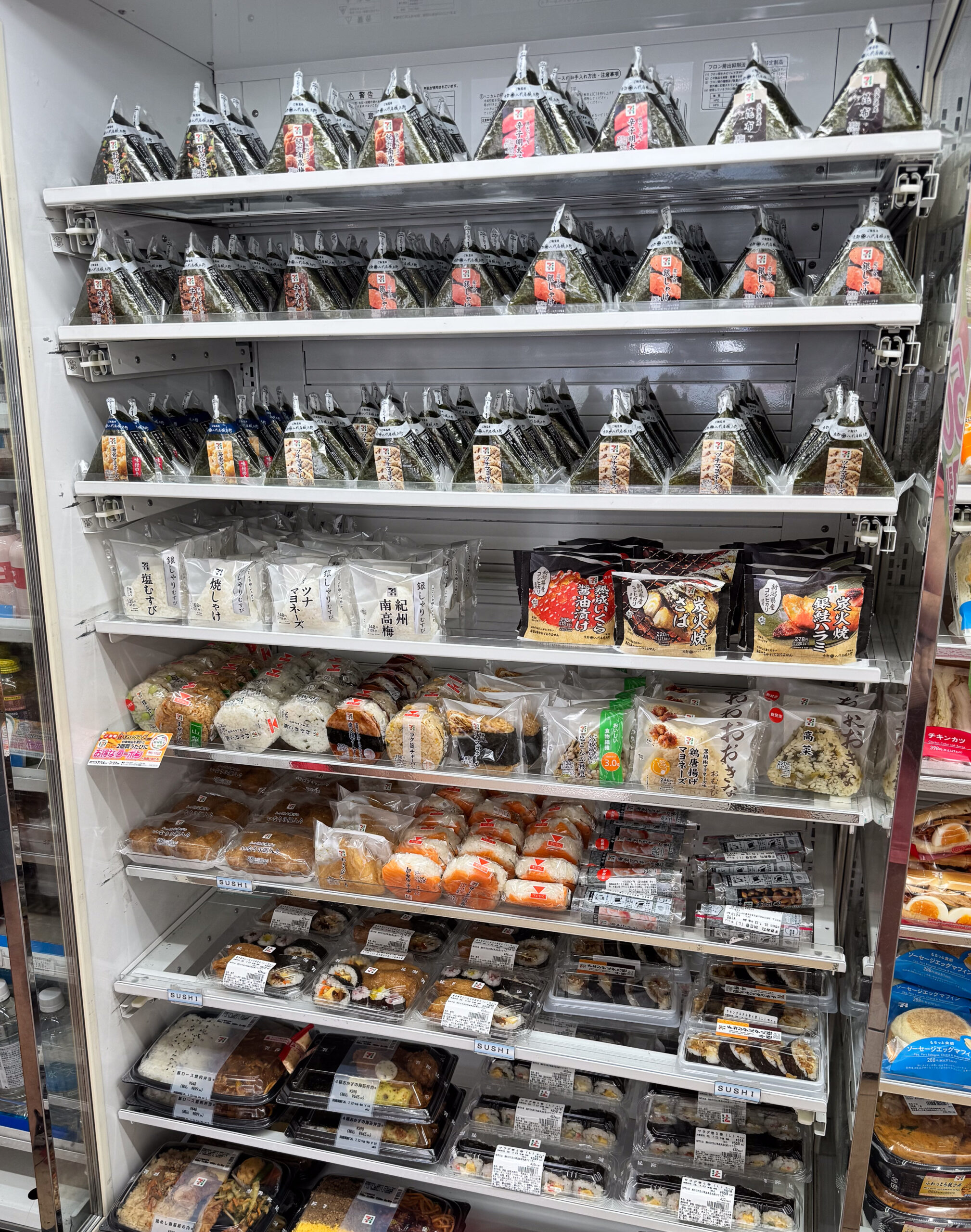
Speaking of food, traveling with teenagers means their eyes are often much bigger than their stomachs, especially when it comes to Japanese convenience stores (konbini). But honestly, I don’t blame them. The food in Japan was amazing almost everywhere we went, including the convenience stores.

Lawson and 7-Eleven became regular stops for us. We had a Lawson literally across the street from our hotel and frequently grabbed lunch or dinner from the fresh-food shelves. One day, we spent about $50 for the four of us and came back with an absolute feast: ice cream, noodles, salads, chicken meatballs, croquettes, meat and potatoes, and spring rolls.

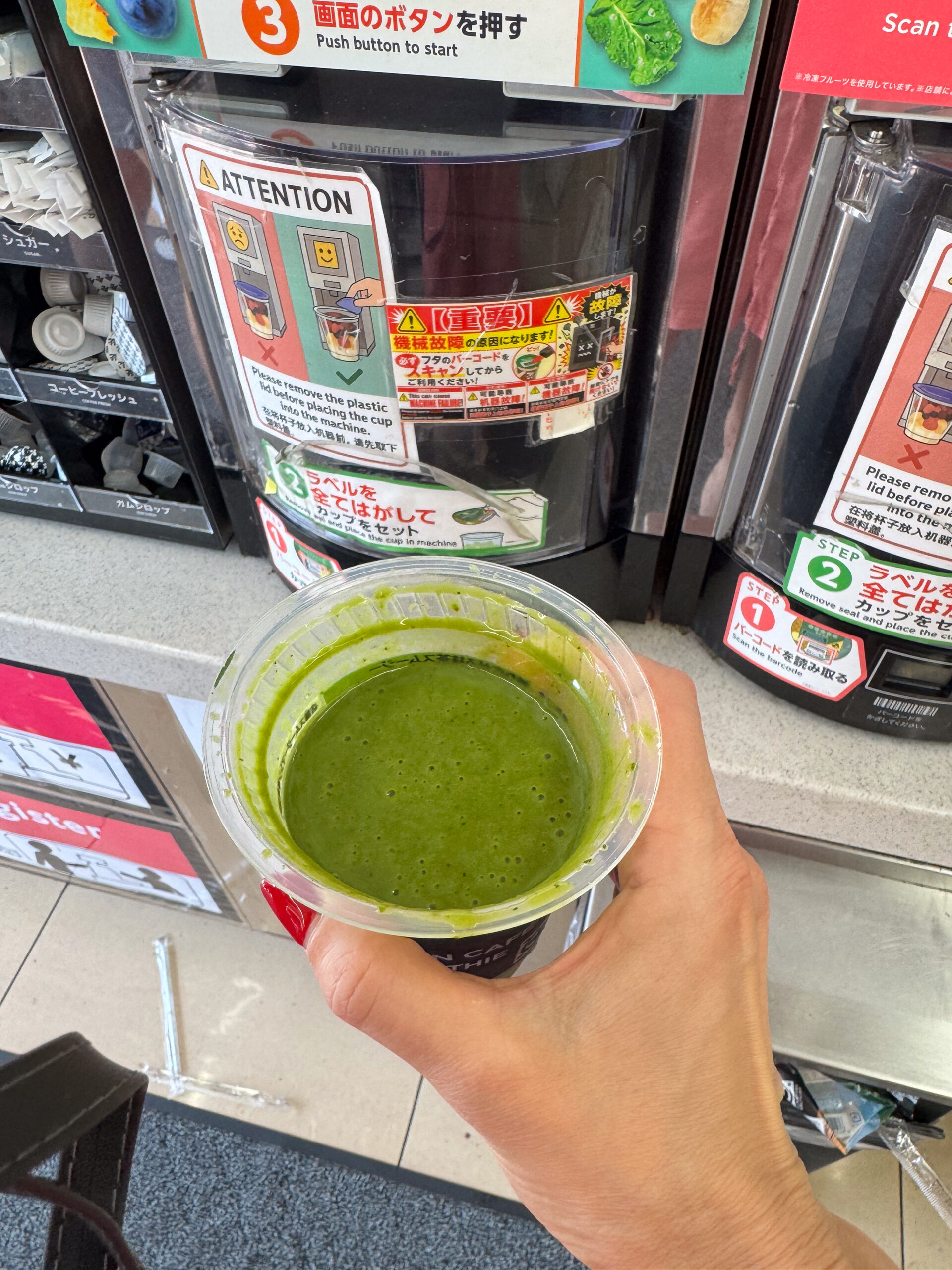
My absolute favorite convenience-store discovery was the 7-Eleven smoothie. You buy a frozen cup filled with fruit and other ingredients, scan it at the register, and put it into a special blending machine right there in the store. It makes a fresh smoothie in seconds. I’m going to miss the efficiency of Japanese snacks so much.

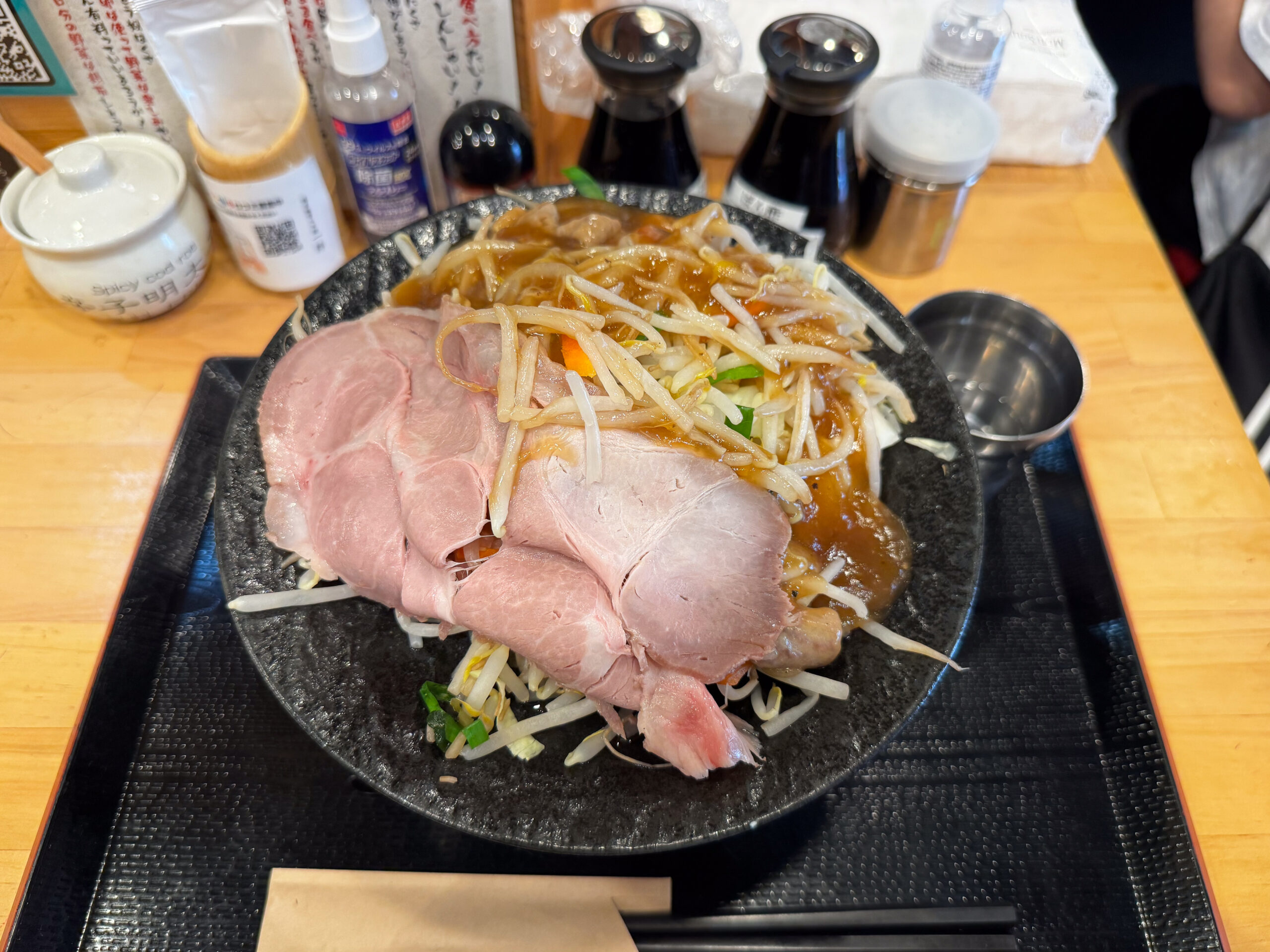
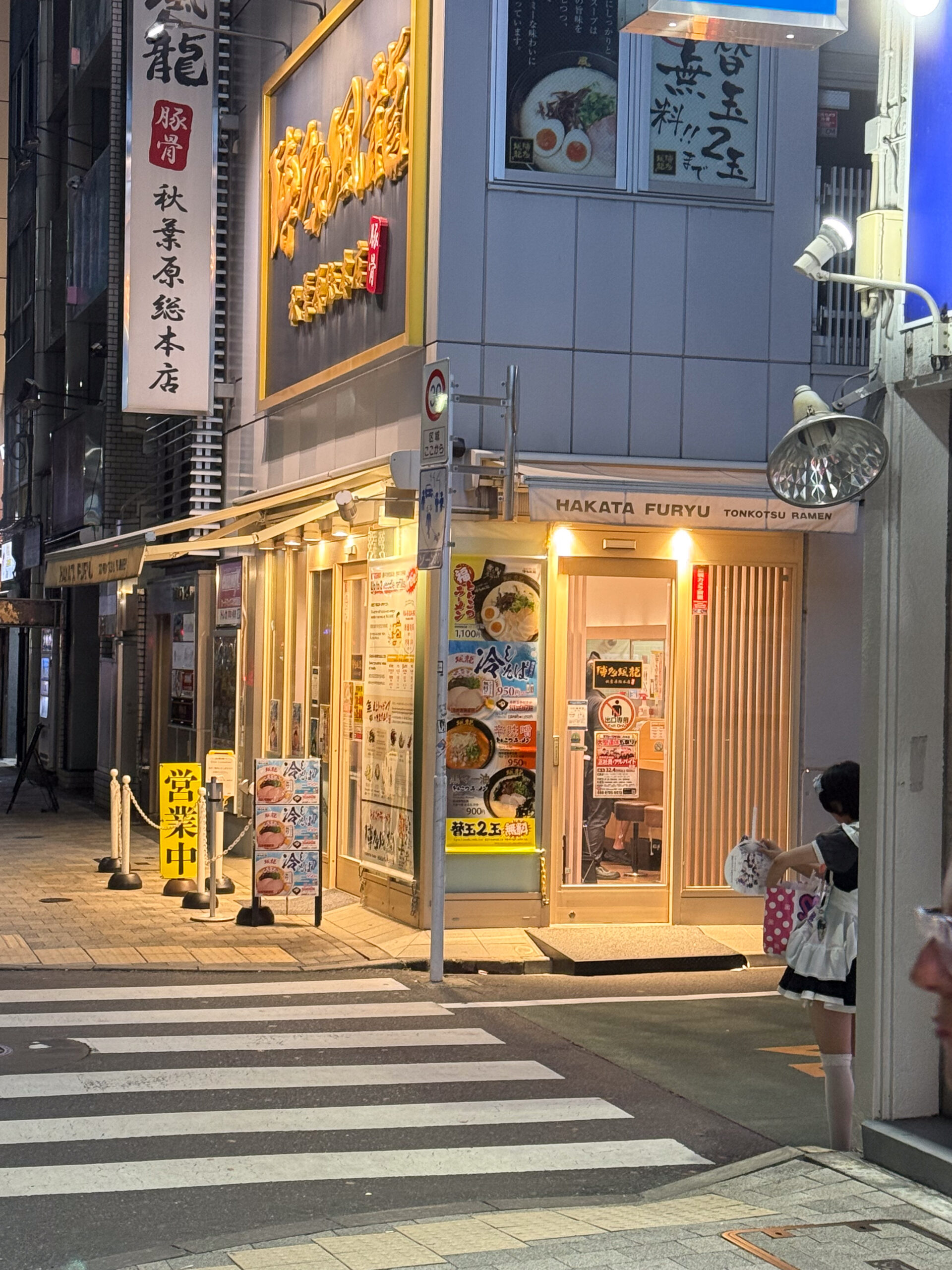
Beyond the konbini feasts, we explored traditional spots too. One day, we went to a tiny, super-cheap tonkotsu ramen place where a huge portion cost around 1,000 yen. The restaurant seated maybe 10 people at a single counter where you could watch the chefs work. It was cash only, so you bought a ticket from a machine first and then waited for a seat. They gave us a paper form to customize the bowl exactly how we wanted it—spicy or mild, with or without green onions, extra oil, garlic, or extra vegetables.

Once we sat down, the chef handed our orders right over the counter. The staff were so sweet—they used their phones to translate instructions for us, even translating into Russian when they heard us speaking it. They strongly advised us to eat the ramen and vegetables in the intended order instead of dumping everything into the broth and turning it into a hot pot. I also spent some time secretly studying the Japanese girl sitting next to me to learn the proper technique: noodles with chopsticks while simultaneously sipping the rich broth with the large spoon.

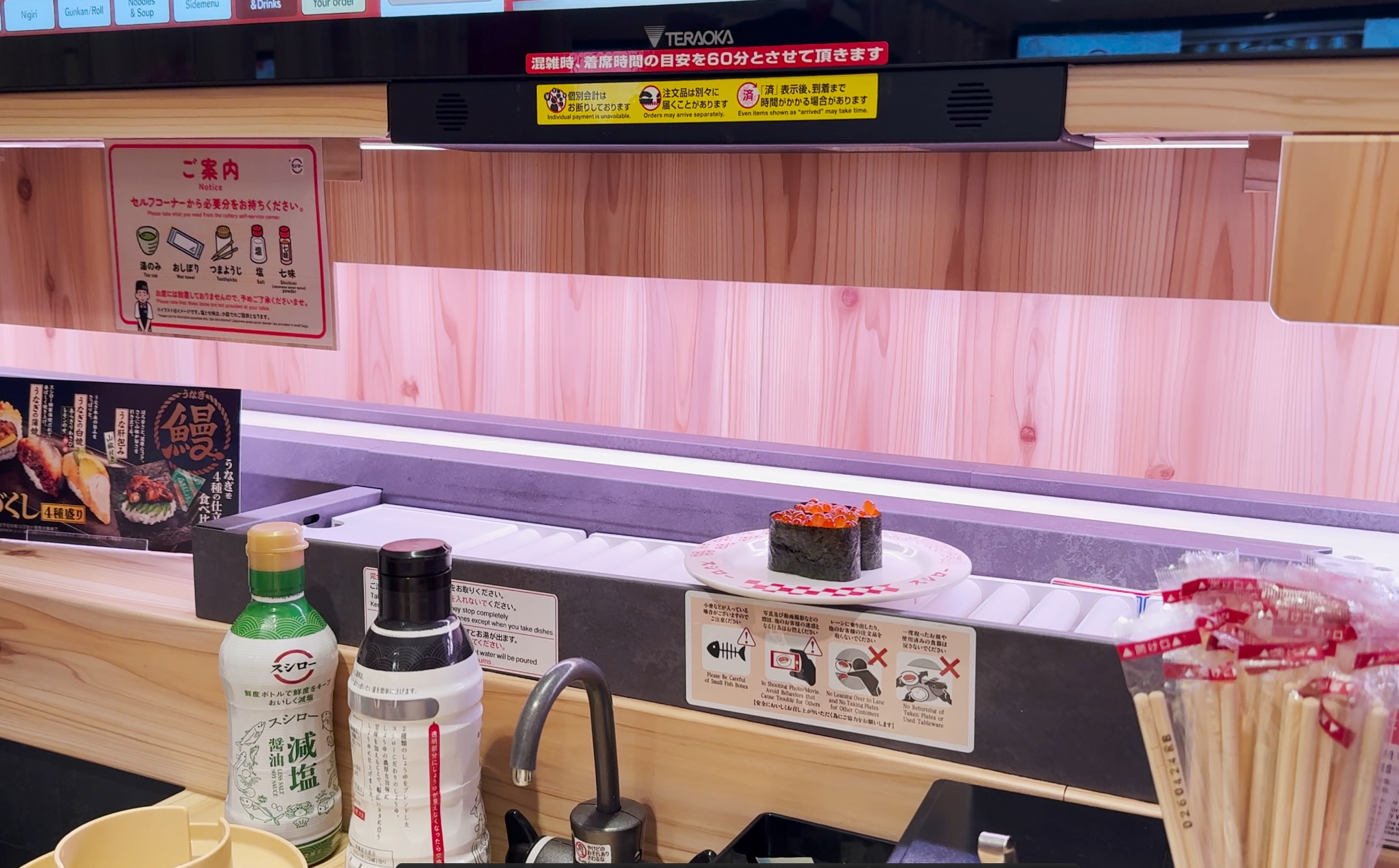
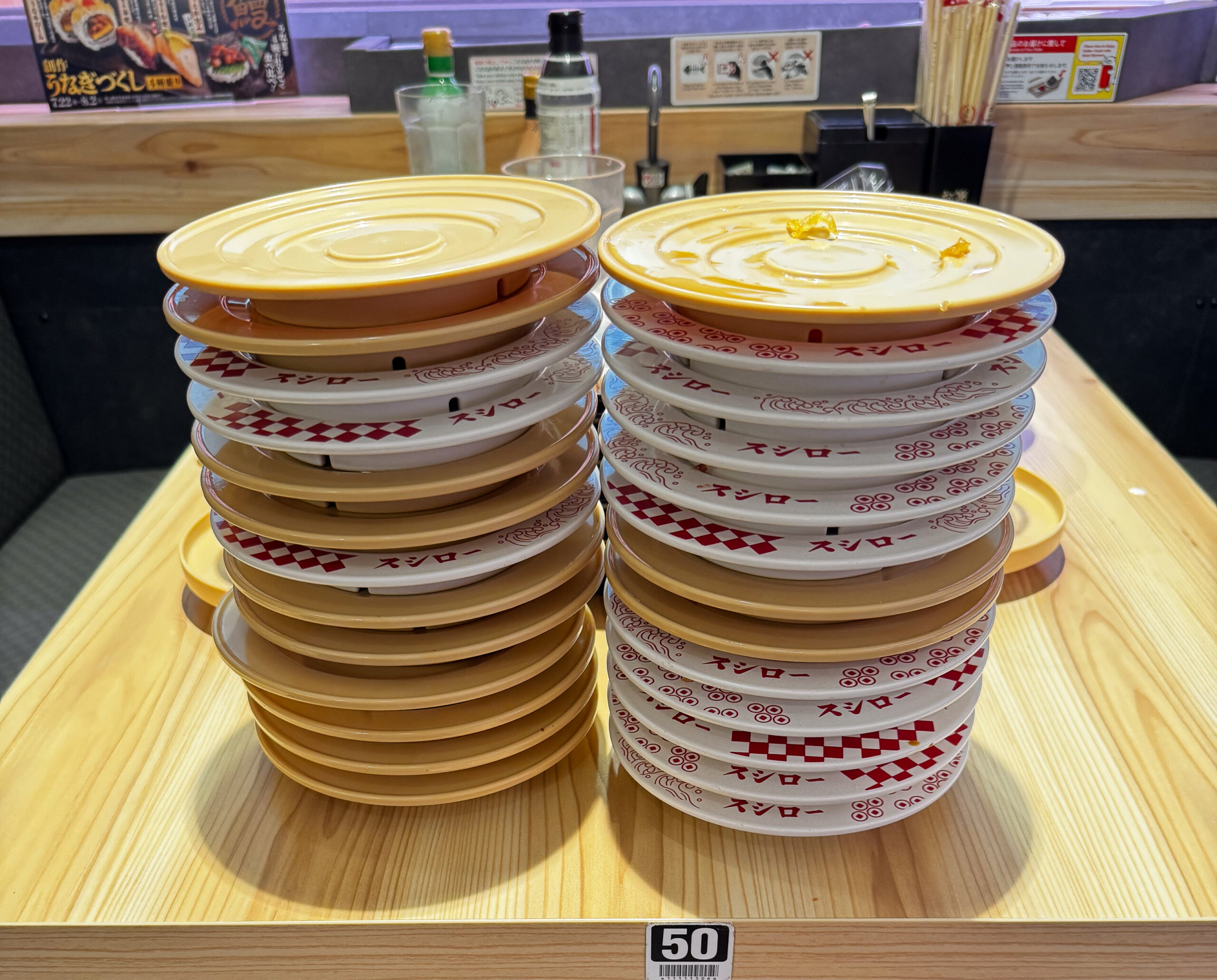
We also went to Sushiro, a popular conveyor-belt sushi chain. You take a ticket, wait for your table, and order from a touchscreen or your phone. We went completely wild. By the time we finished our incredibly delicious dinner, we had a leaning tower of 30 or 40 empty little plates stacked on our table!

Where Is the Trash? (And Where Are the Dogs?)

There’s another cultural difference I have to mention: the surprising lack of garbage bins on the streets. If you walk around Toronto, you’re used to seeing public bins everywhere. In Tokyo, we could walk for ages carrying empty bottles and wrappers without finding anywhere to throw them out.

One explanation often given for the scarcity of public bins is that many were removed for security reasons after the 1995 Tokyo subway sarin attack. There is also a strong expectation that people take responsibility for their own trash and carry it until they can dispose of it properly. Whatever the combination of reasons, the result amazed us: very few public bins and incredibly clean streets. We quickly learned to keep a little garbage bag with us.

This brought up another mystery for me: where were all the dogs? In two weeks, I felt like I saw hardly any, and most were tiny. Space is obviously at a premium in Tokyo, and pet-friendly housing can be restrictive and expensive, so small breeds make a lot of practical sense. We even saw little dogs being pushed around in special strollers. Coming from home, where dogs are such a visible part of everyday neighborhood life, their absence really stood out to me.

Japan in July: Hot. Lost. Amazed. And Completely in Love. Part 2

The Tokyo Oven and the Great Subway Quest

When we arrived back in Tokyo, the city was its own kind of hot pot. It was already over 33°C (91°F), and on the worst days it hit 36°C, with suffocating humidity that made it feel closer to 40°C. We felt like we were literally boiling in our own sweat. We bought personal electric fans, constantly chugged ion drinks, and ate special salt tablets provided by our hotel just to replace what we were sweating out.

But the real stress wasn’t the heat. It was the Tokyo transit system.

If you don’t speak Japanese, the Tokyo subway is a high-stakes escape room. Imagine a gigantic anthill with millions of ants moving in every possible direction through thousands of holes. That is Tokyo. Coming from the Toronto subway, which has just a few simple lines, my mind was blown. Tokyo has 13 underground subway lines, plus a huge network of surface rail lines operated by different companies, all intersecting at massive hubs.

Even a simple transfer can involve so many exits, levels, and corridors that you end up completely lost. Almost two weeks into our trip, we were still getting confused. We navigated using Google Maps and Apple Maps, and eventually I discovered a lifesaver: Google Maps can track your progress while you’re traveling, showing the station you’re approaching, entrance and exit numbers, and departure times. Sadly, I figured out how useful this was a little late.

In the beginning, I was in charge of navigation. After a few “strategic errors”—like taking us three stops in the wrong direction—I happily surrendered navigation duties to Mikhail and Sasha. It became a lot more relaxing once I just blindly followed them!

Transit Card Chaos and High-Tech Toilets

Japan is a beautiful paradox: it is simultaneously living in the year 3000 and the year 1990.

Our hotel was near Ueno, right by the smaller Okachimachi station. Despite doing my research on Suica and Pasmo transit cards, our first day in the subway was a disaster. Mikhail and I easily added digital transit cards to our phones, but we couldn’t get them to work for the kids. We had to withdraw cash and buy physical cards instead.

Eventually, we managed to transfer one physical card to a digital Pasmo on my phone, while I moved my own card to my Apple Watch. So I was tapping myself in with my watch and my son in with my phone! My other son finally got a card on his phone, but Apple Pay wouldn’t work for him, so we still had to top it up with cash at the machines.

Between the cards, getting lost, and running onto the wrong trains, we had a lot of adventures. More than once, we got trapped by the turnstiles because something had gone wrong with our tap. The station attendants had to perform some kind of digital magic on our phones to release us and hand us paper tickets instead.

And when we traveled to Yudanaka to reach our hot spring village, our high-tech transit cards suddenly became much less useful. Parts of the journey required paper tickets, and the Shinkansen added another layer of confusion: we were given two tickets each and had to understand when to insert one and when to insert both. If we hadn’t stopped to ask several locals for help, we absolutely could have missed our train. I quickly learned my golden rule of Japanese transit: arrive early, especially when you have to exchange QR codes for physical tickets at a special machine!

But then, you walk into the bathroom.

The toilets in Japan are an absolute marvel. Back home, we spent a fortune to install a bidet toilet, but in Japan heated washlet-style toilets seem to be everywhere—from tiny cafes and train stations to traditional ryokans. Heated seats, washing functions, multiple flush options: after fighting with paper train tickets, sitting down on one feels like suddenly being transported back into the future.

The Swimsuit Quest and Japanese Modesty

Before heading to our next destination, Kamakura, I had a mission: I needed a swimsuit. I had packed light and completely forgot mine, assuming I could just buy one in Tokyo. I was very, very wrong.

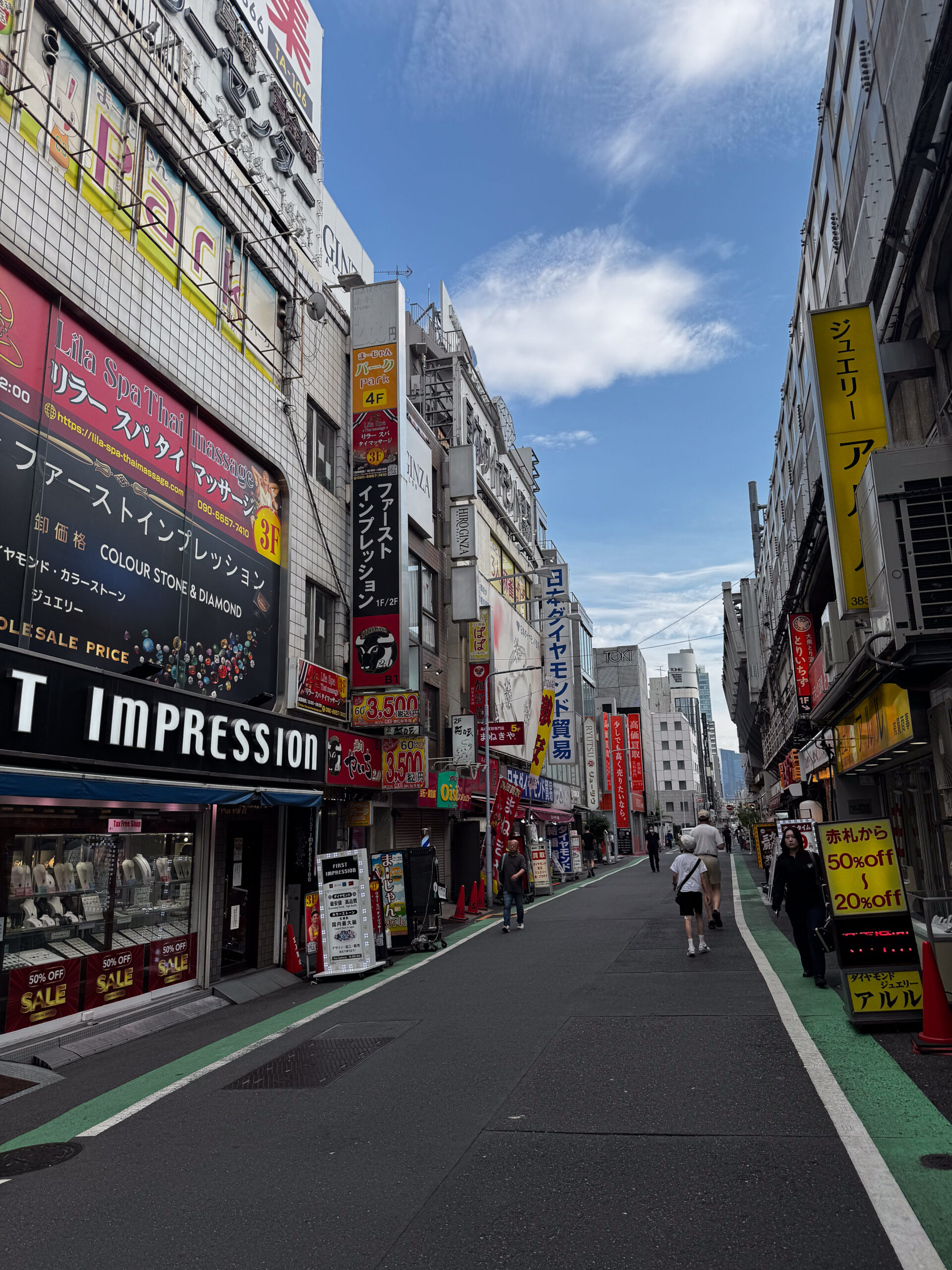
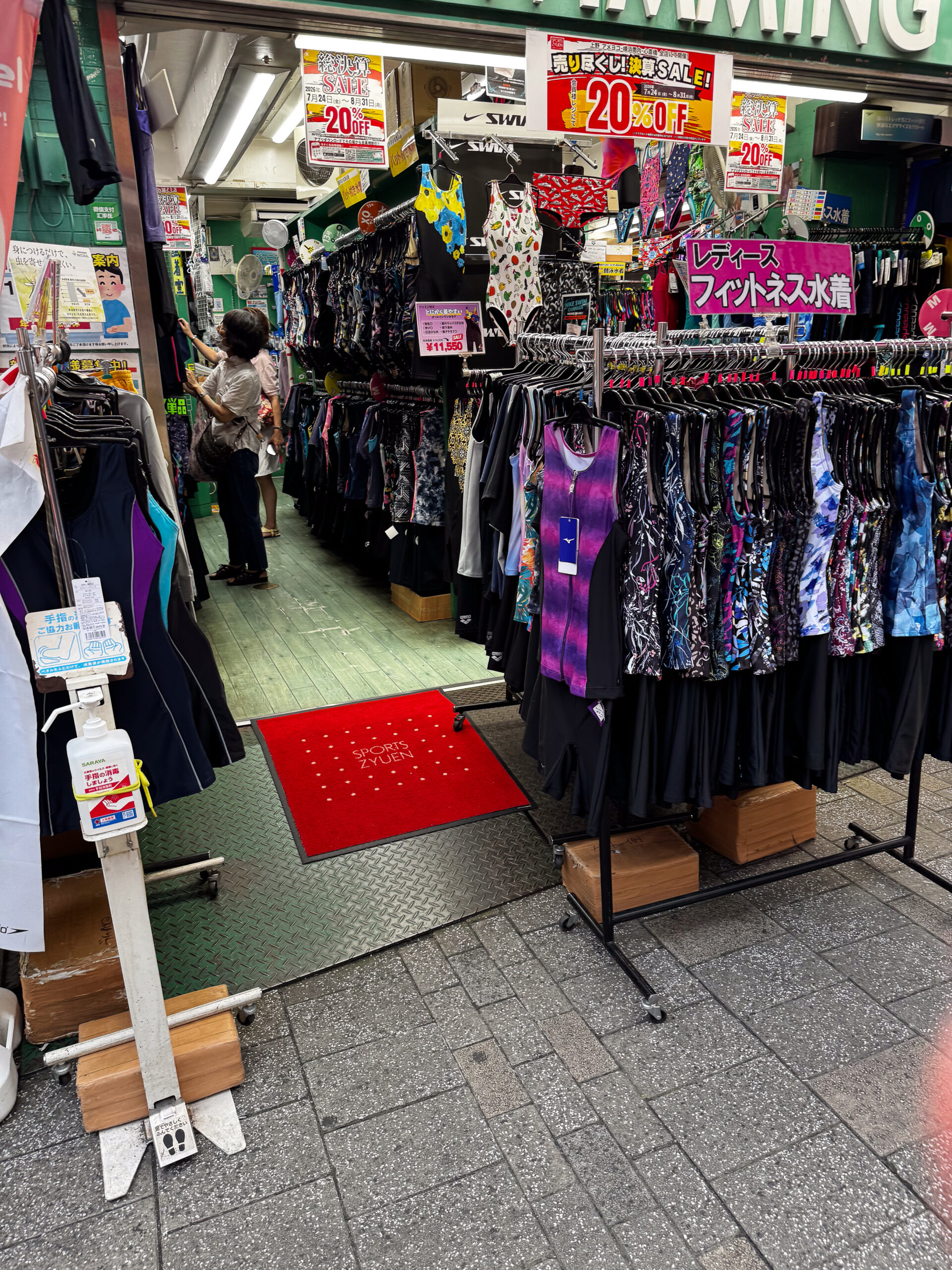
We were staying near Ueno and Okachimachi, right next to a massive, bustling street market where you can buy literally anything—from fresh peaches to sneakers. But a normal swimsuit? Impossible. We spent two hours wandering. I asked Gemini, I asked Google Maps. We found a few sports stores selling professional swimming gear, but no beachwear anywhere. Plus, Japanese sizing runs incredibly small, and I needed a 2XL just to get it on my body.

We tried Uniqlo and GU, but no luck. Finally, we asked a saleswoman in a tiny shop selling men’s trunks. She pointed us down an alleyway to a multi-story sports shop. There, on the very top floor, I finally found a one-piece swimsuit in a 2XL for a reasonable 6,600 yen.

I later tried to figure out why a regular Western-style swimsuit had been so difficult to find. One explanation was the much stronger emphasis on sun protection in Japan. We certainly noticed umbrellas, covered arms, and layers everywhere despite the heat, and many women’s swim outfits offered far more coverage than what I’m used to seeing in Canada. Whatever the reason, I learned not to assume that something as basic as a swimsuit will be easy to buy just because you’re in one of the biggest cities in the world.

Fashion Contrasts: From Conservative Commuters to Anime Maids

That preference for coverage was also noticeable in everyday fashion. A lot of the adult clothing we saw was quite conservative. When you look in some stores, it feels like every outfit is designed for meeting the Queen or working in a bank.

While shopping at a GU near a robot exhibition, I bought a slightly sheer camisole. I wanted to put it on immediately to survive the heat. The cashier looked at me with pure terror in her eyes, silently pleading with me not to wear what she apparently considered an undergarment outside. I didn’t care—I was thrilled to have something cool to wear! The locals might prefer layering up to avoid the sun, but I will gladly take the Japanese anti-dehydration drinks and wear my sheer camisole.

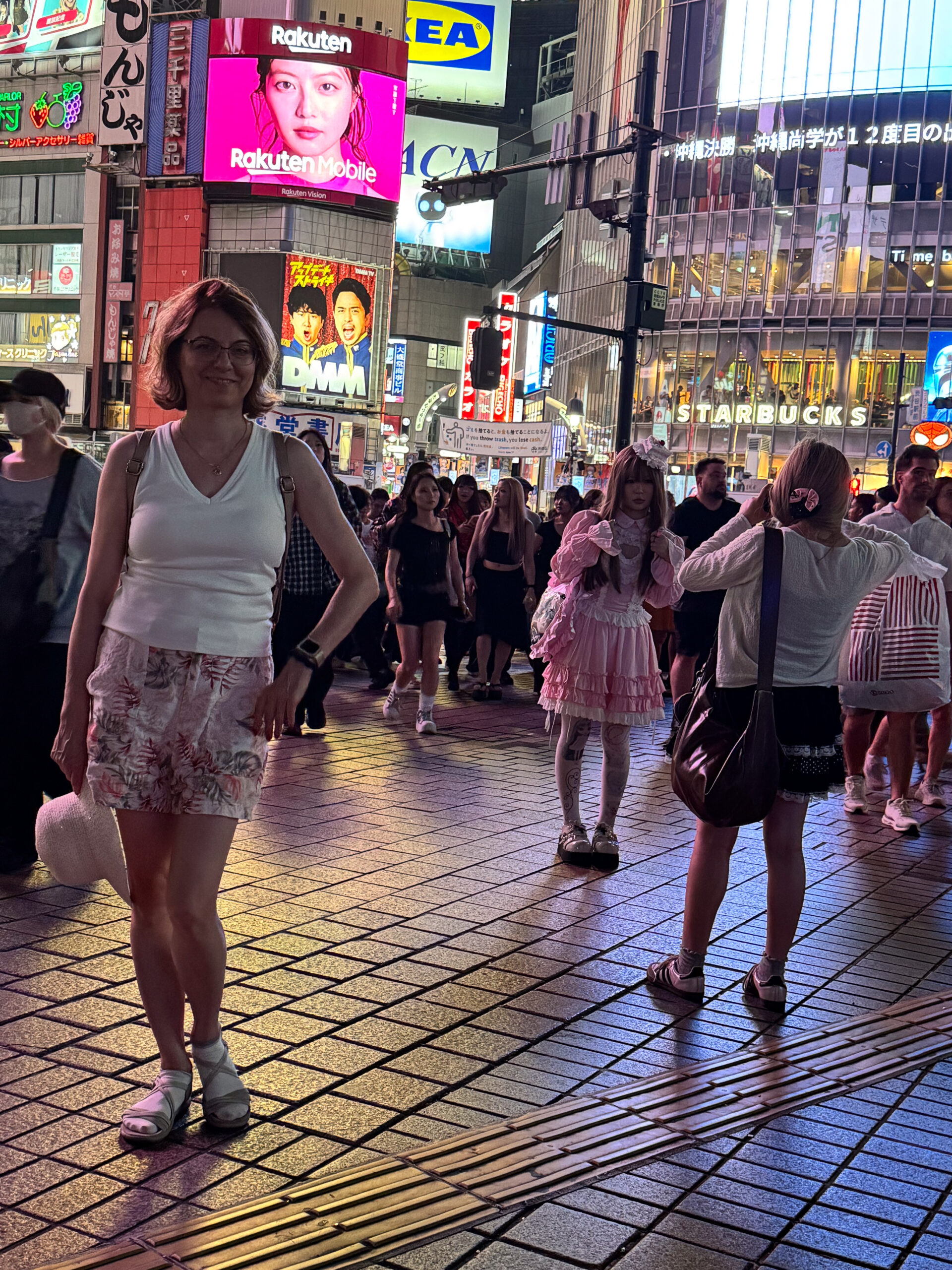
However, there is a wild flip side to this conservative fashion. In places like Shibuya, teenage street fashion is incredibly cool and vibrant. And then there are the “Maids.”

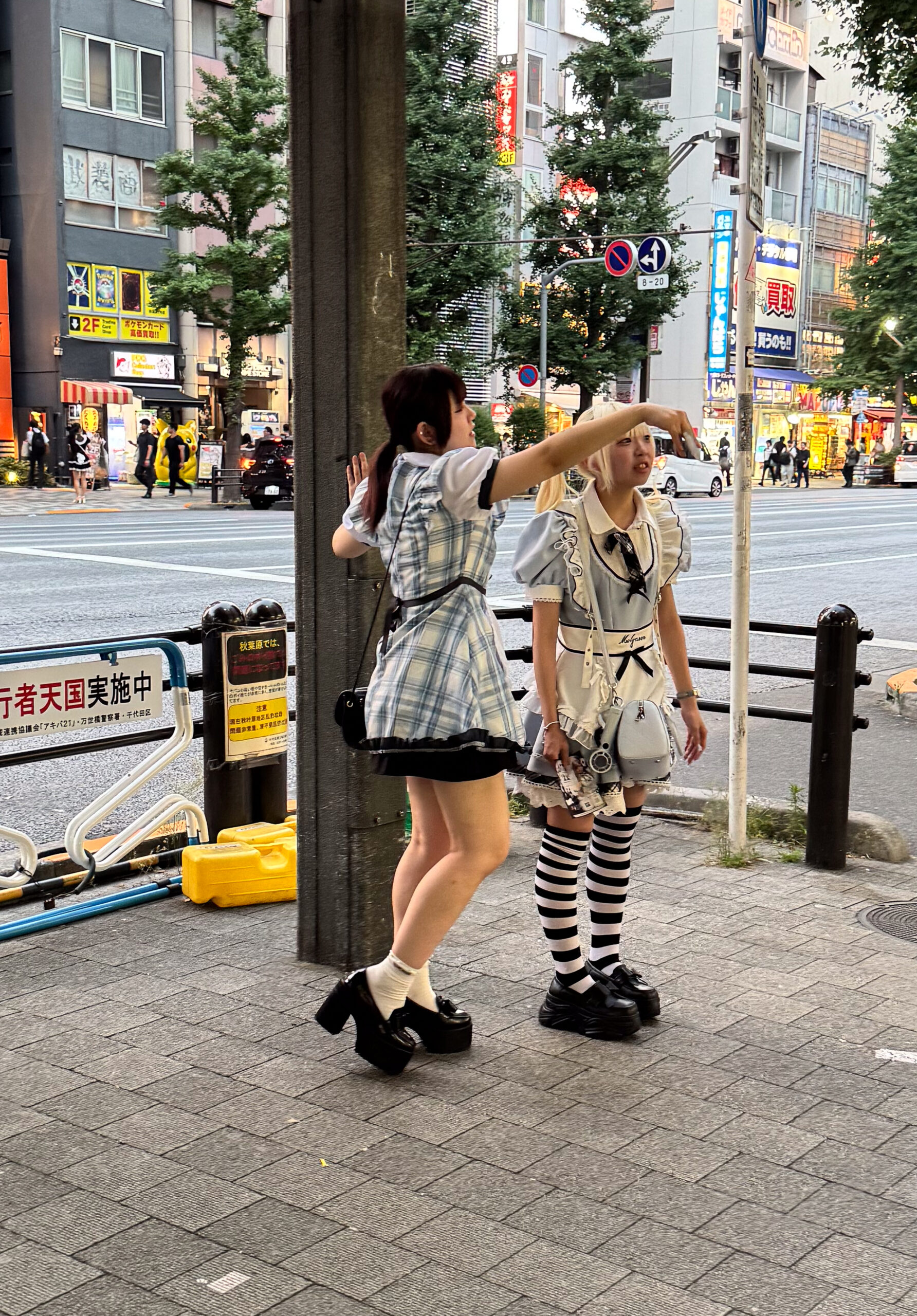
Near Akihabara, we saw girls dressed perfectly as anime maids standing on the sidewalks and inviting customers into Maid Cafes hidden on upper floors. Inside, they dance, sing, and perform “magic spells” over your food. My boys absolutely refused to go into one, but it was fascinating to see them dotting the streets!

Shopping Quirks: Face Bags and Magic Bins

Shopping in Japan comes with its own unique set of rules and mind-blowing tech.

If you want to use a fitting room, you may be asked to take your shoes off. In nicer stores, attendants can also hand you a breathable gauze cover to place over your face before trying on tops so your makeup doesn’t stain the clothes. Definitely a first for me.

But the most futuristic part of shopping is the checkout at places like Uniqlo and GU. There are no barcodes to scan one by one. You simply drop your entire basket of clothes into a large bin at the self-checkout, and the RFID tags are read almost instantly. Your whole purchase appears on the screen in a split second. It feels like magic.

Japan in July: Hot. Lost. Amazed. And Completely in Love. Part 1

My Invisible AI Tour Guide

My boys had been begging to go to Japan for two years. As a mom, I had always been mildly terrified of the 13-hour flight and the massive time difference. It turns out, those were the least of my worries. The flight honestly didn’t feel much different from flying to Europe—provided you have a good neck pillow and spend the time sleeping or binge-watching movies. Surprisingly, thanks to a little melatonin magic, I barely felt the jet lag and switched to the new time zone pretty quickly.

The real adventure began when we landed.

This was the first trip I planned almost entirely using AI. Honestly, it felt like Gemini Pro was a personal guide traveling in my pocket. I used it for everything, from “Where should we eat right now?” to “Are we on the right train?” and “What does this beautiful origami at the temple mean?”

I planned almost our entire itinerary with it, and it was incredibly helpful. It recommended the major attractions, told me how far in advance to book tickets, and helped structure our visits to Lake Kawaguchiko to see Mt. Fuji, Shibuya Sky, TeamLab Planets, Tokyo Skytree, and our incredible side trip to Shibu Onsen in Nagano.

Shibu Onsen: Hot Springs and Sasha’s Brilliant Idea

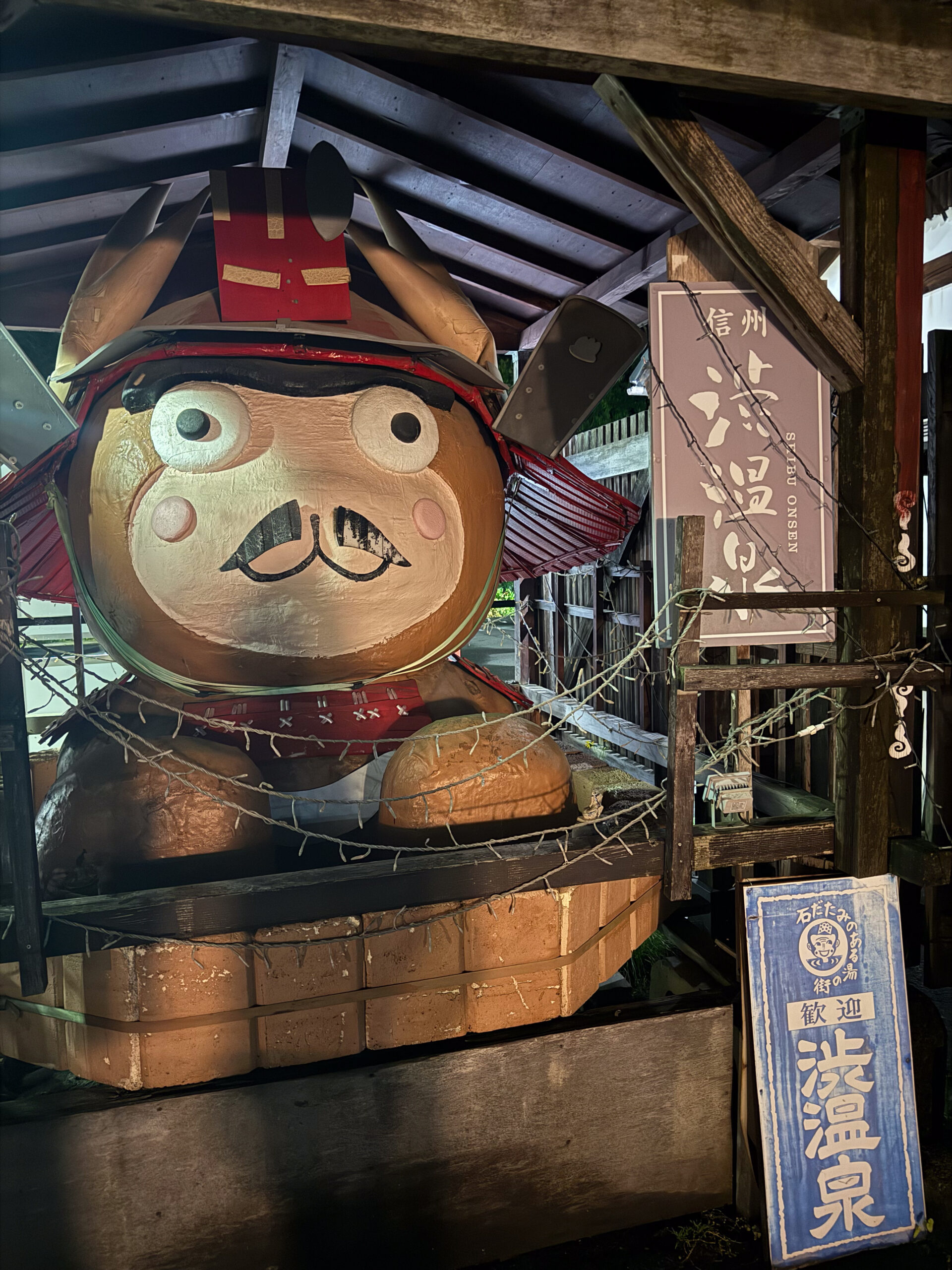
My older son, Sasha—who probably knew more about Japan before this trip than the rest of us combined—suggested we stay at a traditional ryokan (Japanese inn) with hot springs in the mountains. That is how we ended up booking a two-night stay at the 70-year-old Suminoyu Ryokan in the scenic Yamanouchi village. It ended up being the absolute highlight of our trip.

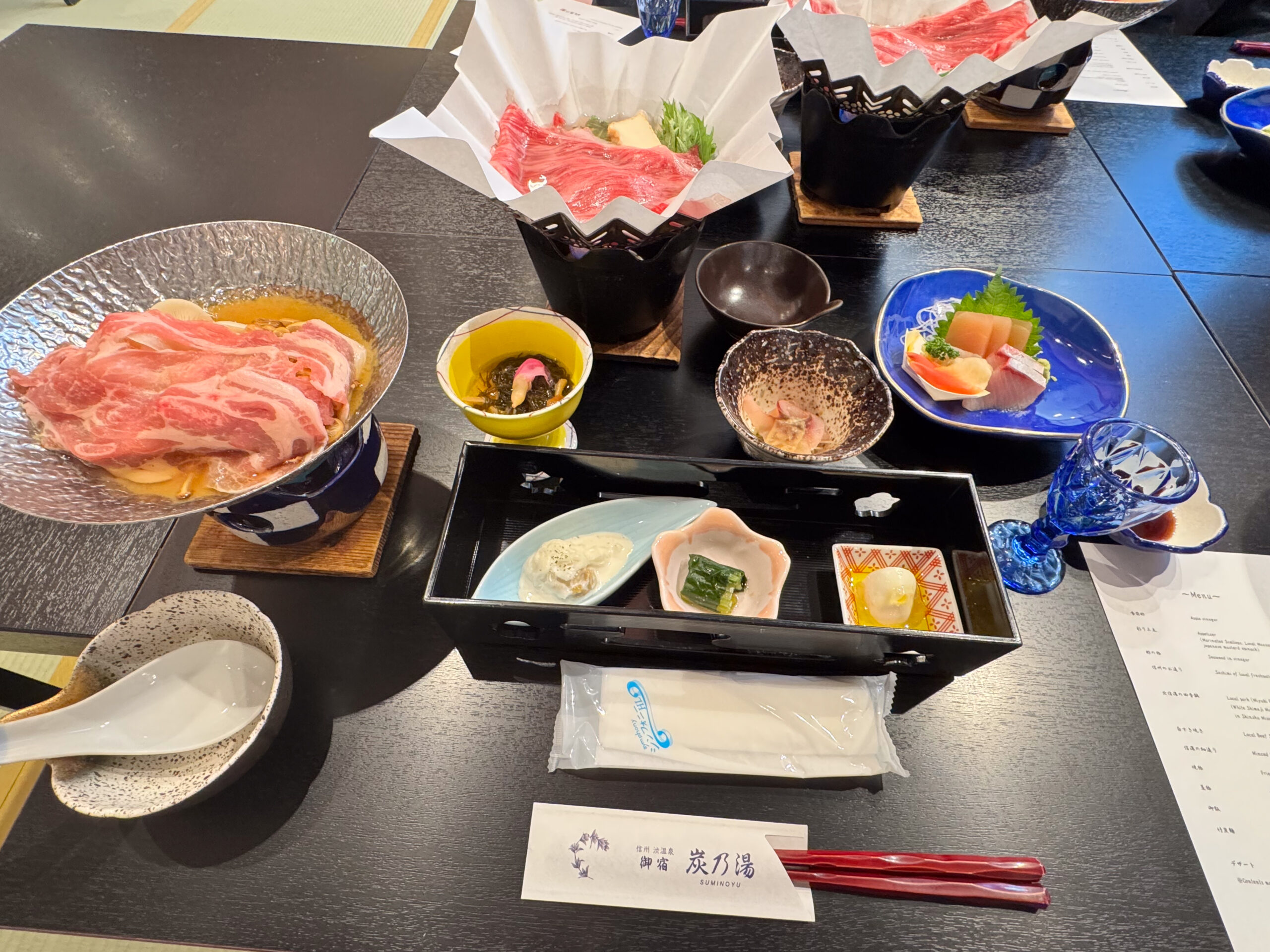
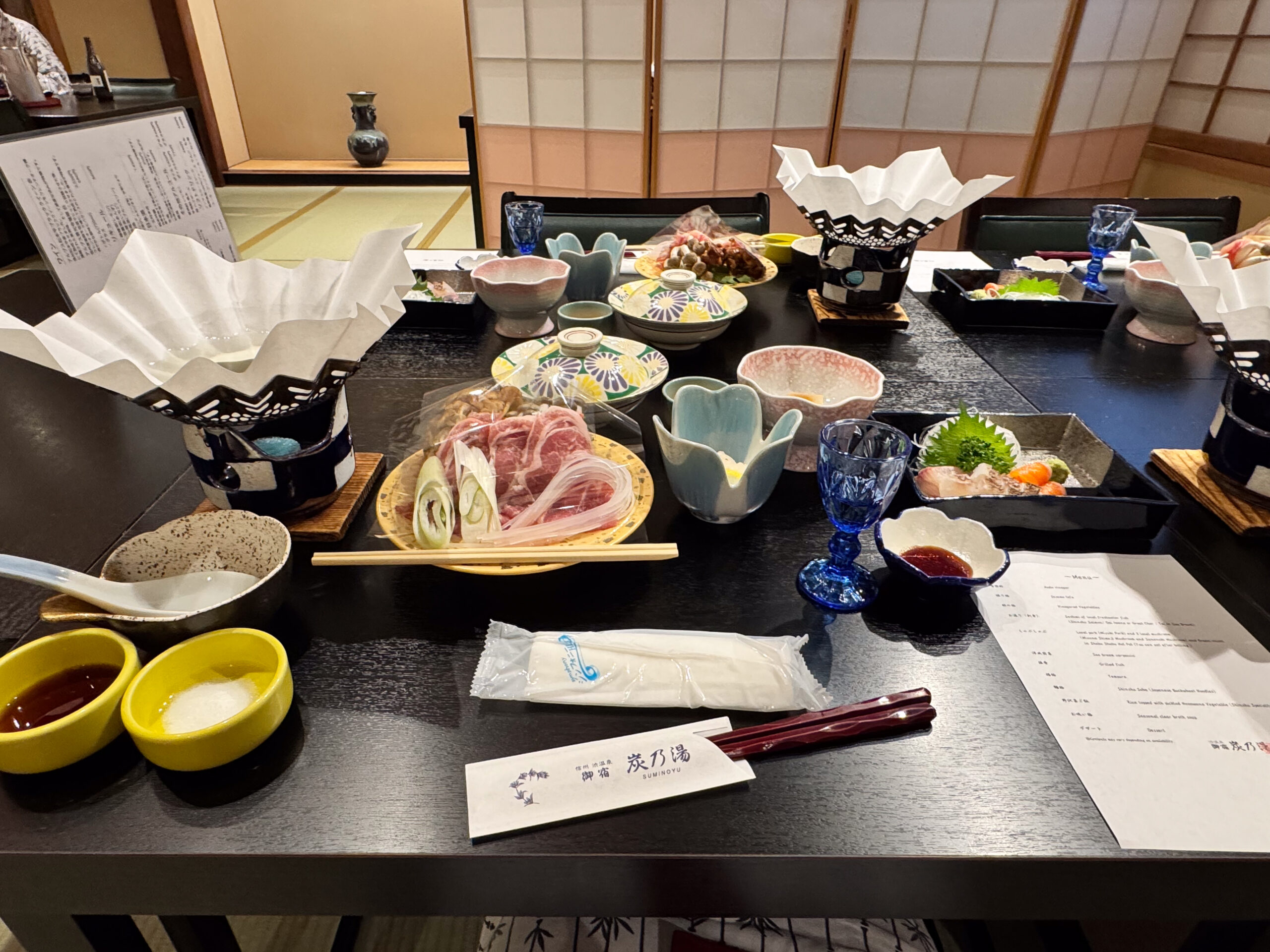
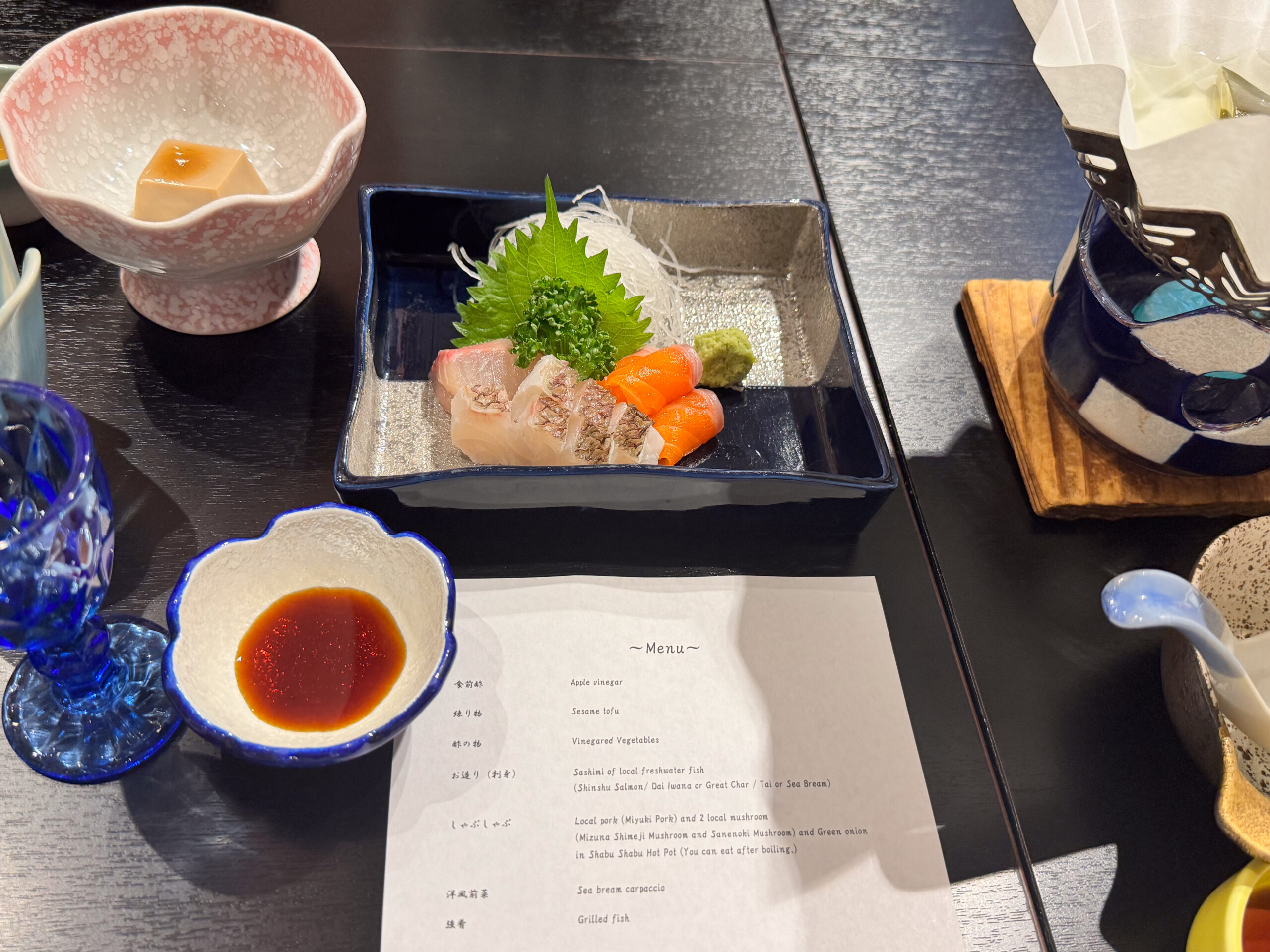
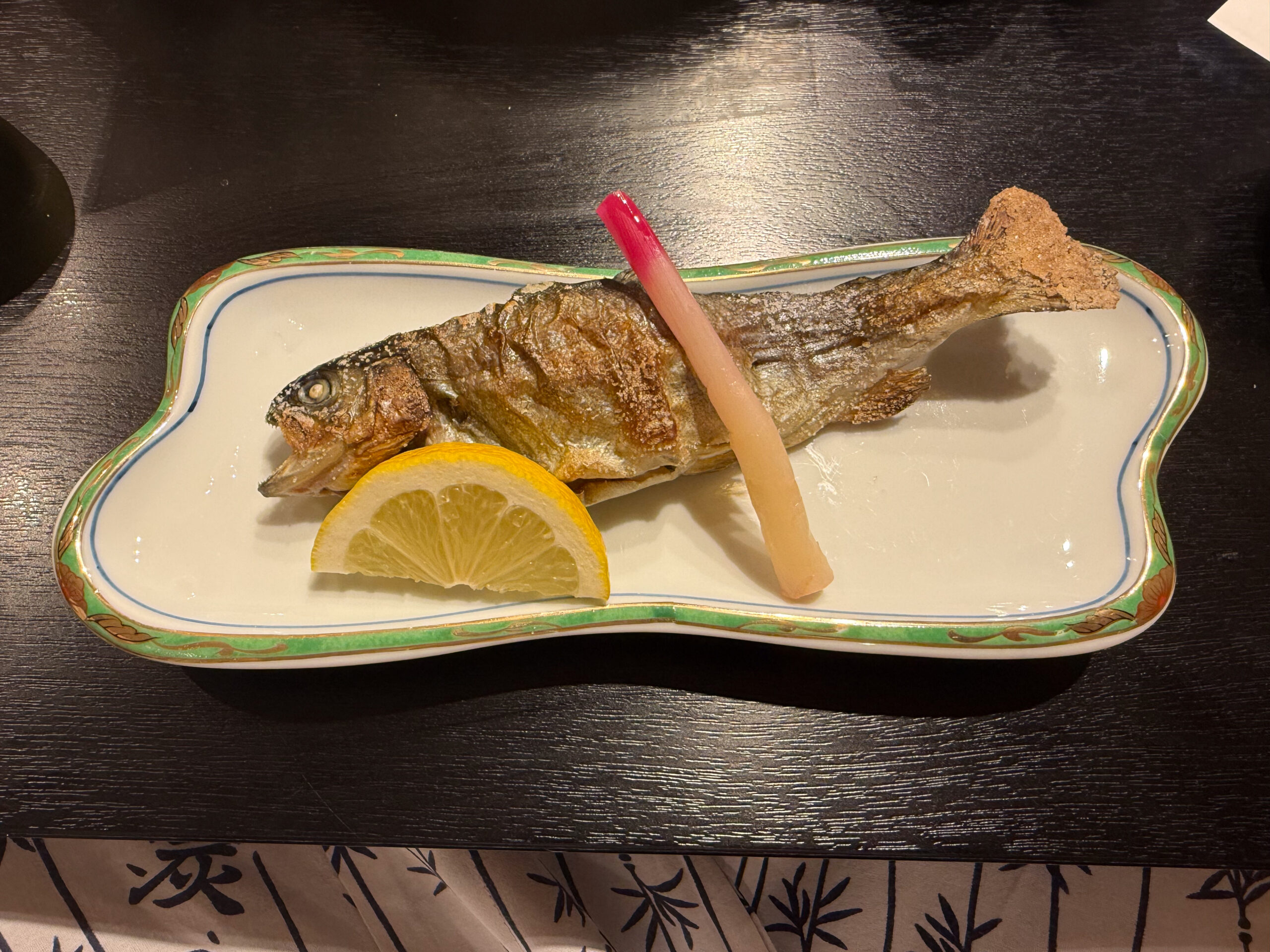
Our stay included breakfast and a spectacular multi-course kaiseki dinner. We’re talking about 12 exquisitely presented small dishes: sashimi made from incredibly fresh local fish like Shinshu salmon, mountain char, and sea bream, alongside tofu, noodles, and miso soup. The best part was the meat, mushrooms, and vegetables cooked right on our table in a shabu-shabu hot pot.

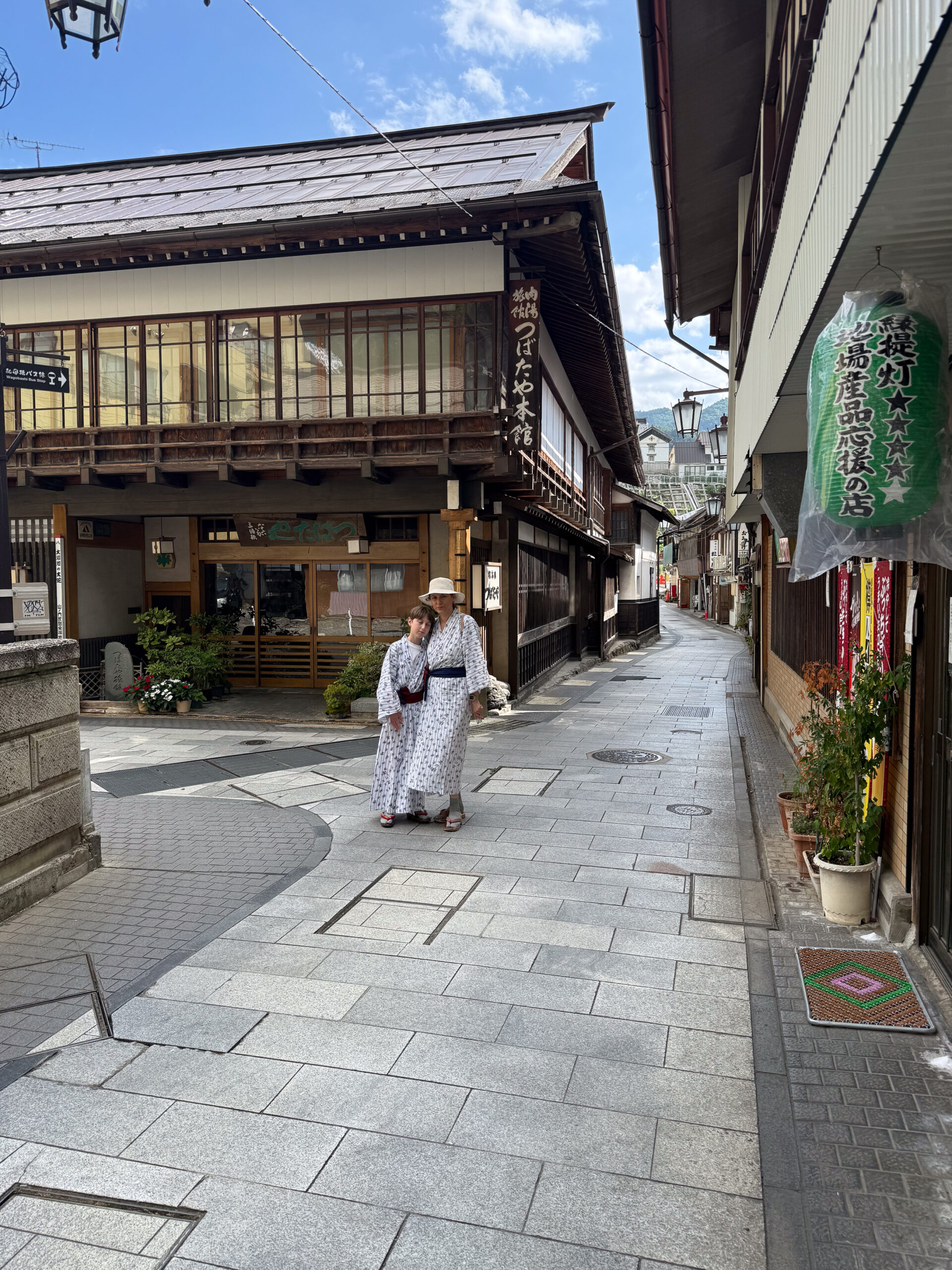
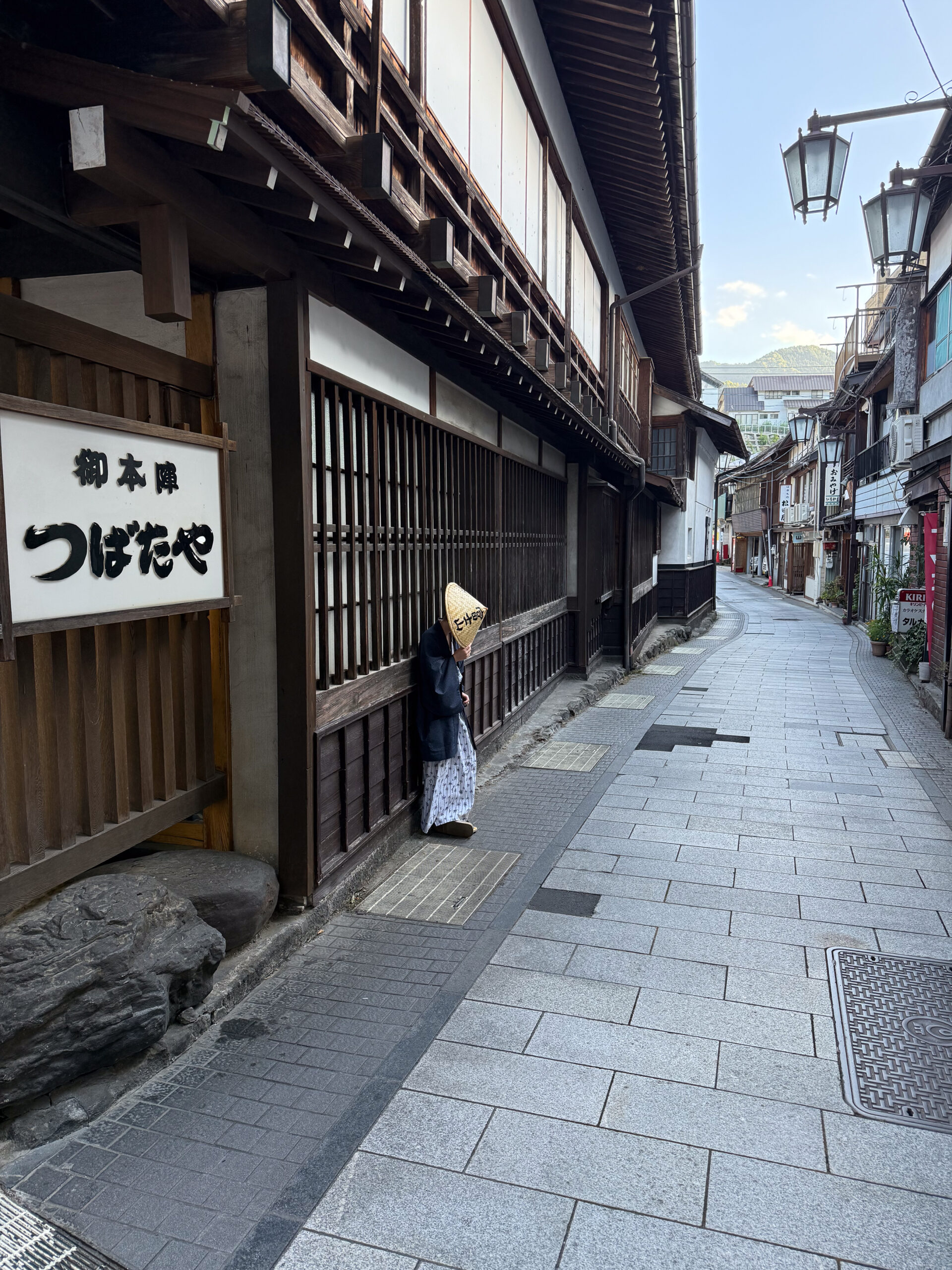
The village itself is famous for its complex of nine public hot spring baths (soto-yu) spread along the cobblestone streets. Our incredibly welcoming hostess handed us an old-fashioned key attached to a huge wooden plate that opened all nine baths. She explained that visitors usually buy a special towel for 500 yen and collect a stamp at each bath as a souvenir. We visited all nine to look, but skipped bathing in them since they were quite small, crowded, and lacked showers.

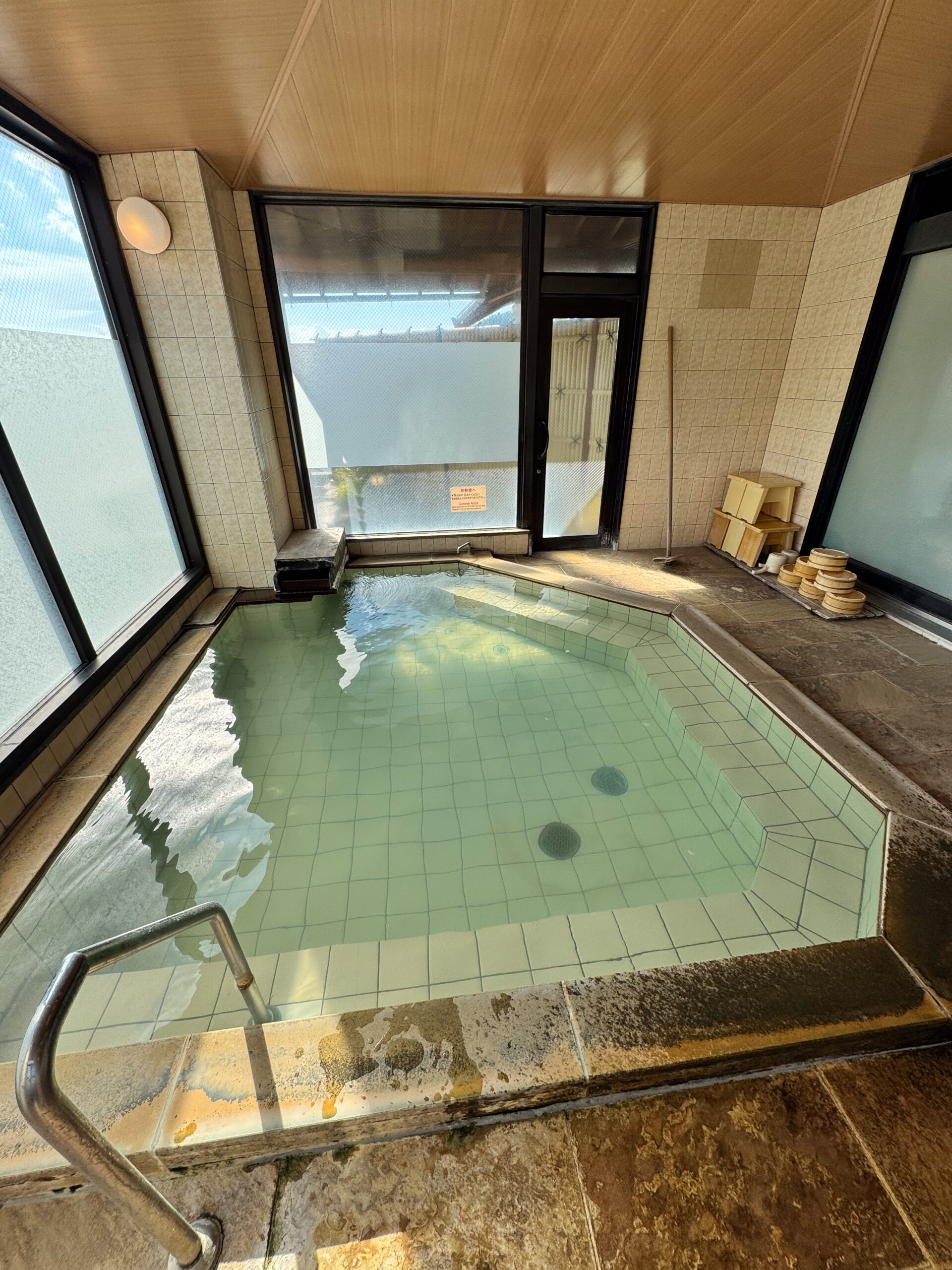
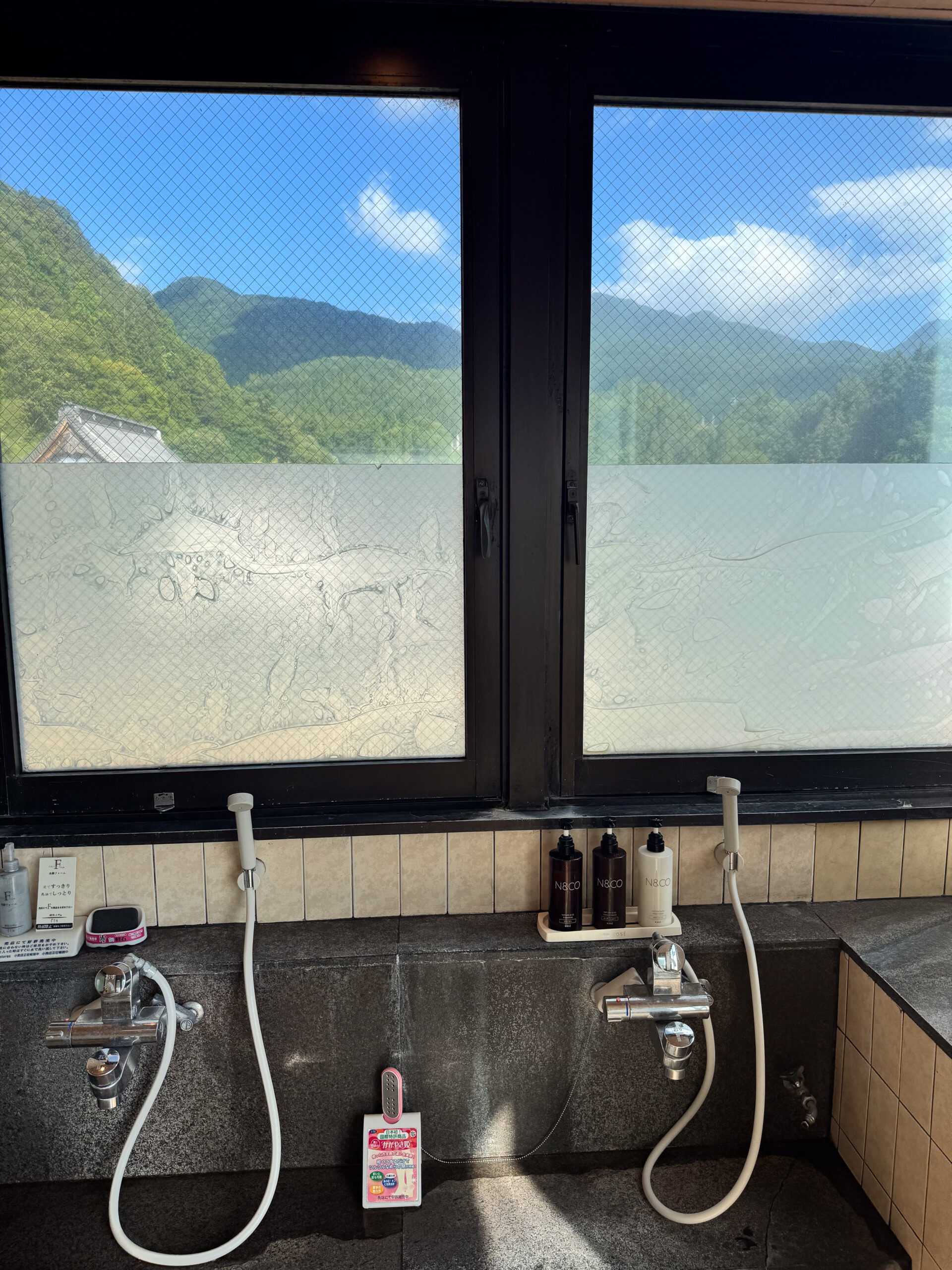
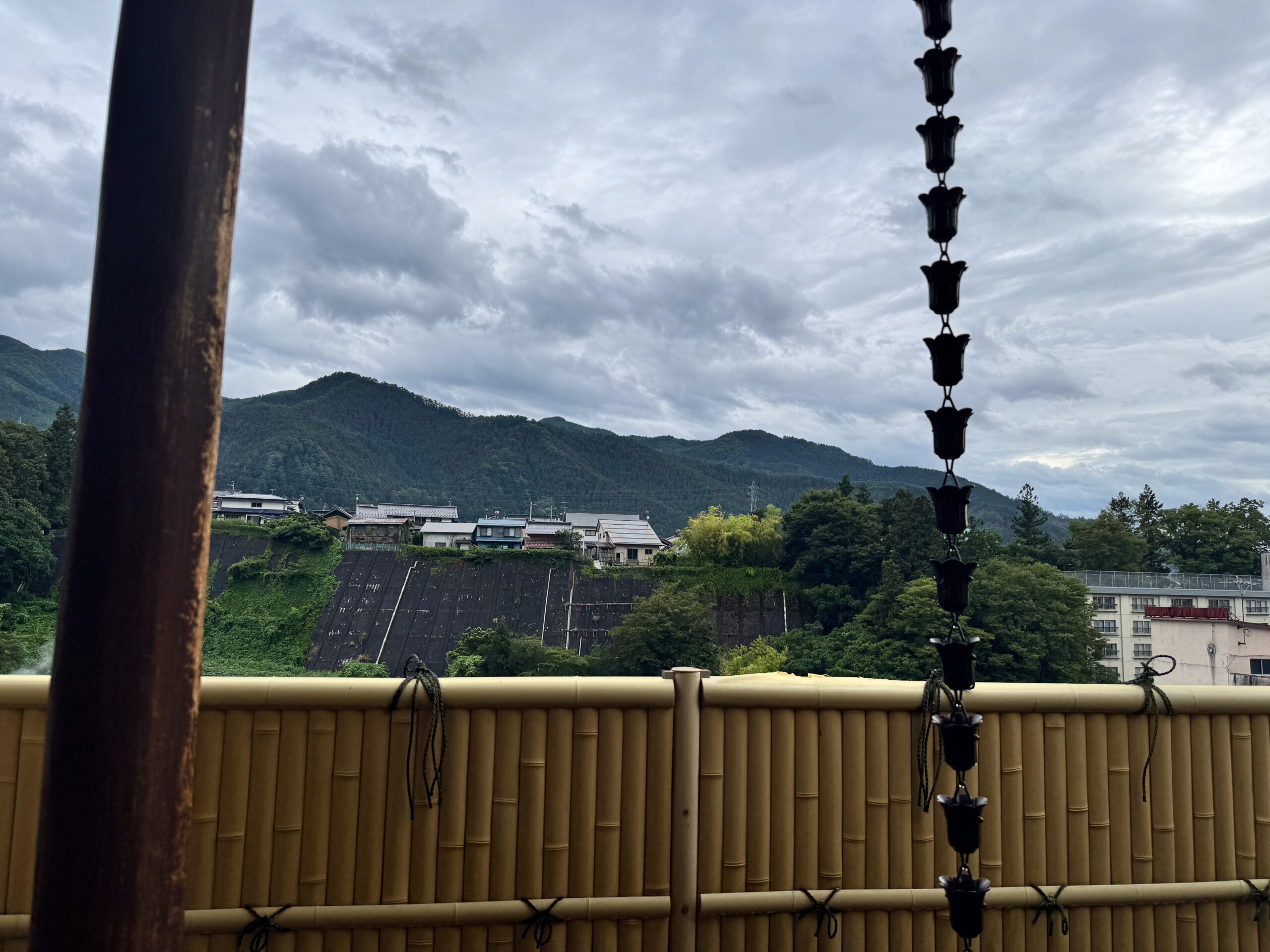
Instead, we took full advantage of our hotel’s amazing onsen. They had an indoor bath, which was very hot, and a much more comfortable outdoor bath with breathtaking views of the village spread across the mountain hills.

Speaking of onsens, there was one mystery I didn’t fully solve until two weeks after we came home: the purpose of the tiny towel we were given at the hotel. At first, I thought it was a washcloth. Then I saw Japanese women balancing theirs on their heads in the onsen, so I assumed that was its purpose. Apparently, I was still missing something.

Two weeks later, Hugh Jackman finally enlightened me with this hilarious explanation. He figured the tiny towel was meant to cover your private parts — only to discover that it was ridiculously too small for the job. 😂 Interestingly, I never saw a single Japanese woman even attempt that. The towel went on the head; modesty apparently took care of itself.

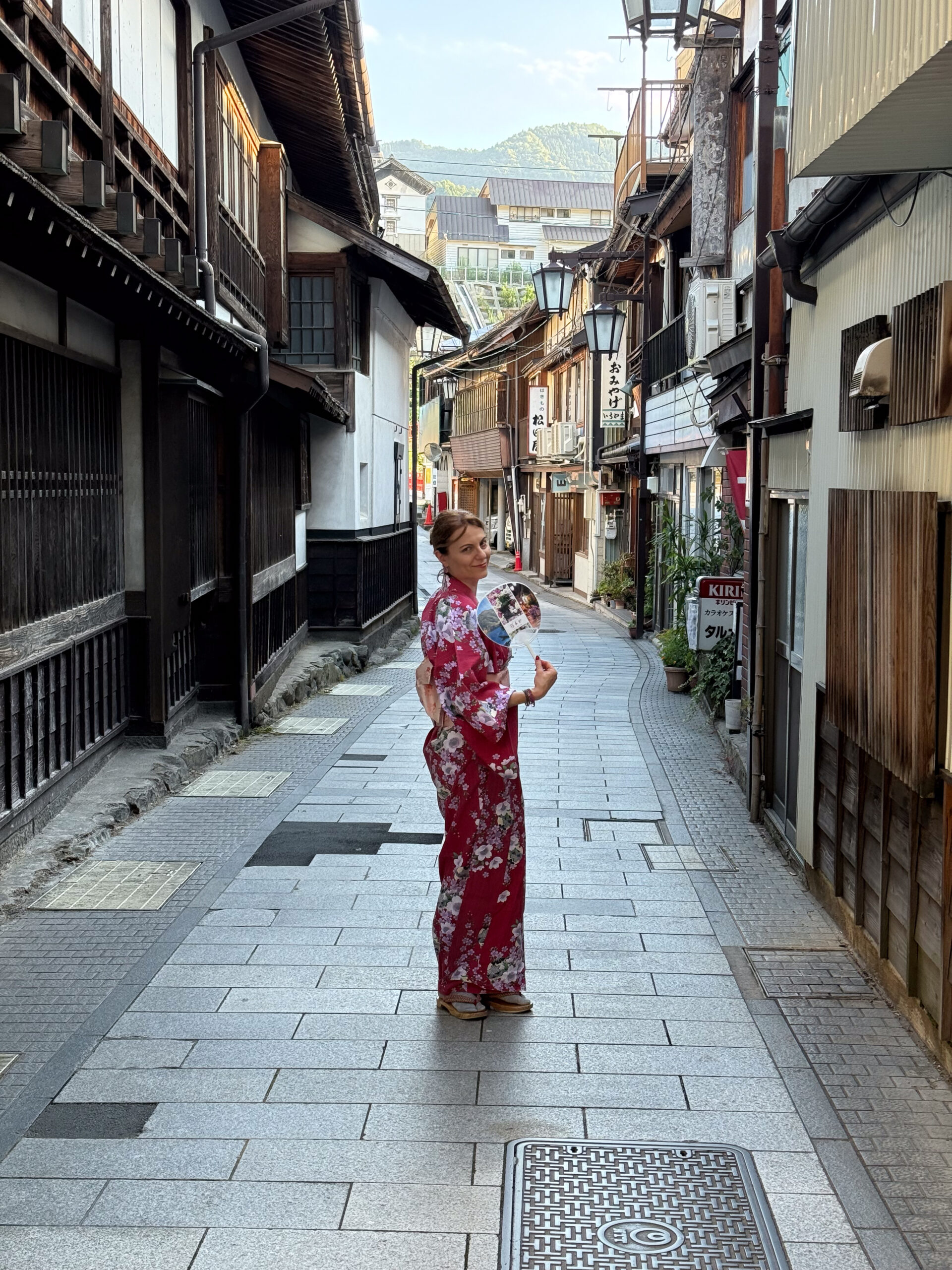
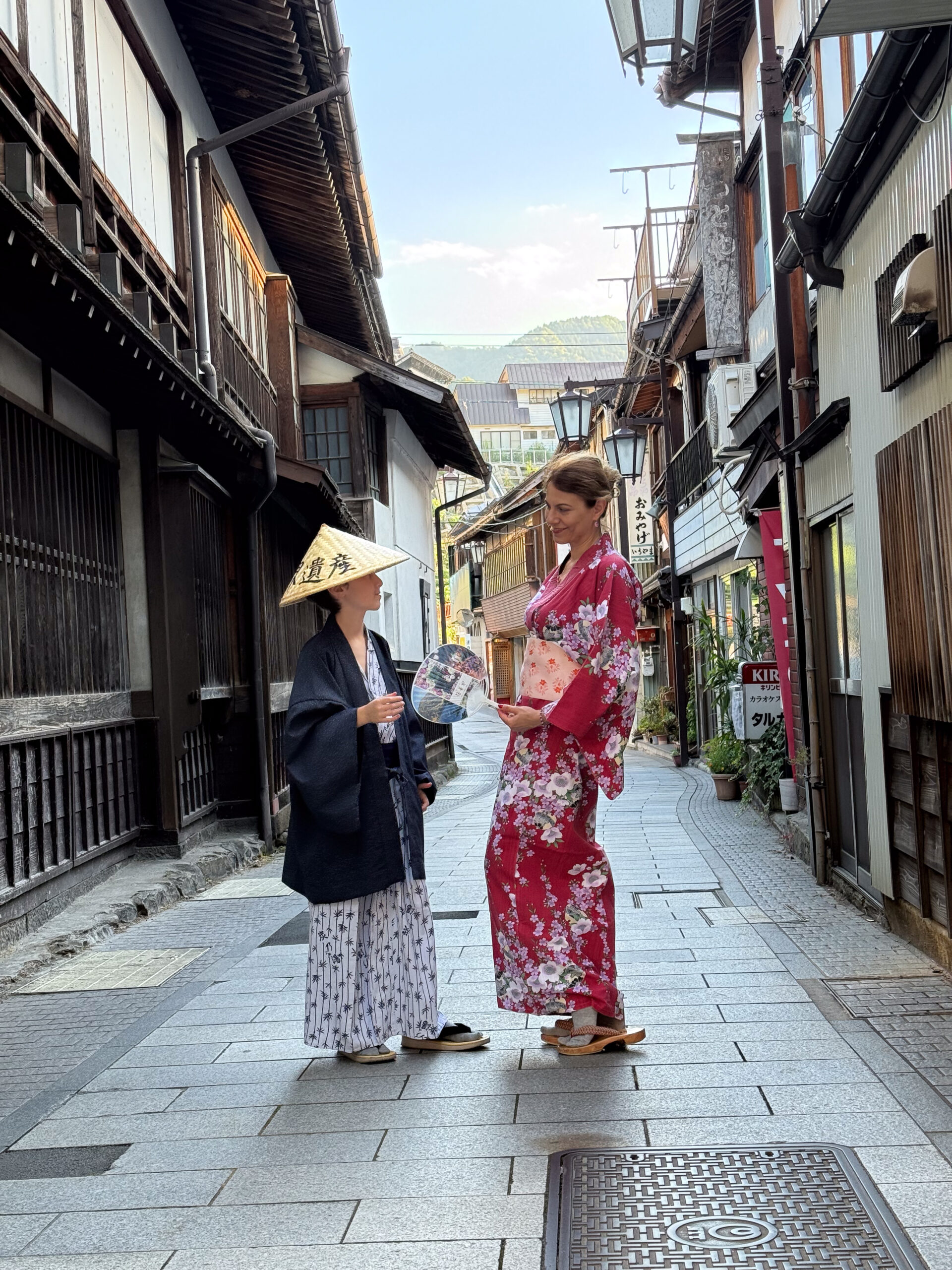
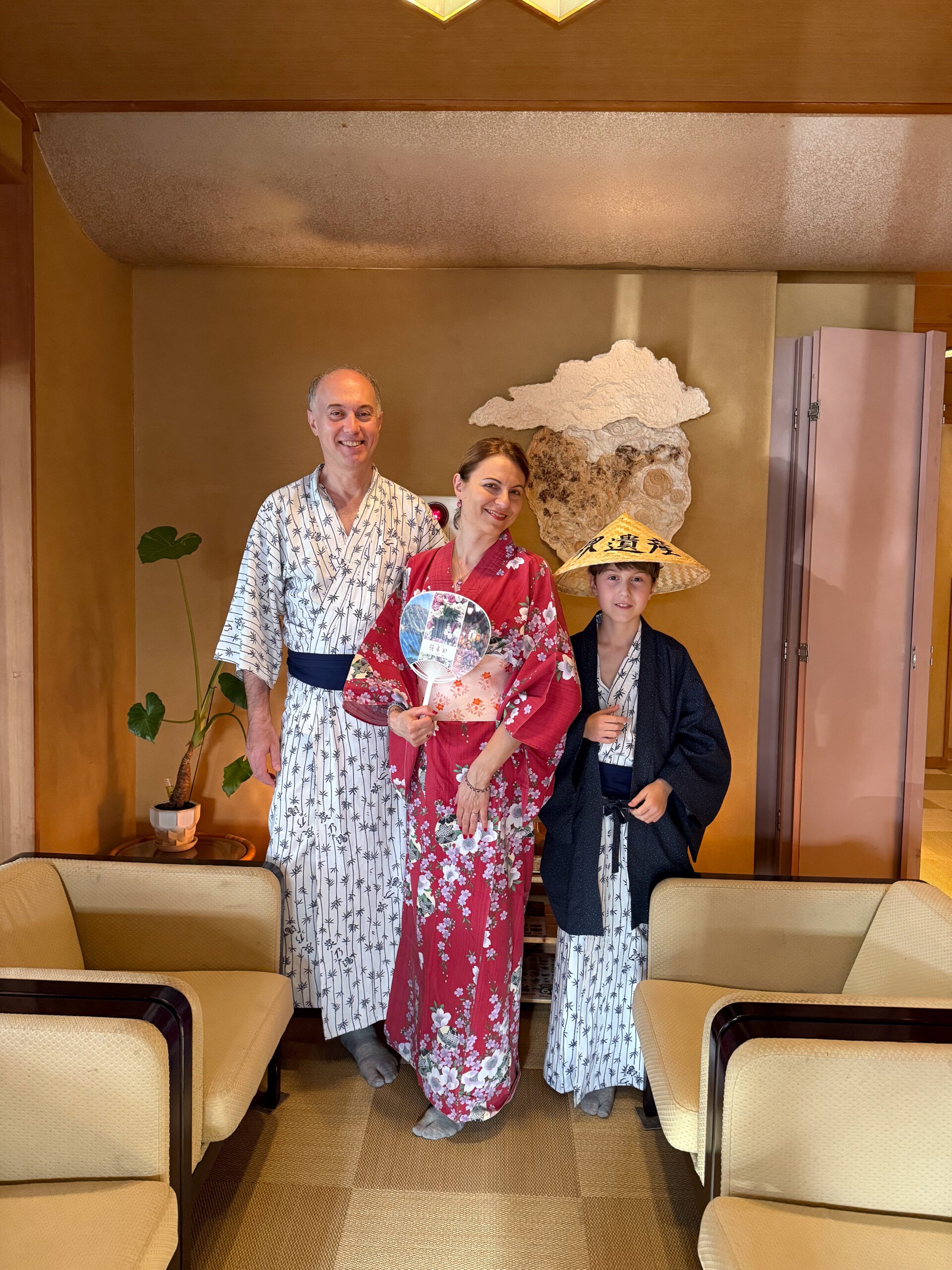
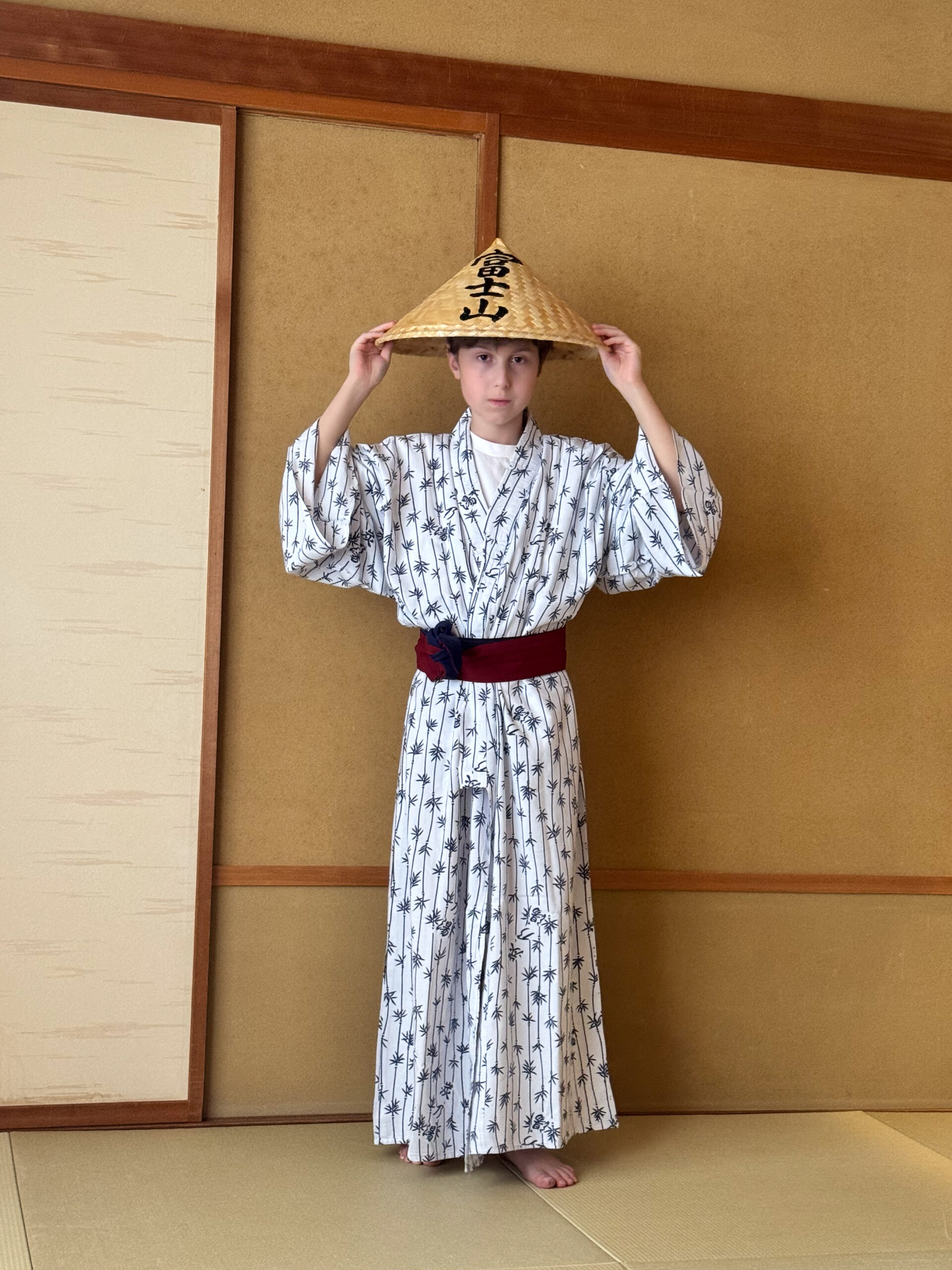
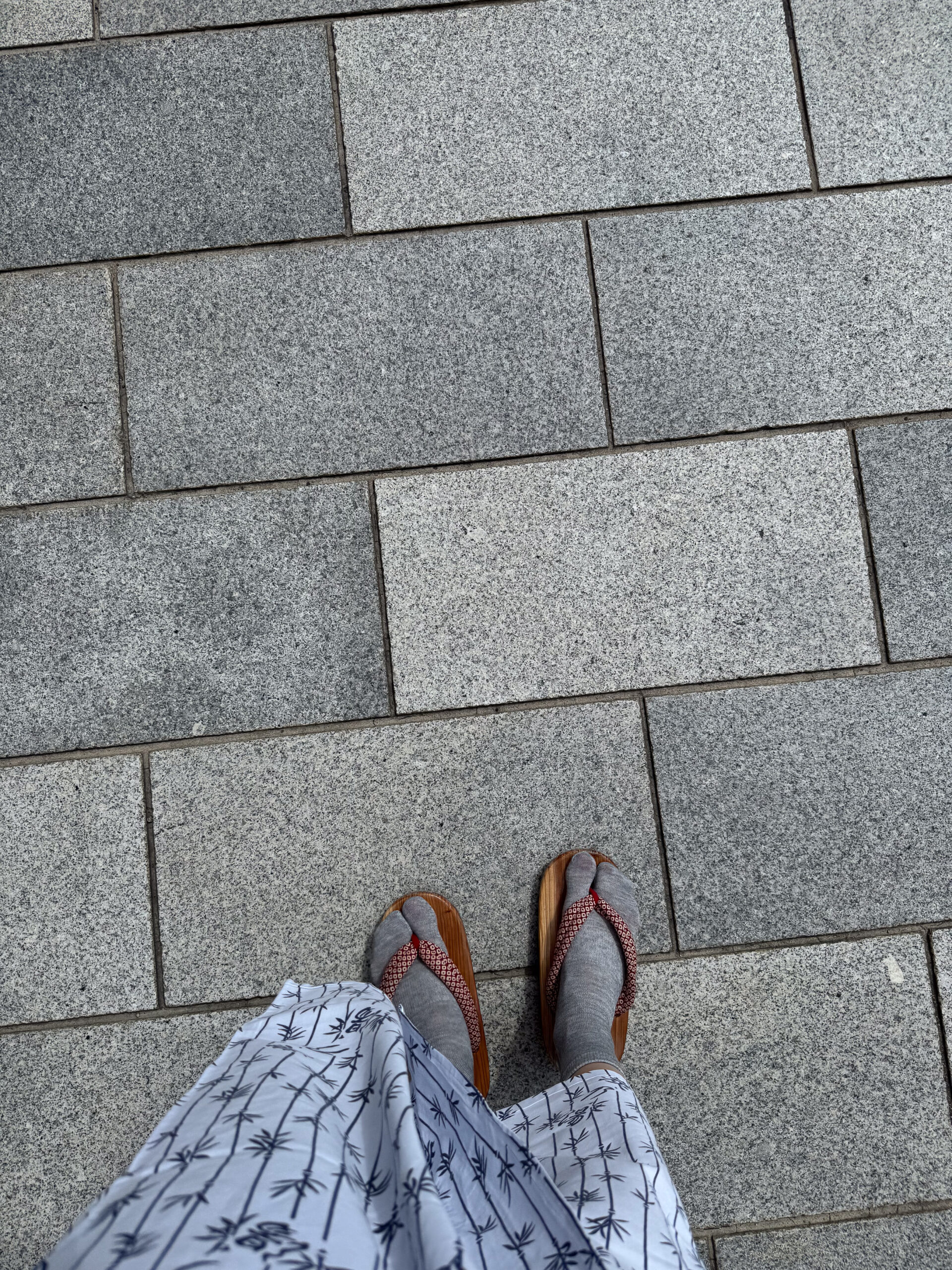
In ryokans, outdoor shoes are strictly forbidden. Inside, we walked around in special tabi socks, which have a separated big toe so you can easily slip on traditional wooden geta sandals. We clacked around in these geta along the village’s cobblestone streets. In addition, we were all given yukatas (light cotton kimonos) and short haori jackets for the evening. I even rented a brightly colored yukata for a fun family photo shoot!

Through the Rain to the Mountain Spirits: Macaques, Temples, and Paper Prayers


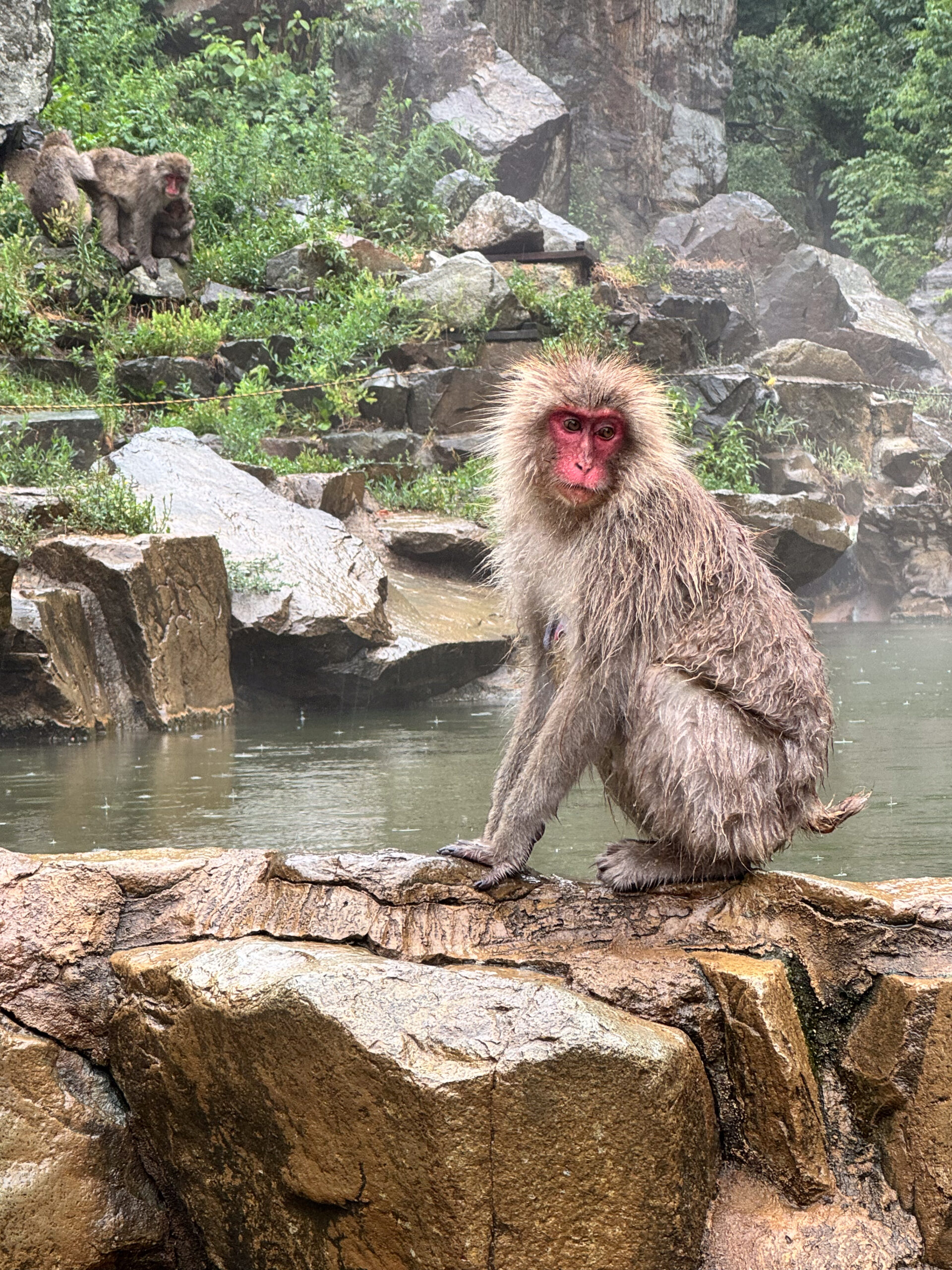
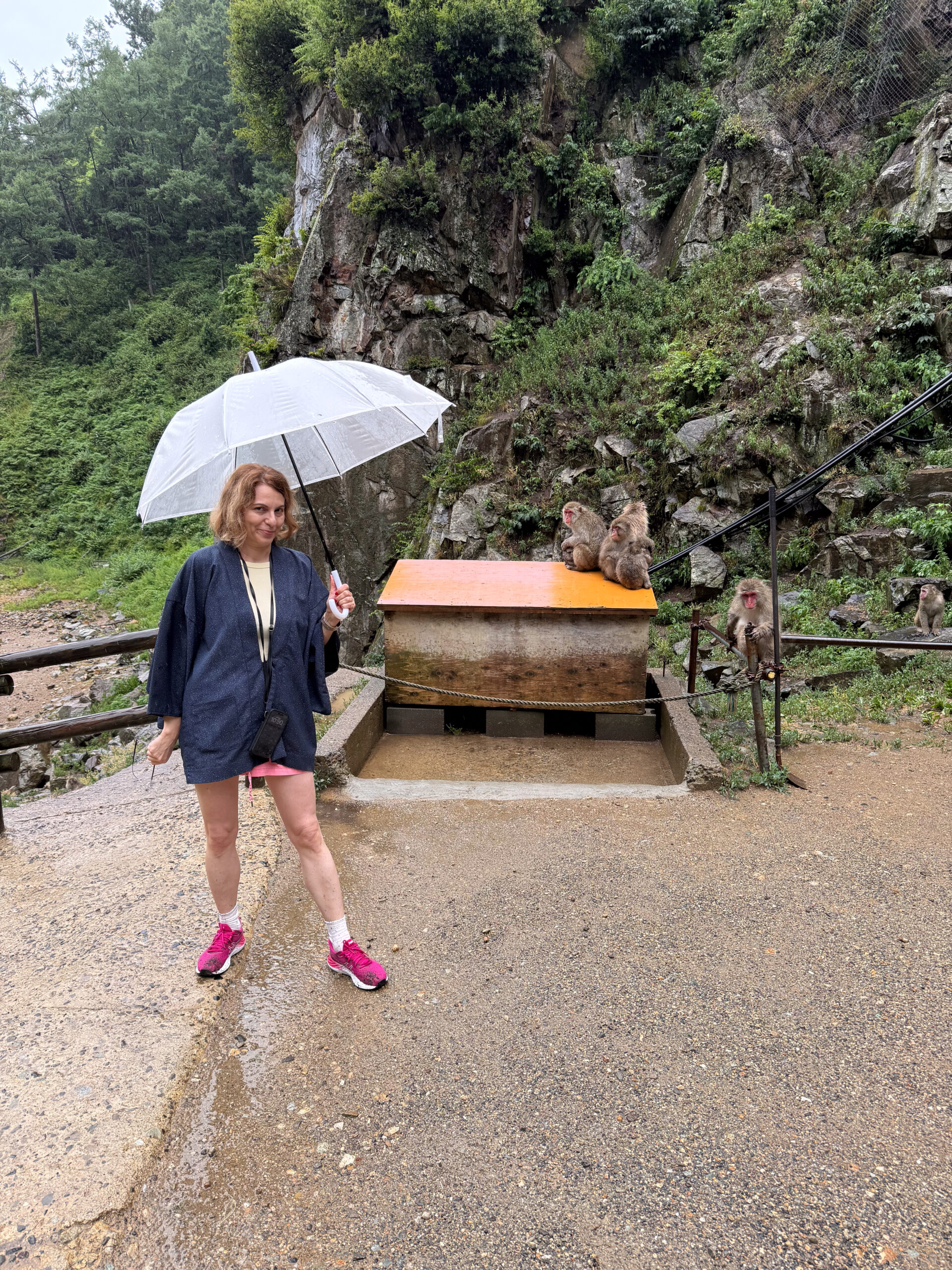
The next day, we were scheduled to go to the Jigokudani Snow Monkey Park. It started raining heavily that day, and at first, we wanted to cancel the whole thing. But, armed with umbrellas from the hotel, we decided to risk it anyway—and it was totally worth it, even though our shoes turned into clumps of mud by the end.

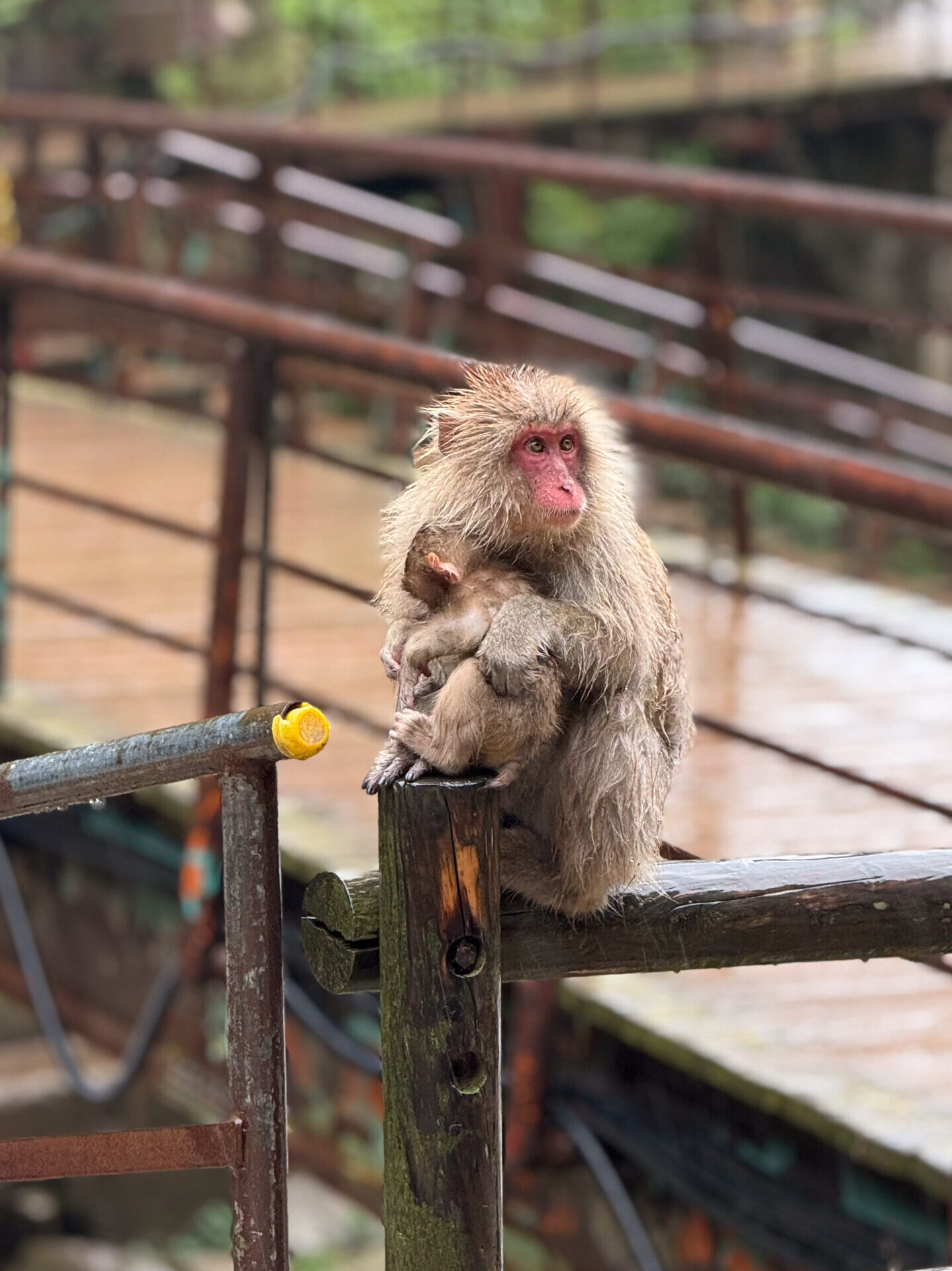
The macaques and their babies posed for us so picturesquely. By the way, a long time ago, they learned to warm up in the hot springs during the winter, and later a separate bath was built just for them in the park. They are capable of traveling long distances, but thanks to the food and the hot springs, they choose to stay in the park. Some macaques do manage to wander off from the park, though.

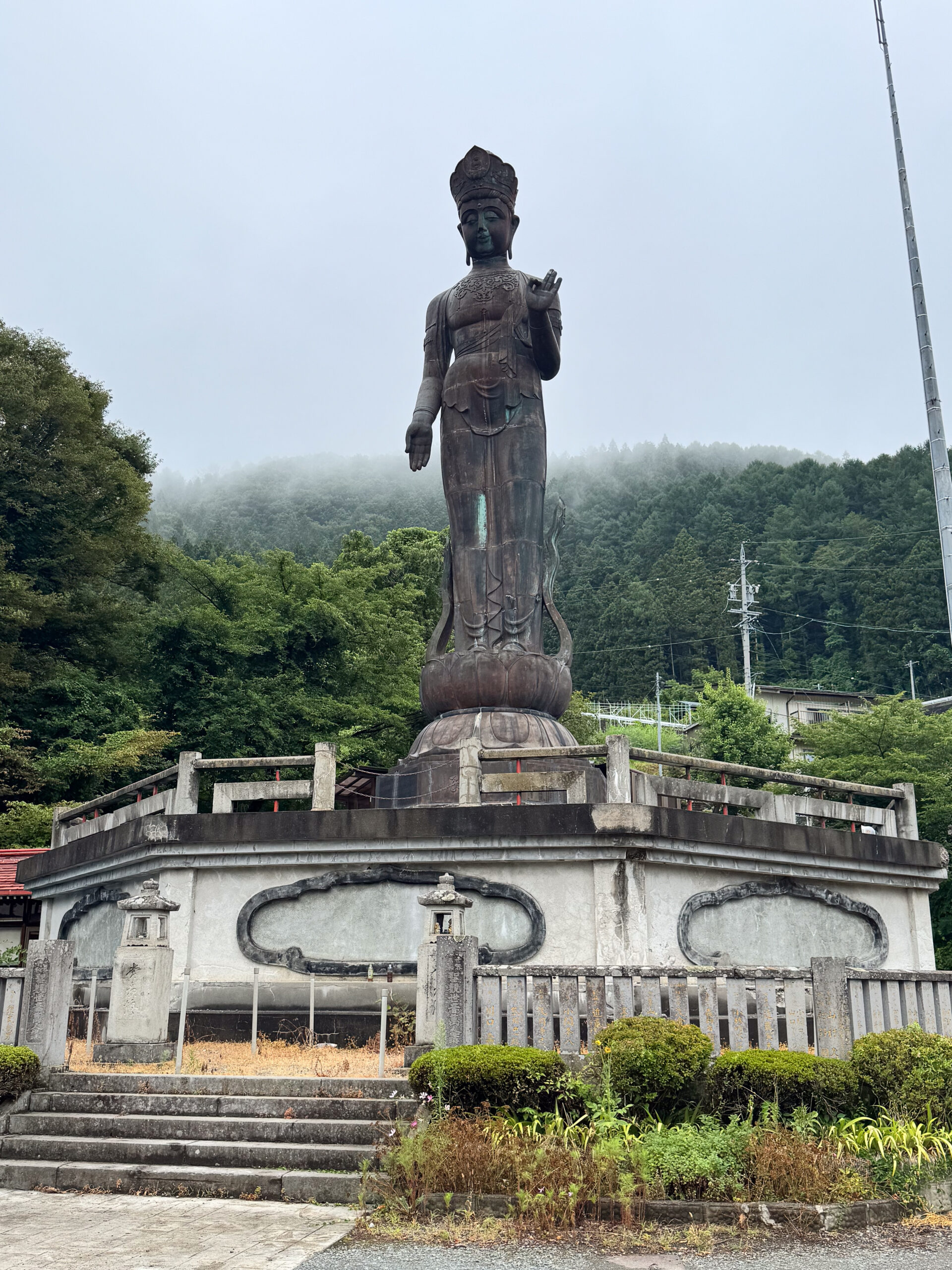
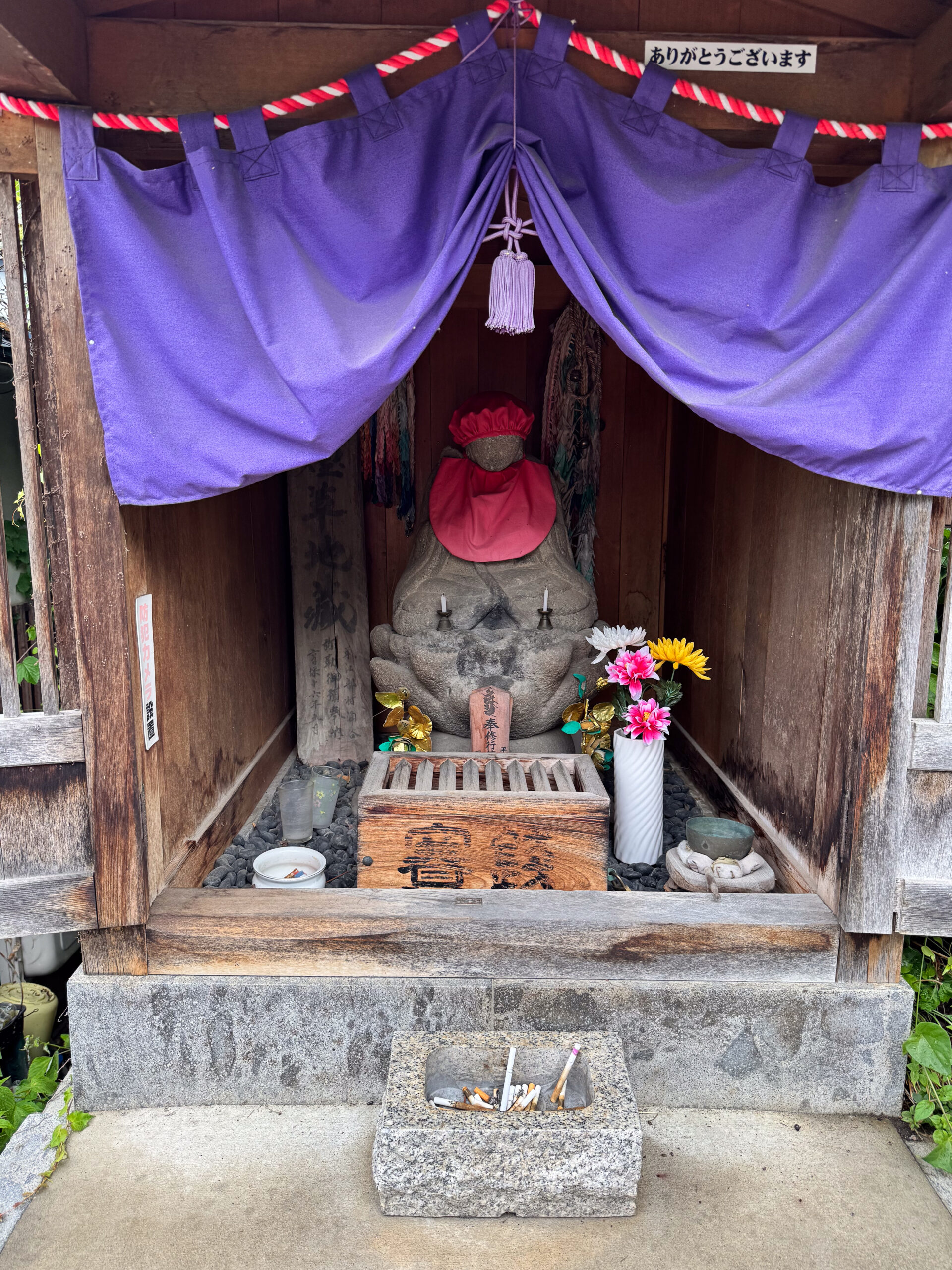
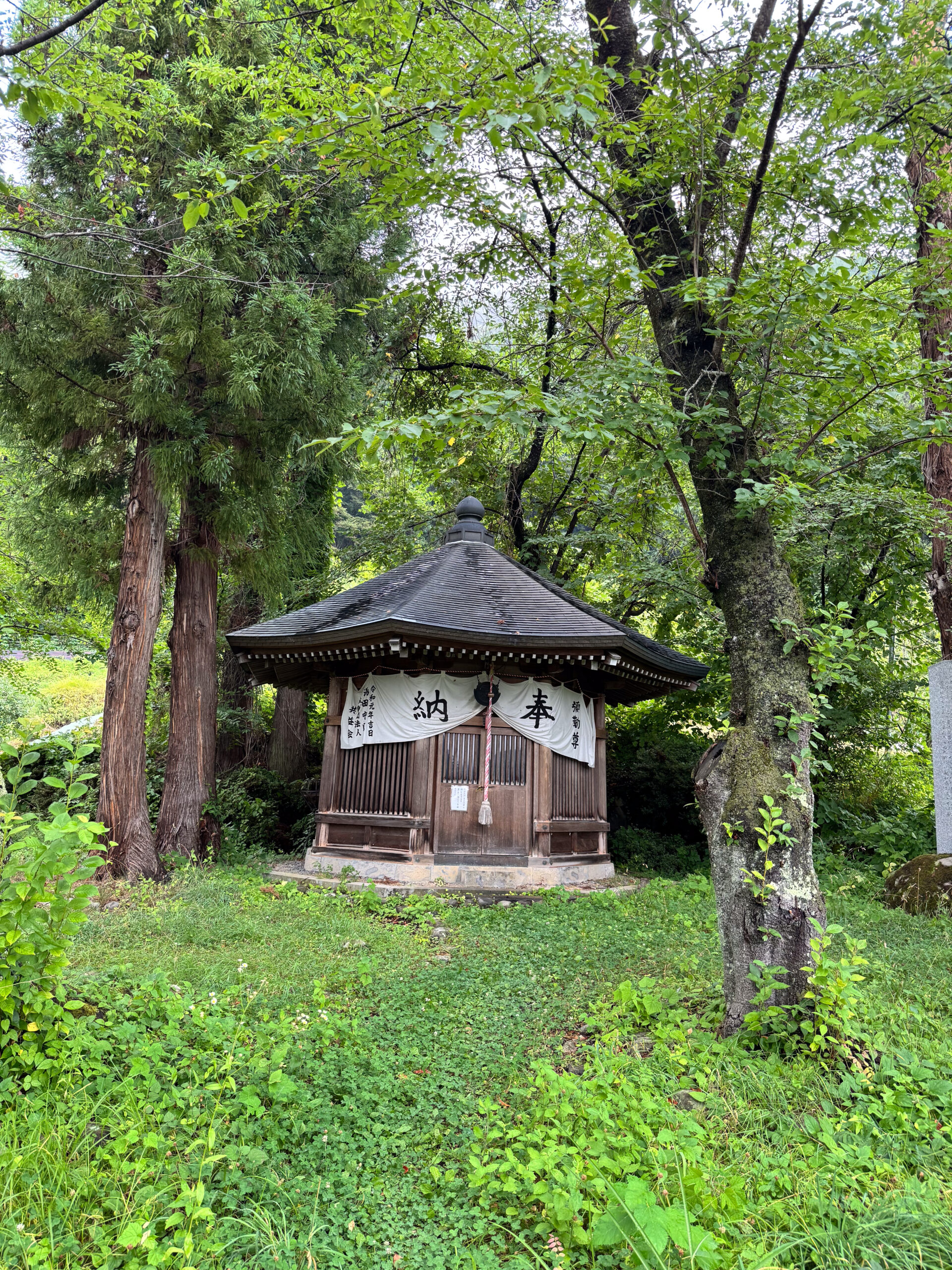
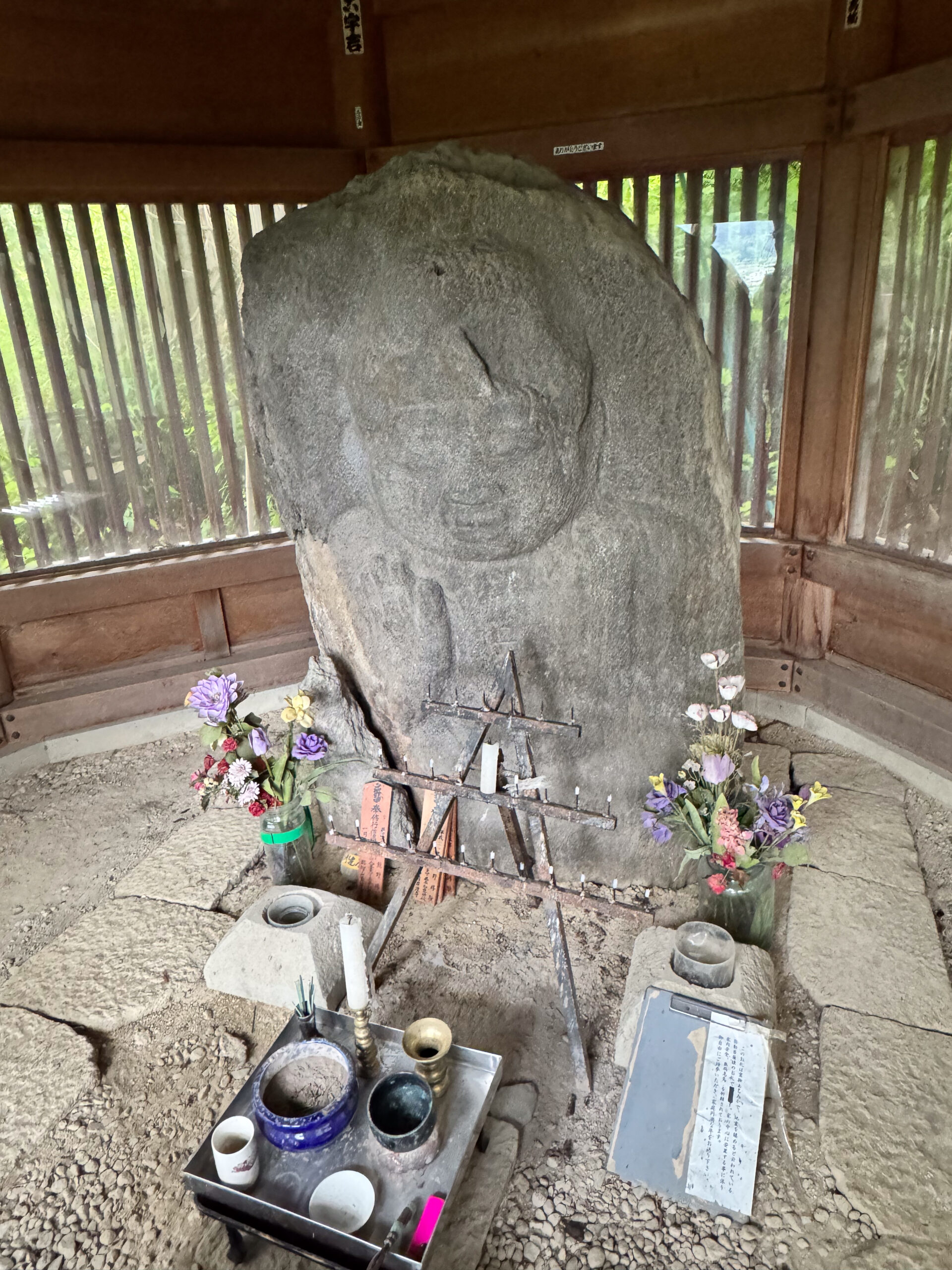
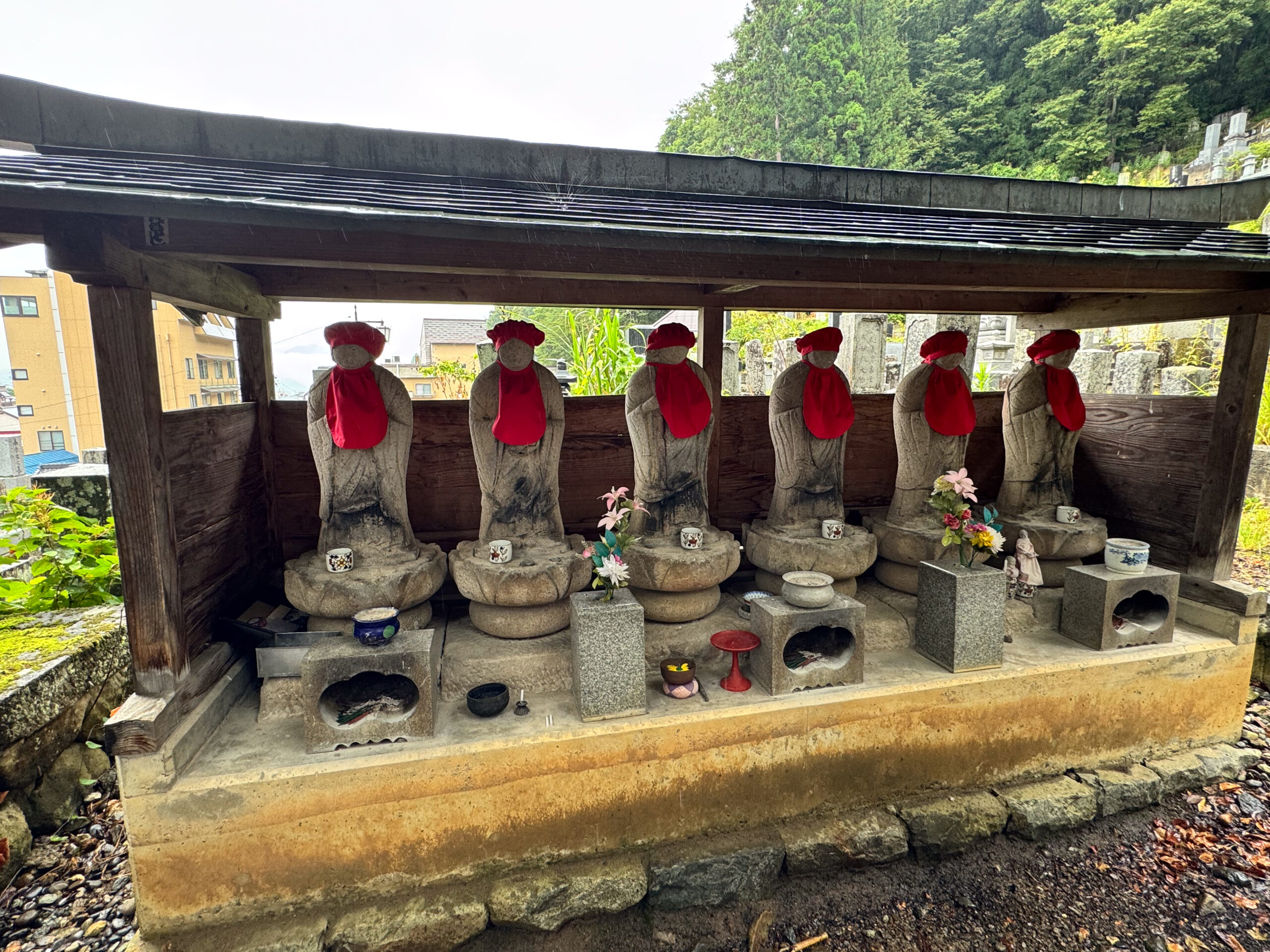
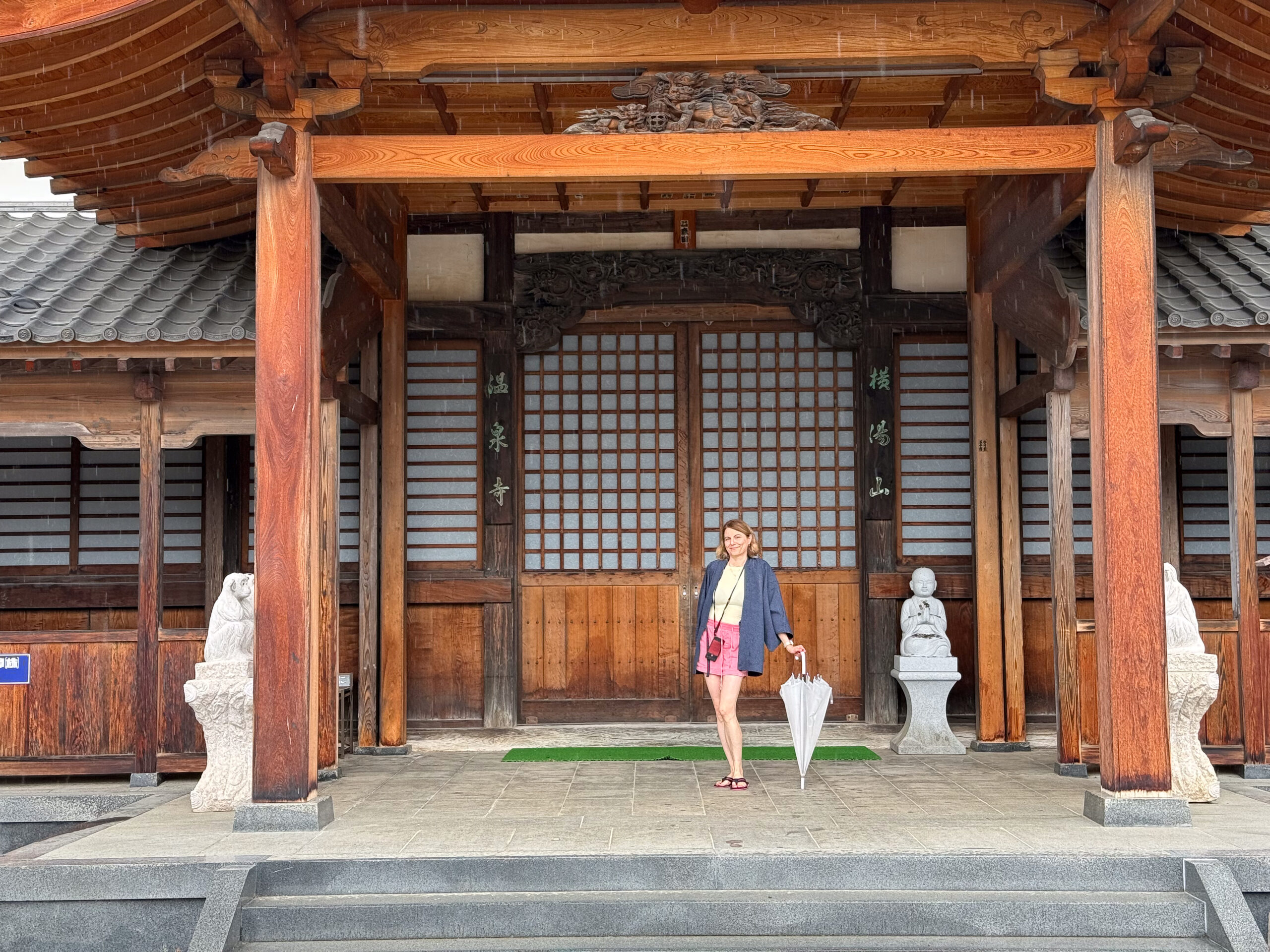
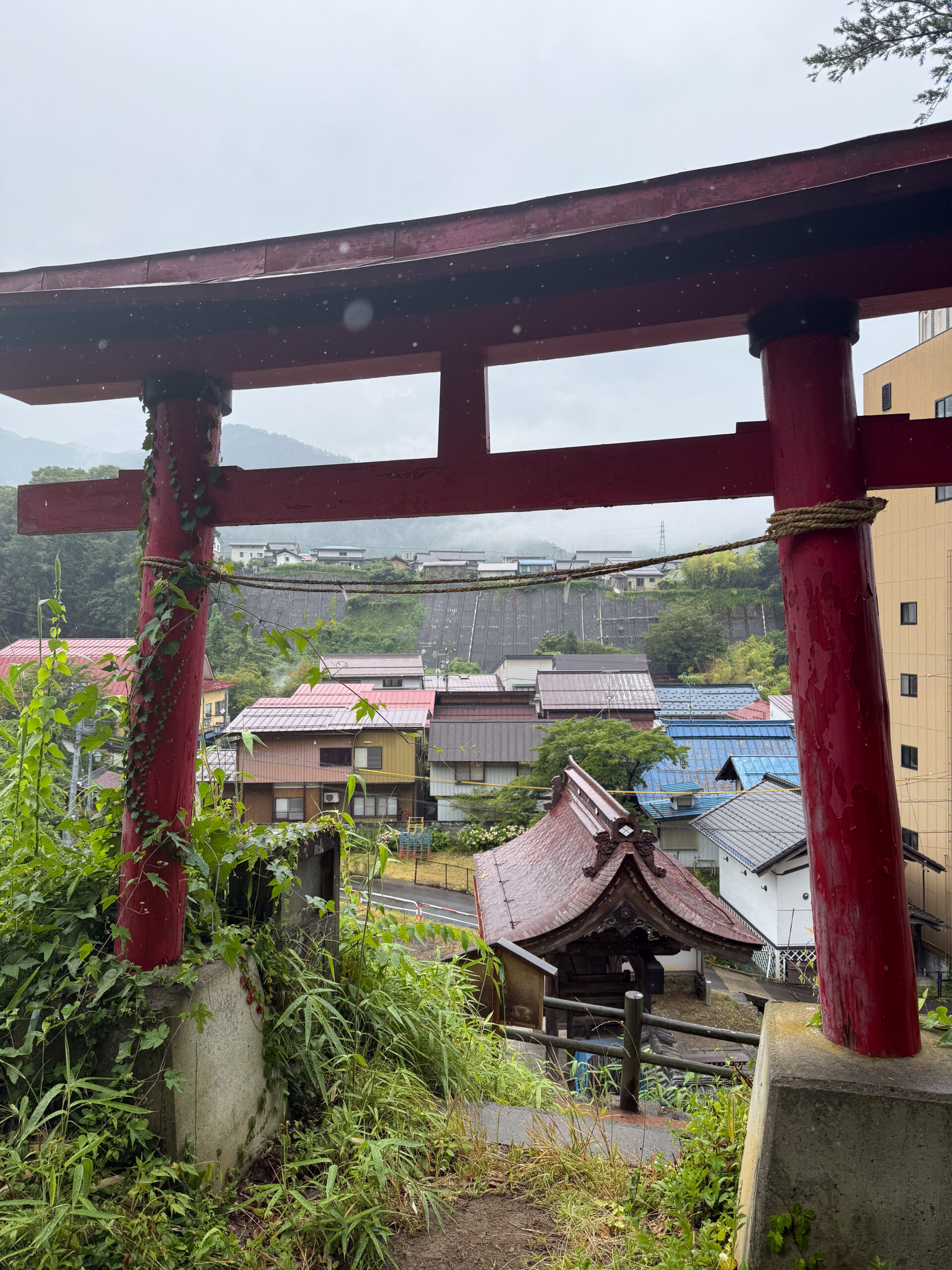
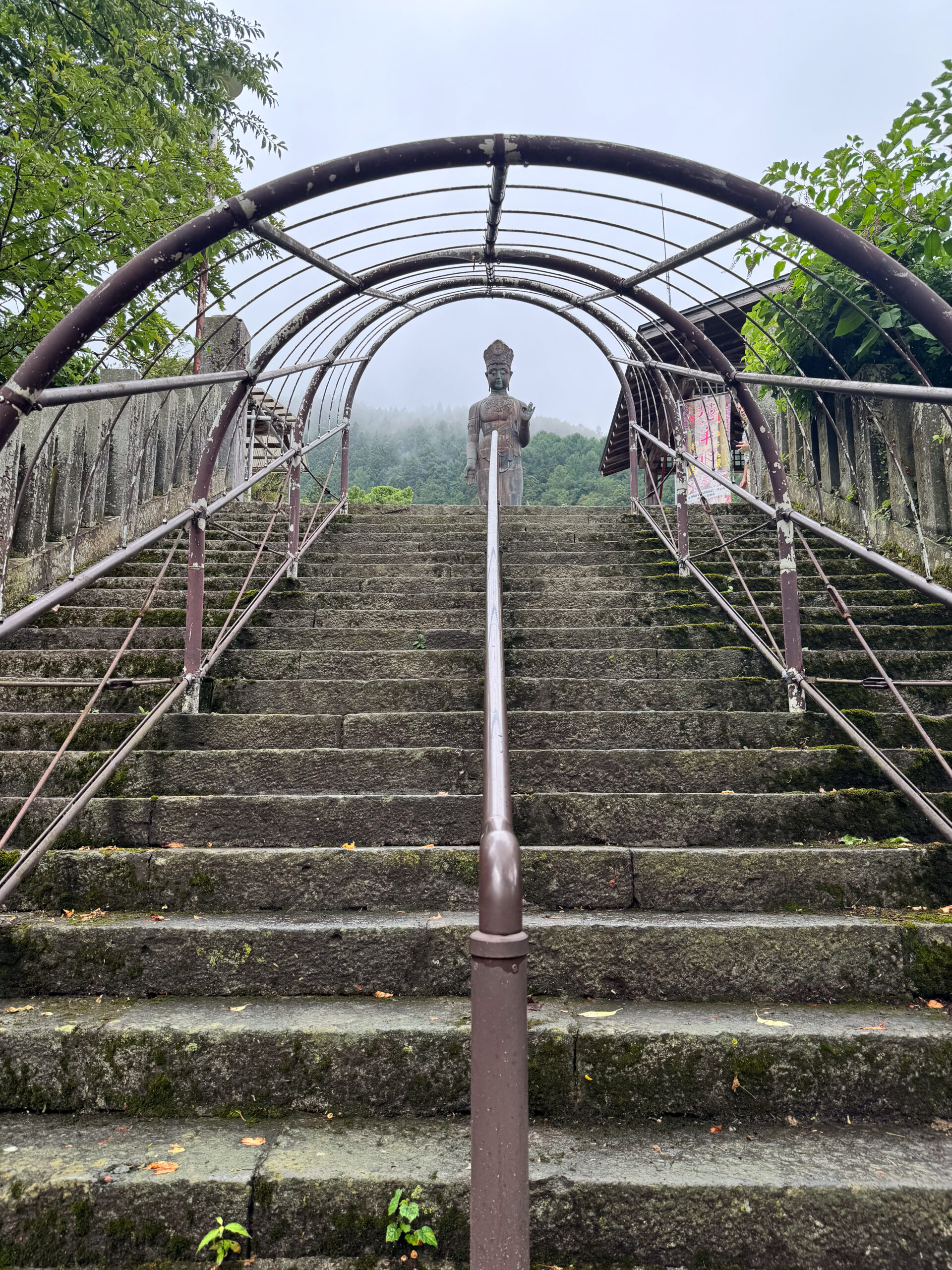
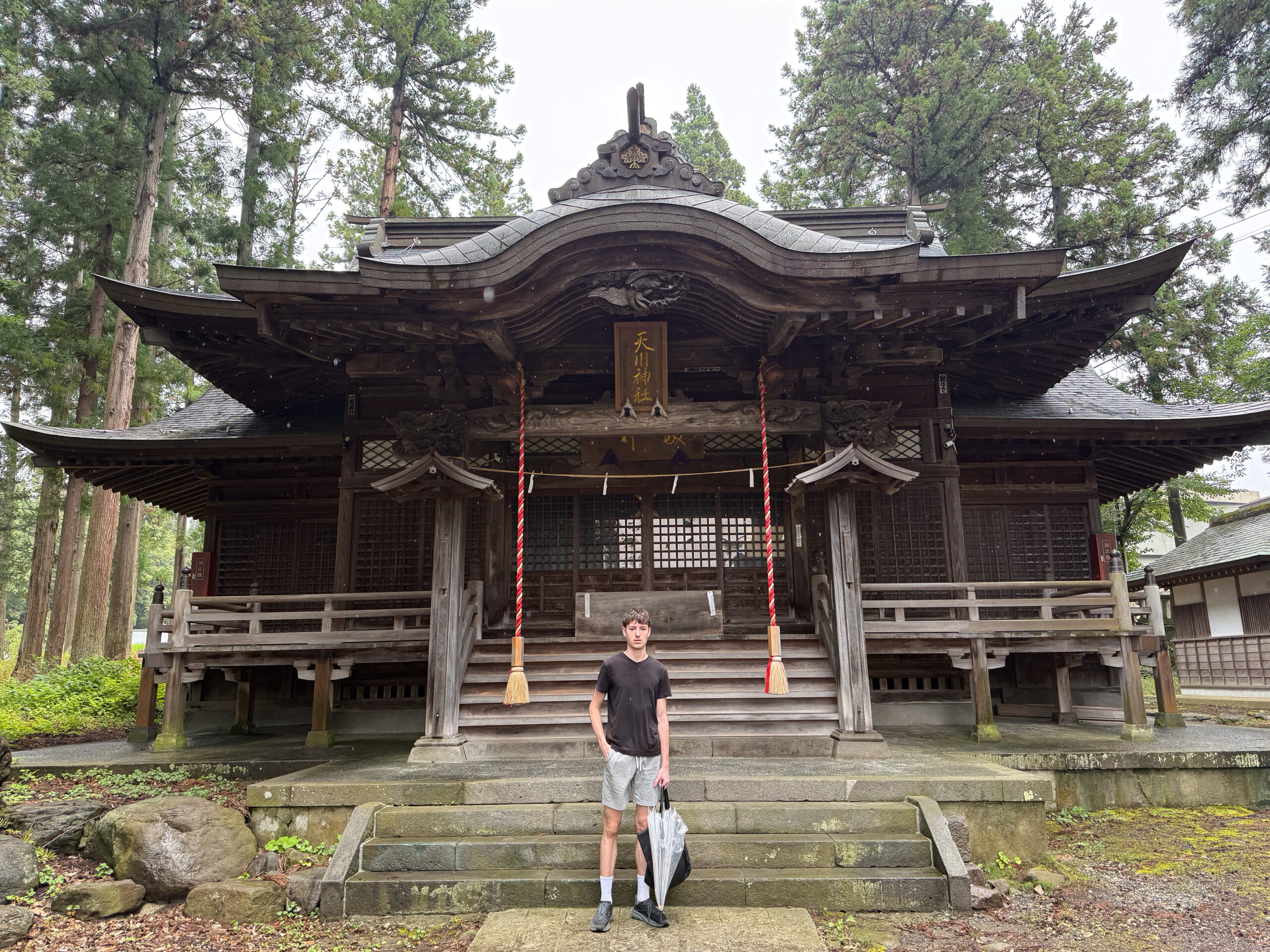
We walked to the opposite end of the village and found a massive 25-meter statue of the Buddhist Goddess of Mercy, Kannon, which was erected in the 60s as an appeal for world peace (partly following the tragic events in Hiroshima and Nagasaki at the end of WWII). Actually, there are quite a few even larger statues of this goddess in Japan (the biggest one, standing at 100 meters, is in the city of Sendai). Not far from Kannon, inside a small Shinto shrine, sat a very ancient stone statue of the Buddha of the Future. A lock was installed on the outside of the shrine—specifically to keep the monkeys from breaking in! Just a couple of minutes’ walk down the slope is Tabako Jizo, a small stone statue of the patron deity of travelers and the suffering. This altar was created for pilgrims who came to heal at the hot springs but couldn’t overcome their tobacco addiction. To this day, smokers from all over Japan come here to leave their last pack of cigarettes for the deity and ask for the strength to quit, or they light and leave a cigarette at its base as a “treat” in exchange for lung protection and longevity.
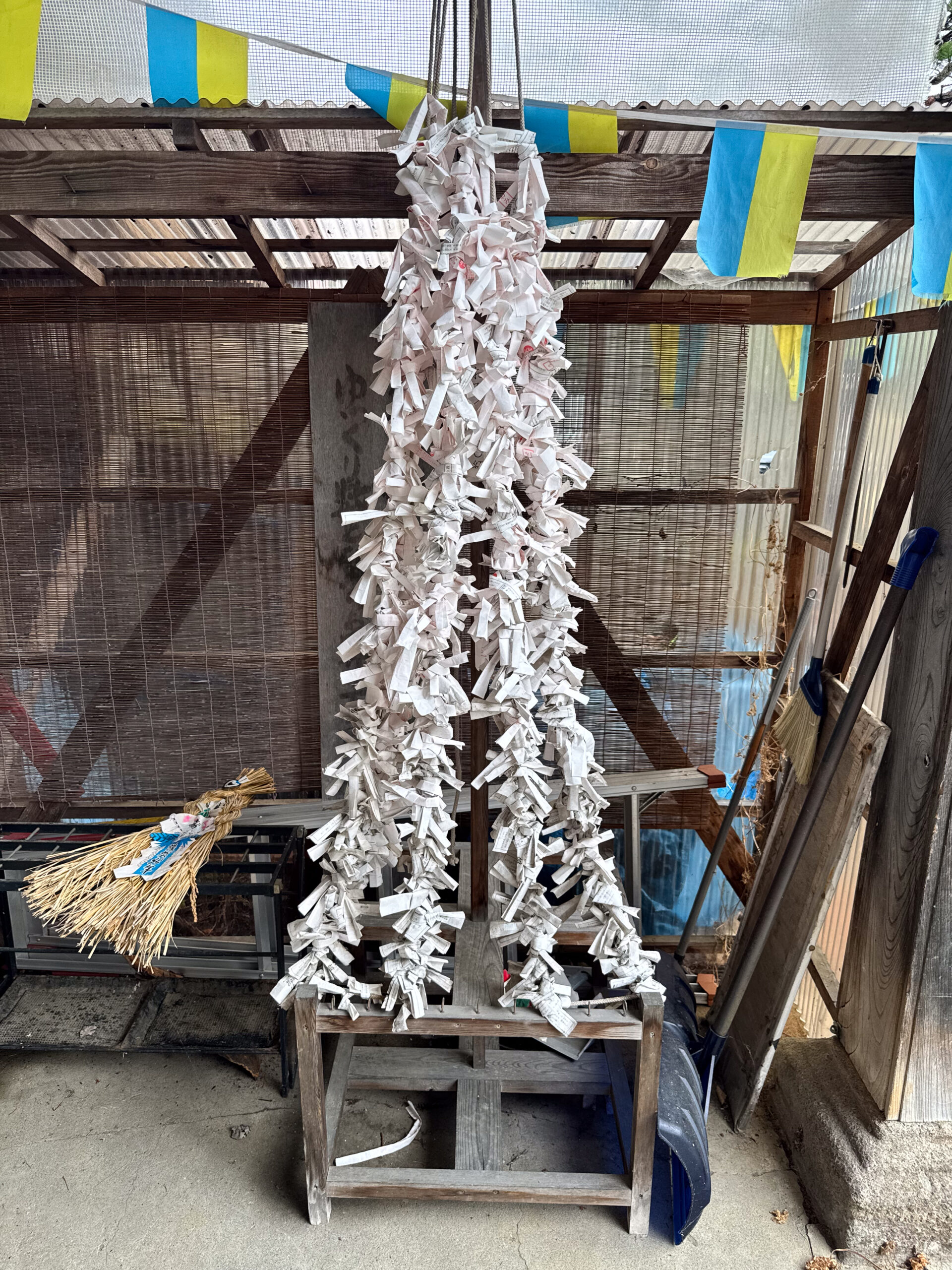
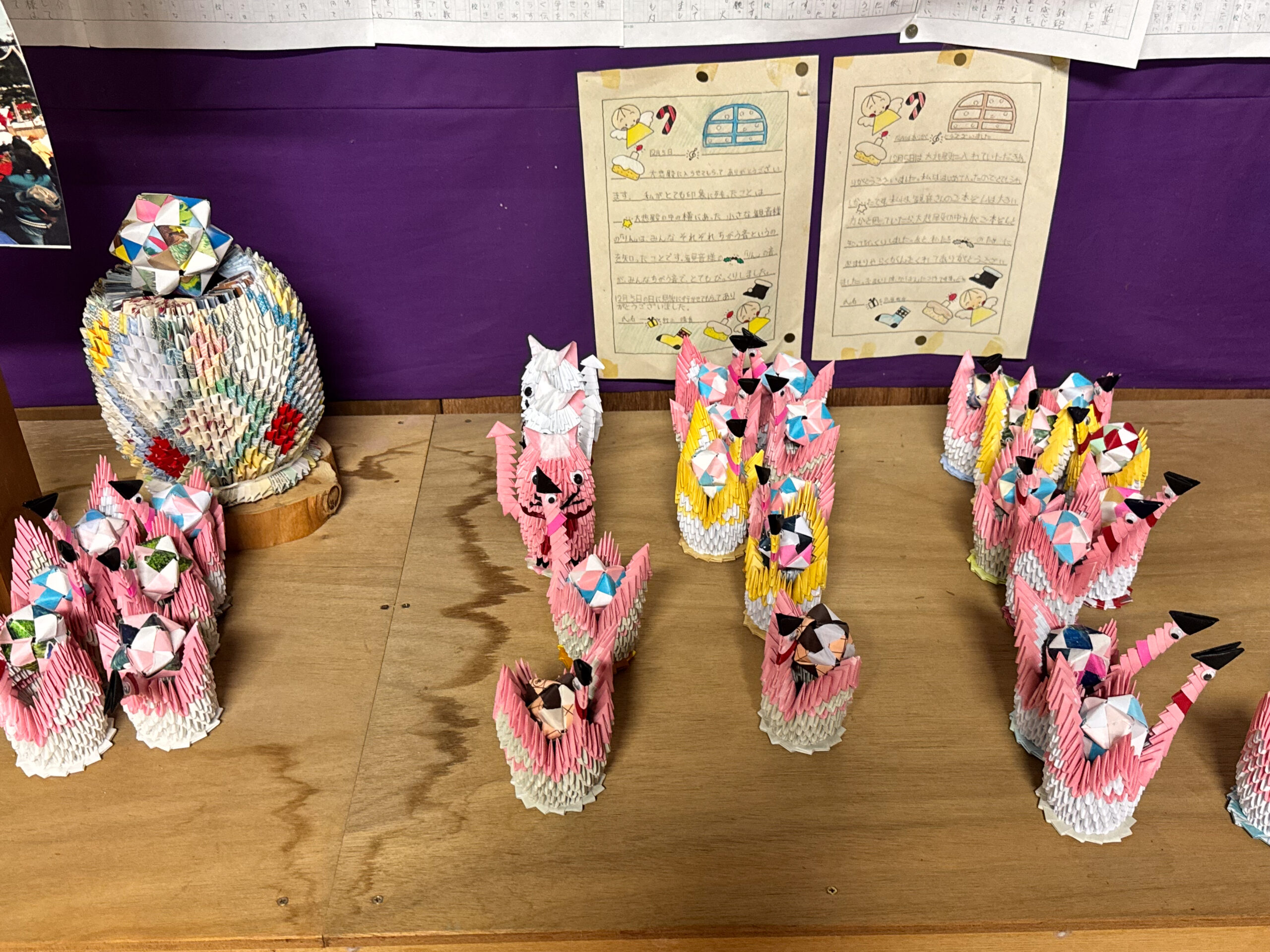
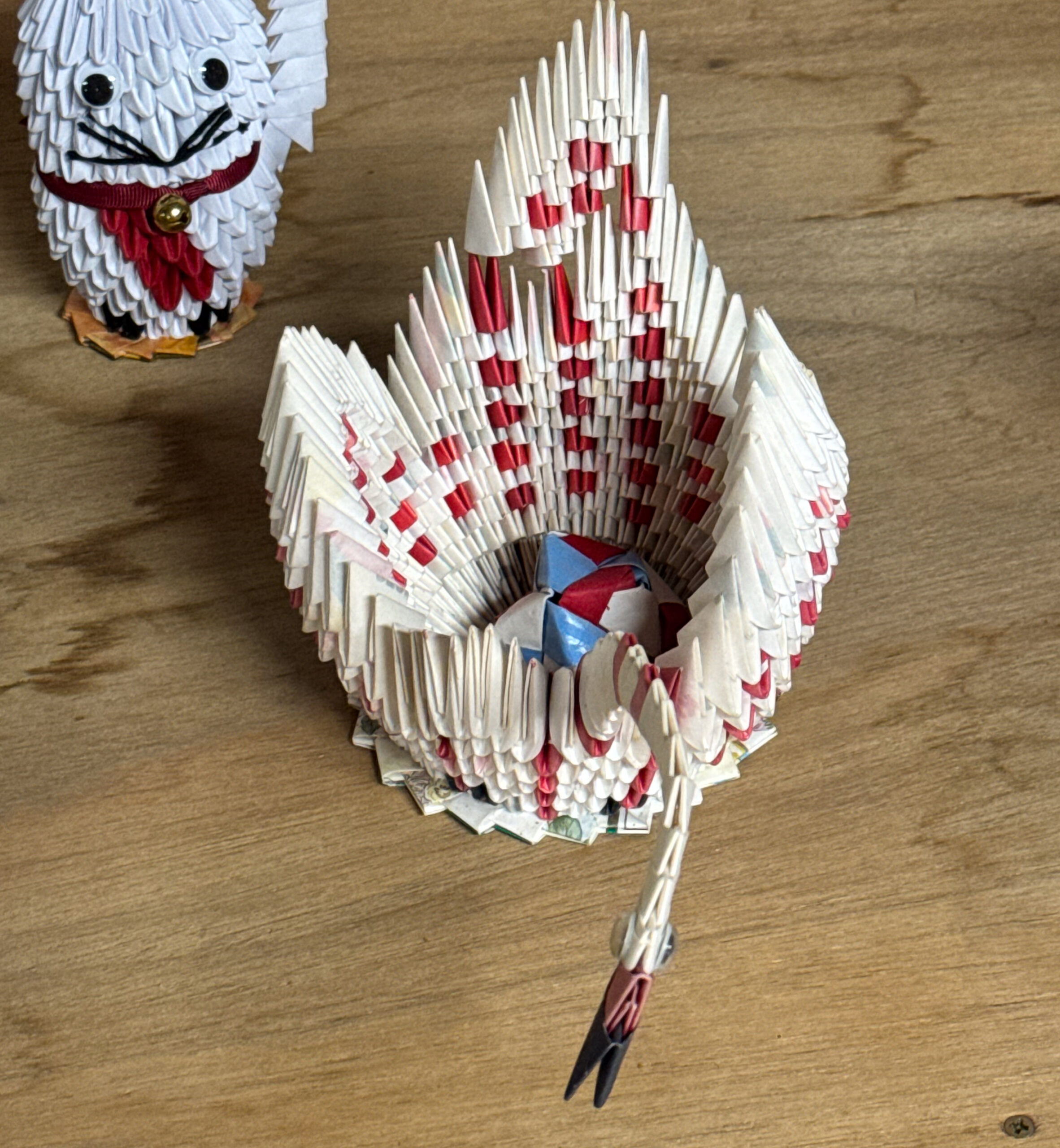
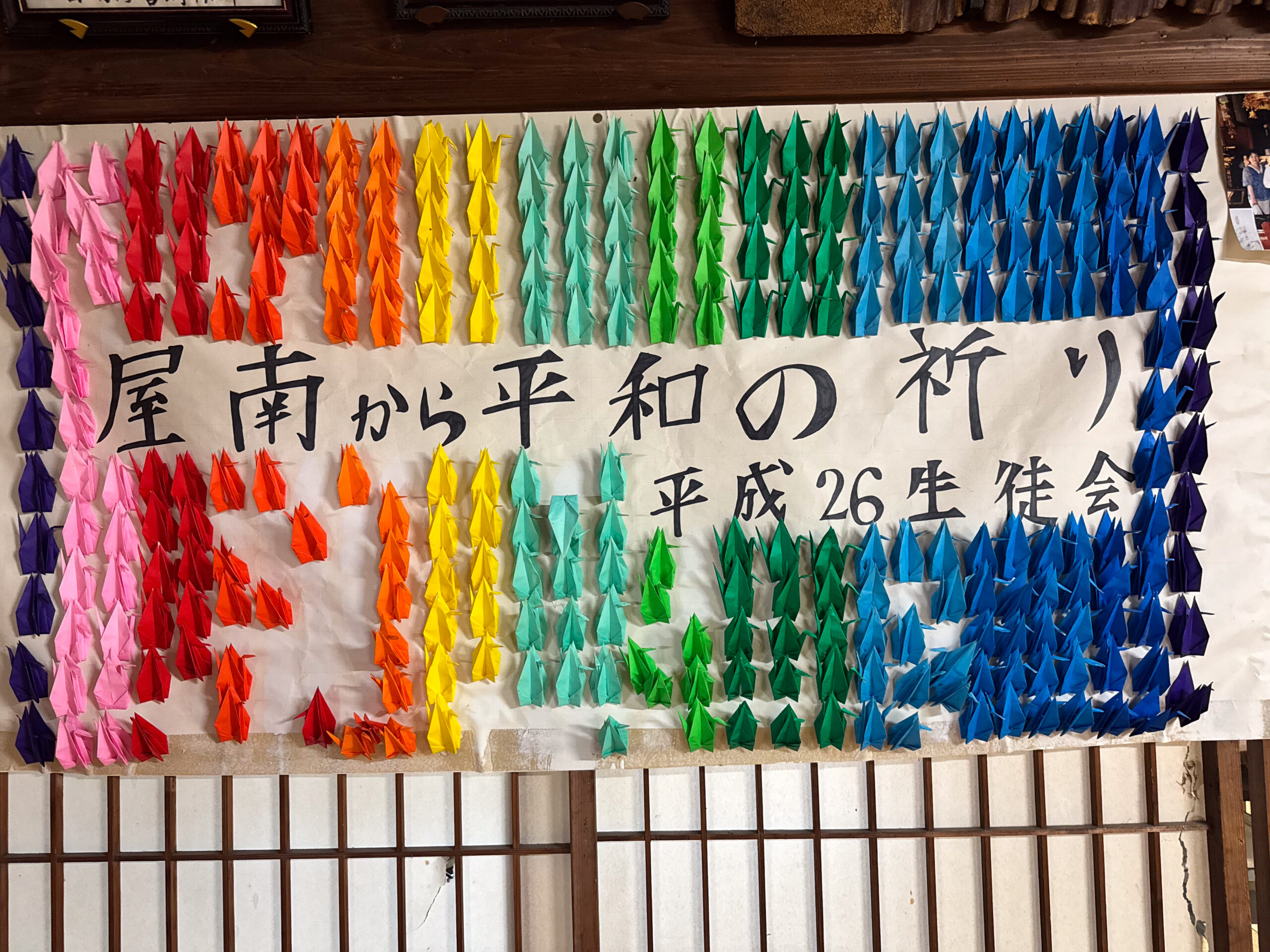
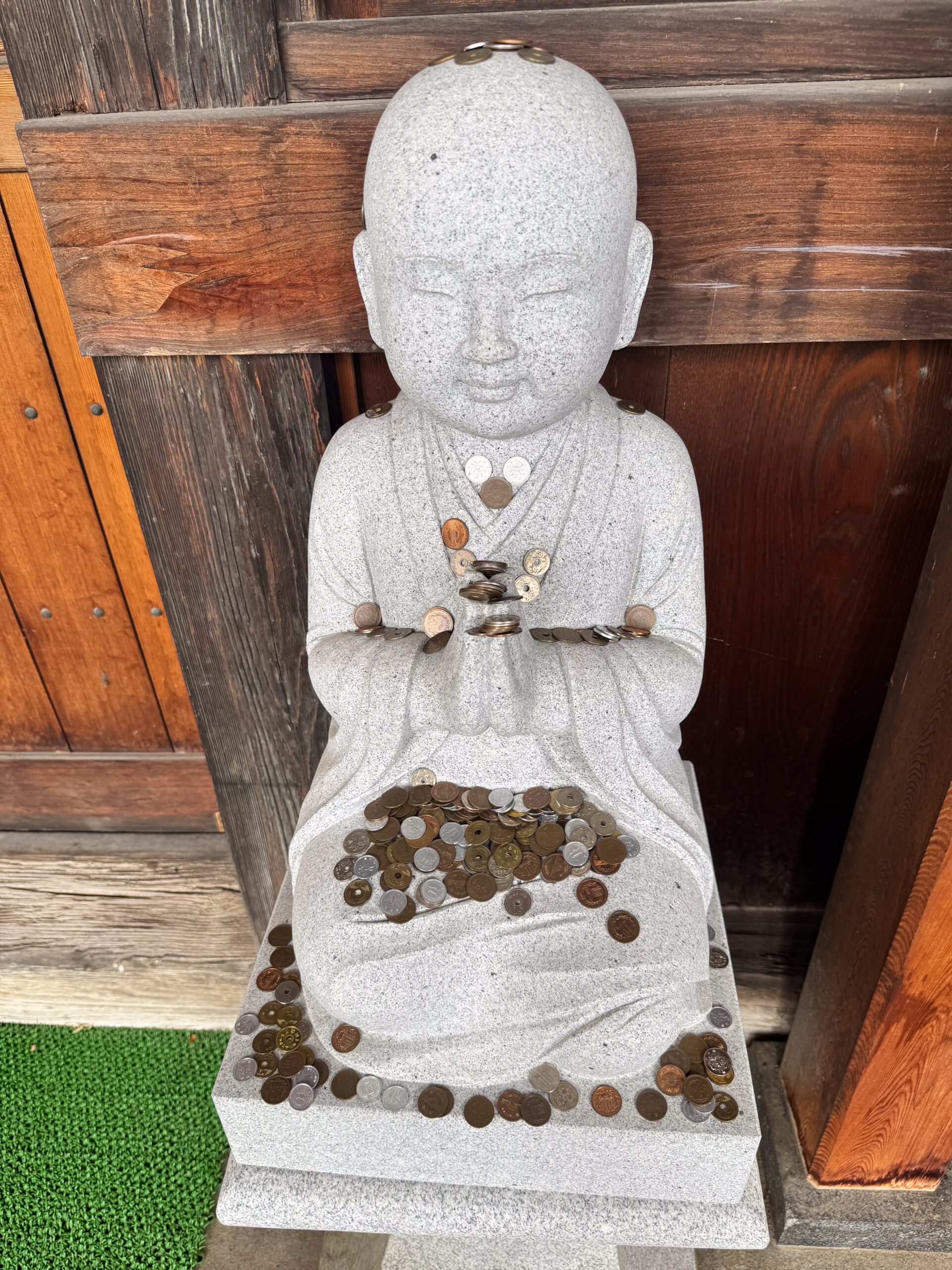
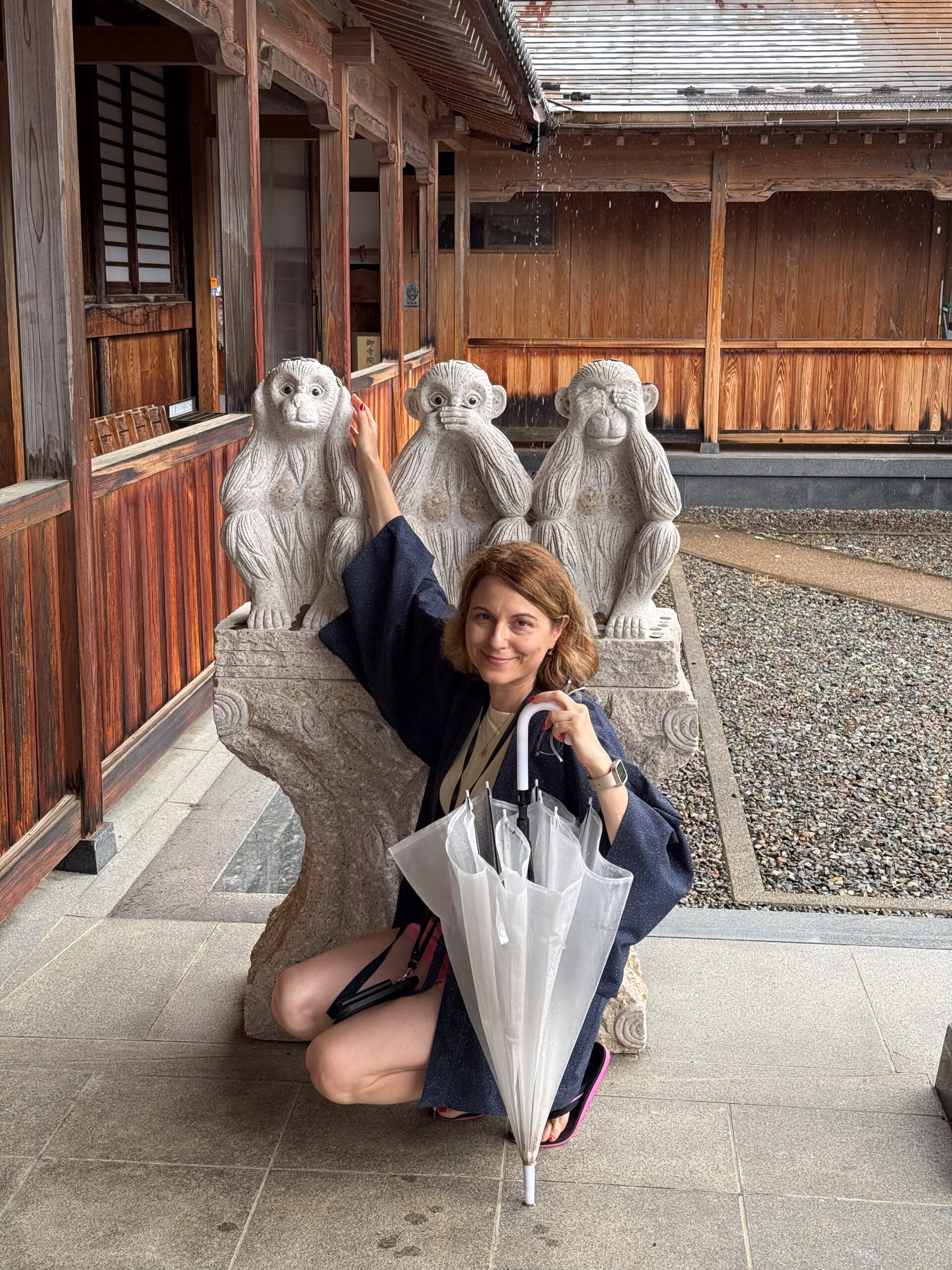
In Japan, Shintoism and Buddhism have existed for centuries not as competing religions, but as a single syncretic system called Shinbutsu-shugo, where ancient Japanese deities (kami) were considered local earthly incarnations of Buddhas. This deep religious synthesis still defines the everyday lives of Japanese people, who traditionally celebrate births and weddings with Shinto rituals, while funerals and memorial services are held in Buddhist temples. Despite an official state decree to separate the religions in 1868, their architecture and rituals remain inextricably intertwined: on the grounds of a single complex, you will almost always find both Shinto torii gates and Buddhist pagodas, and the Japanese themselves often pray at both Shinto shrines and Buddhist temples without making strict distinctions between them. Inside the Buddhist temple, we saw beautiful origami and paper fortunes called omikuji. Few people know that the art of paper folding actually originated as a temple ritual: the figures were initially created by monks to decorate altars and make offerings to the gods. Today in Japanese temples, you can often find garlands of a thousand brightly colored paper cranes (senbazuru), which Japanese people painstakingly fold and bring here as a sincere prayer for the recovery of a loved one or the fulfillment of a cherished wish. The legend of the thousand cranes is connected to Sadako Sasaki, a little girl who was two years old when she survived the atomic bombing in Hiroshima and later developed leukemia. While in the hospital, she remembered an old Japanese belief: the gods will grant a wish to anyone who folds a thousand paper cranes (senbazuru). Dreaming of recovery, Sadako diligently made the birds out of any paper scraps she could find, but she only managed to finish 644 before her death in 1955. Her friends folded the remaining cranes, and ever since, these origami figures have become Japan’s main symbol of hope, healing, and prayers for world peace. Right next to the origami, we also saw traditional omikuji scrolls; if you draw bad luck, you carefully tie the paper to a tree branch or a special stand to leave the misfortune behind under the protection of higher powers. Pilgrims also frequently leave coins on religious statues as offerings (osaisen) for granted wishes or safe travels, trying to carefully balance them on the head or shoulders of the statue: according to belief, if the coin stays put and doesn’t fall, the requested wish will definitely come true. In stark contrast to the cozy temples in the valleys, the Shinto shrines in this village were hidden at the very tops of the hills, so you always had to climb steep, moss-covered stone stairs, braving a tough ascent just to meet the mountain spirits.

From Burnout to Breakthrough: Why I Decided to Start Learn & Beyond

Don't Have Time to Read This Blog Post?

Listen to the podcast (duration - 19min)

Start listening

In 2018, I wrote a blog article about my job at a large software company where I worked as a marketing automation manager for a few years. I was encouraged to write it by a psychologist, who recommended I document my experience to help recover from the stress I felt after being unexpectedly let go from the company.

This was my first job in marketing automation. Before that, I was a marketing manager at a small private company selling internet services. When I started this job I entered a completely new world—working in a large organization, learning new technologies, making new friends.

Things were good until the company got a new boss who wanted to “restructure.” People started quitting on their own, and others were let go. I wasn’t ready to give up. I worked hard, as I always do. I made friends, built relationships, and genuinely loved my job. I didn’t want to leave.

One day, my boss scheduled a casual “touch base” meeting. But when I showed up, he led me to a room at the end of the building where the HR manager was already waiting. It was a shock. That’s how they let me go—telling me my position was eliminated. I was asked to gather my things and was sent home in a cab.

It was devastating.

It wasn’t just a job to me—it was my second home. I was emotionally invested, passionate about what I did, and it felt like they’d just cut off a part of me. I had to take a few sessions with a psychologist to deal with the emotional stress.

Eventually, I found another job. It was different—new people, a different culture—but I adjusted. Then I found another job, and another. Today, I’m in my fifth or sixth position since then, working as Director of Marketing Operations.

This current job started off great. It was right after COVID, and demand for IT and workplace consulting services was booming. The company was growing fast and hiring rapidly. I started with one direct report, built a strong team, and felt like we were really making an impact.

But at some point, things slowed down. Revenue growth stalled, and the company began to downsize. I had to let someone on my team go—ironically, putting me on the other side of the table from where I was years ago. It didn’t feel good.

One teammate was moved to a different department, and another recently resigned after finding a better offer. That left me with just two team members and the same amount of work as before. I was not only managing the team—I was back to doing the work myself. The stress became overwhelming.

To make things more complicated, the company brought in new leadership and decided to move our team to a different department. Our mid-year reviews reflected some of the tensions with stakeholders. I realized that growing my career further might come at a cost I wasn’t willing to pay.

I didn’t want to work 12-hour days anymore. I wanted work-life balance. I wanted to shut off at 5 p.m. and have a life outside of work. But that was hard to achieve with the workload and stress.

I began looking for new opportunities but quickly saw how much the job market had changed. Every job posting I applied to had hundreds of applicants. Competition was intense, and employers had become incredibly selective—looking for the perfect match in skills, culture, and communication. Even getting interviews was tough.

At the moment I am trying to build the relationship with my new boss. She is smart, demanding, and extremely organized. I want to learn from her — not just professionally, but personally. She seems to have structure in every part of her life, and still makes time to enjoy her family, stay healthy, and have fun. That’s something I admire.

I’ve realized that I don’t want to sacrifice my physical or mental health for professional success. I want both. I want to achieve my career goals, but also prioritize my personal well-being.

Recently, I started listening to audiobooks again—something I hadn’t done in years. One that really resonated with me was The Let Them Theory by Mel Robbins. It gave me a new perspective on how to handle stress and emotional overwhelm, especially in high-pressure work environments. I’ll share some of the lessons I learned from that book in a future post, because I think they’re helpful not just for people in my situation, but for anyone struggling to find balance in life.

The Birth of Learn & Beyond

Around the same time, I had a realization. Maybe this chapter of my life isn’t about climbing higher in someone else’s company. Maybe it’s time to build something of my own.

I’ve accumulated so much knowledge over the years—marketing, digital tools, web design, video editing, social media strategy, copywriting, and audience engagement. Why not share it? Why not teach others what I’ve learned?
That’s how the idea for Learn & Beyond was born.

At first, I imagined it as an online school for professionals like myself—people starting their careers in marketing or looking to upskill. But the more I thought about it, the more I realized this could be something bigger.

To me, Learn & Beyond isn’t just an online course platform. It’s a community—a network for people of all ages and backgrounds. Starting from school kids like my son Andrew and his friend Egor who are already learning how to create videos and animations. Then there are marketing students or recent grad who need practical experience. And finally, there are small business owners—friends of mine—who want to grow their businesses but don’t have resources or don’t know where to start.

What if Learn & Beyond could help?

What if it could become a place where people gain real experience by working on real projects? Where students and aspiring marketers help small businesses build websites, promote them on social media, build their email marketing campaigns. What if the platform not only teaches skills—but builds portfolios and confidence?

I want to connect the dots: students who want to learn, and small businesses that need affordable help. It’s a win-win. Students gain experience, and businesses get support they couldn’t otherwise afford. It might start as a side project, maybe even a pro bono effort, but the impact could be huge. Imagine saying, “I helped promote this local wellness clinic” or “I built the website for a family-run catering service” — those stories mean something. They make your resume stand out, and your heart feel full.

Learn & Beyond for Your Career and Business

Learn & Beyond can give young professionals a way to gain real experience—especially those just starting their careers, who feel stuck because they don’t have the right job title or bullet points on a resume.
Right now, the job market is incredibly competitive. Employers aren’t just looking for degrees—they want portfolios, hands-on experience, and proof that you can deliver results. But how do you build experience when no one gives you a chance?

That’s where Learn & Beyond comes in.

Whether you’re a recent graduate, someone changing careers, or a stay-at-home parent looking to reenter the workforce, you can become a part of this community and start creating. You’ll work on real-life projects with real businesses, develop your skills, and build a portfolio that reflects what you’re truly capable of.

It’s not just about checking boxes — it’s about confidence. About seeing yourself not just as a job title, but as someone who has value, creativity, and a story to tell.

And for small businesses, Learn & Beyond could be a lifeline. I know so many small business owners who are doing amazing things—but they’re struggling to grow because they can’t afford marketing help. Professional agencies charge thousands of dollars, and DIY-ing a website or promotion while juggling everything else is overwhelming.

Through Learn & Beyond, I want to match these businesses with learners who can help them grow. It’s not about working for free—it’s about collaboration, purpose, and mutual benefit. A business gets much-needed support, and the learner gets experience, confidence, and a real-world success story.

Eventually, this could evolve into something even bigger — a network of people helping each other, building real connections, and using digital tools to change their lives.

And maybe, just maybe, it’ll become a little movement. A reminder that you don’t have to be a “guru” or an “influencer” to share your knowledge, build something meaningful, or help someone else succeed. You just have to start. You just have to care.

Learn & Beyond for My Friends and Lasting Memories

Another dream I have for Learn & Beyond is to use it as a way to reconnect—with my friends, and with the community I used to be a part of more actively.

Over the years, many of us become what I now call “remote friends.” We care about each other deeply, but we don’t see each other often. Life got busy—jobs, families, health issues, responsibilities. And of course, the pandemic changed everything. It altered how we connect. We used to visit each other’s homes, have parties, and celebrate birthdays together. Now, it’s rare to even get a text or photo.

I miss those connections.

Learn & Beyond could be a way to bridge that gap—not just with students or business owners, but with my friends. I want to inspire them to create and share again. To write something. Record a short video. Take meaningful photos—not for Instagram likes, but for real connection.

I know some of my friends will say, “That’s not me,” or “I’m not a writer,” or “I’m not into video editing.” But I believe Learn & Beyond is for everyone—not just creative or tech-savvy people. It’s for anyone who wants to stay connected and share their life moments. We don’t need to “perform” for social media. We just need to stay present in each other’s lives, even if we’re not physically together.

Social media, as we know it, doesn’t quite fill that role anymore. Platforms like Facebook and Instagram often feel curated—highlight reels of vacations, achievements, or polished moments. That’s fine, but it’s not real life. Real life is messy, beautiful, surprising, and worth sharing, even in its simplest form.

I want to use Learn & Beyond to encourage you, my friends, to capture and share memories—not for followers, but for each other. Let’s exchange photos and videos so we can stay connected and know what’s going on in each other’s lives.

Even if we don’t have time to meet in person, this can be our way of staying close. We can share glimpses of our everyday moments, swap ideas, collaborate on creative projects, or simply check in. To me, that would mean a lot. And maybe—just maybe—we’ll feel a little more seen, a little more supported, and a little more inspired.

In today’s world, everything feels temporary. We’re constantly consuming, whether it’s products, food, or social media content that’s here one minute and forgotten the next. We rarely pause to create something with lasting value, something that future generations might treasure.

One of the core visions behind Learn & Beyond is to encourage people to create meaningful memories, share their unique stories with friends, and preserve them for future generations.

When I was a child, my parents had a big, bulky photo album filled with pictures from my early years. Later, as a teenager and young adult, I made my own albums with printed photos. I still have them today—and they’re some of my most treasured keepsakes.

But now that everything is digital, our memories are scattered—some on our computer hard drive, others on Google Photos or buried in social media feeds. My dad used to develop black-and-white photos himself, in a darkroom under a special lamp. Then came Kodak film rolls and photo print shops. Those old photos feel so special, don’t they? Ever wonder why? Because they took time and effort to create.

Today, snapping a photo takes a second, and most of them end up online—or hidden away on our phones and drives. Will our kids keep those photos and videos? Will they look through them with their own children the way we look through our family albums? Honestly, I’m not sure.

Unless, as families, we become part of something like Learn & Beyond—a place where we intentionally create meaningful photos and videos together. Memories that truly matter. Moments our kids will want to keep, revisit, and pass on.

And the best thing is you don’t need to be a professional creator to build lasting memories.

***

So here it is: Learn & Beyond—a digital space for creating, connecting, and growing together. A place to find your voice, sharpen your skills, support your community, and remember what lights you up.
Let’s make something that matters. Let’s build something of our own.

Join the Learn & Beyond Journey

If any part of my story resonates with you—if you’ve ever felt stuck, creatively unfulfilled, or simply longed for more meaningful connections… if you’ve ever wanted to leave something memorable for your family, your kids, or future generations—I invite you to be part of Learn & Beyond.

To help shape this vision, I’d love to hear from you. Whether you’re interested in learning new skills, sharing your expertise, or just staying connected, your input is invaluable.

Here’s how you can get involved:

1. Follow our journey
This idea sounds exciting, but you’re not quite ready to commit yet — you have too much going on in your life. That’s okay! You can still follow our progress. Sign up for our newsletter to stay updated on new blog posts, podcast episodes, and project highlights. It’s the easiest way to stay engaged with Learn & Beyond.

2. Learn new skills
You’re ready to master digital content creation or digital marketing, and you need these skills for your career or business. Visit our website to explore the courses we’ll be launching soon, and sign up for a free class on any topic that interests you — no obligation.

3. Sign up your child
You’d like your children to learn some of the digital skills we offer. Browse our lessons for kids and sign them up for a free class to see if it’s a good fit.

4. Become an instructor
If you already have experience in digital marketing, content creation, or any other skill you’d love to teach, we’d be thrilled to have you join us as an instructor. Since Learn & Beyond is still in its early stages, we can’t guarantee immediate compensation. However, as we grow our network and bring in more students, future compensation will absolutely be possible. We value your time and contribution deeply and will work with you to ensure your efforts are recognized and rewarded as the community expands.

5. Promote your business
Are you are a small business owner who wants to gain new clients by growing your online presence but not sure where to get resource or how to start? Join Learn & Beyond to either learn online marketing yourself—through easy-to-follow, practical lessons—or get help from our trained students who are looking to build real-world experience by supporting small businesses like yours.

You’ll be able to choose the path that fits you best: learn and do it yourself, or collaborate with emerging talent eager to help you grow.

6. Join our Beyond Generations network
Become part of our private Beyond Generations community — a creative space for families and kids to share photo galleries, videos, blog posts, poems, artwork, kids’ creations, and any other meaningful pieces of life and imagination.

To join, you’ll need to create an account, as this is a private network designed to protect the privacy and creativity of our members. I’m currently looking for help from a few programmer friends to build a secure website, so the project is still in development.

***

When you sign up for any of the above, you’ll be asked to complete a short survey to help us learn more about your interests and how you’d like to participate in Learn & Beyond.

Your feedback will help shape the future of this project and build a community that grows together.

Thank you for being here, for reading, and for being part of this journey. Let’s create something beautiful together. 

My gentleman and Best Friend

When I was a child I was afraid of dogs. I thought they were dangerous predators.  Dogs that barked loud scared me the most. Especially because my mom was attacked by dogs. First time it happened when she was 4. She told me she was bitten by a homeless dog and she had to get a shot. When my mom was in her 60s, she was attacked by a German Shepherd who escaped from his backyard through a hole in the fence, when she was walking by. 

Luckily, I had an opportunity to meet very wonderful dogs who changed my perspective on dogs. 

The first one was a labradoodle who belonged to my boss. I met him when the boss invited our entire team to his house for a potluck dinner. His dog was incredibly  sweet. He didn’t bark at all, and he liked to lean on people, like a big soft pillow. He was also an excellent photo model.

Another dog who impressed m belonged to our dance costumes tailor. She had two little girls, and I had no idea what breed they were. They knew how to dance on hind legs (probably after seeing too many dancers who ordered costumes from their mom) and were clearly attention seekers. One of them had big sad eyes filled with so much emotion and love, that I immediately realized that I need to  have my own dog.

Meanwhile my older son was begging me to get a dog.

Most of our friends tried to persuade me that it was a bad idea. They said I would end up walking this the dog all by myself. And that the dog would keep me very busy. They were right!

Initially, we sought a shelter puppy but ended up buying one from a local classifieds site. Unfortunately, the puppy became ill with parvovirus, and the breeder took him back, refunding us.

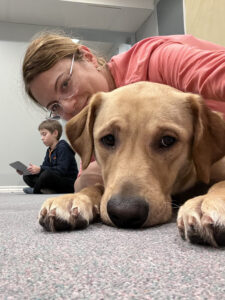
A few months later, through a friend, we found Archie, a golden Labrador retriever. Archie had a rough start, getting car sick on the way home, but we quickly fell in love. Despite the challenges, he became part of our family.

Now, almost two years old, Archie is an essential part of our lives. He goes to a “dog camp” when we’re away, and the joy he shows upon our return is unmatched. His loyalty, warmth, and humor make every day better. He’s a gentleman—offering subtle signs of affection like gently licking my leg or resting his head on my lap when he wants a treat.

Archie’s thoughts seem easy to read:

  • “Why are you staring? Give me food!”
  • “You’re still at the computer? Time to nudge you!”
  • “Let’s walk! I need to sniff the ‘news’!”
  • “You took my slipper? That’s our game!”
  • “Oh, goat cheese? I’m here…”
  • “It’s time to sniff everything outside!”

Archie and I understand each other, even if we don’t speak the same language. He knows when I’m upset and lies quietly beside me, glancing in my direction. If I had to describe Archie in one word, it would be “gentleman.”

Though he has his quirks — chewing on shoes, pulling on the leash, or ignoring his ball — I never stay mad at him. His love, loyalty, and the comfort he brings me make every moment together a treasure.

Archie isn’t just a pet; he’s my therapy, my joy, and my best friend. Hugging him makes everything better, whether he’s aware of it or not. And for his mother — who feeds him, walks him, and shares his photos on social media — Archie will do anything.


8 часов в госпитале

Да уже столько я здесь сижу… все потому что у меня заболел бок. Я пошла в обычный walk-in clinic и мне сказали что есть подозрение на аппендицит и поэтому надо идти в госпиталь, чтоб там сразу сделали все тесты … я думала ну максимум часа четыре. Но я здесь уже больше семи часов. Уже сдала анализ мочи, два анализа крови и даже CTScan сделали, а мне все никак не скажут результаты. Прочем CTScan я сделала 3 часа назад. Час назад я хотела уйти и они сказали что если я уйду не дождавшись результатов то доктор не обязан мне назначать лечение … я просто смогу посмотреть результаты онлайн.. И если найдут аппендицит то придётся прийти снова .. Вообщем напугали. Здесь вообще у них все построено на системе запугивания.. Собственно ковид это тоже была система запугивания.. Вчера мы с мамой были у флеболога, и нас не пустили в офис без масок. Причем за масками пришлось идти вниз в аптеку и платить по 1 доллару за маску. Хороший бизнес!

Оказывается у них здесь один радиолог и он никак не пришлёт результаты моего CT Scan… Я уже попросила медсестер чтоб написали ему … И все это время нужно сидеть в маске.. Но я уже ее почти сняла. Пока я здесь сижу дописала одну статью в английской версии блога.. Пыталась читать книжку но не идет что-то. Я очень надеюсь что не придется здесь сидеть до самого утра.

My new job and what it’s like to work from home

I have been working from home for almost two years now. When the COVID pandemic started in March 2021, I worked for a small software company in Mississauga. The Ontario government closed schools, and we were trapped in the house with the kids..They had their classes on Zoom.. It was frustrating because there was always something wrong with the Zoom links. .. Every hour when children had recess, they made so much noise as if their entire class was in our house. They especially enjoyed distracting us during our work meetings. I was trying to find a quiet place in the house where I could focus. First, I tried to work in the basement, but it was freezing there. Then I tried to work in the bedroom, but I was falling asleep there. Finally, I settled in the family room near a big window overlooking our quiet street. That made me feel somewhat connected to the outside world. At some point, I joined online cardio sculpt classes and took them almost daily. This workout helped me stay in shape and not get depressed. This went on for about a year .. I knew we were not in the worst situation because we could work from home, and some people could not. Still, it was frustrating. I joined a Facebook group called “Kids belong to school”. There were many petitions and a lot of pressure on the government until the schools finally opened. Soon businesses reopened offices. By that time I already changed jobs, and my new office was in downtown Toronto. Those who live at the outskirts of GTA can imagine what it’s like to commute to downtown. During the rush hour, the commute can take up to 1.5hrs. Parking is never free and is not cheap. If you find a cheap parking, prepare to walk 10-15 minutes to your destination. The public transit is more suitable for people who can live on a schedule and don’t worry about sneezes and coughs in the crowd around them. (Thanks to COVID, I now get anxious anytime i hear someone sneeze or cough nearby)

I figured that commuting to downtown was not my thing so I became a 100% remote employee. Although, I do go to the office once in a while. Every trip to the office takes half a day planning and preparation. First, I have to decide what to wear. That’s always an issue because there is always nothing to wear.  Obviously, none of my colleagues would ever remember what I was wearing when I came to the office three months ago, but I still need to wear something “new”, just for my own sake!  I am so used to wearing leggings and hoodies (which is sort of my stay-at-home uniform) that putting on jeans or a skirt, or a dress is literally a torture.

Then, I need to put on the makeup and do my hair and that can take another 30-45 min depending on how creative I feel at the moment. Finally, I need to reserve parking on a parking app.. Finding parking in downtown has always been a pain, especially when I had to search for parking while driving on busy streets and watching out for pedestrians constantly emerging from nowhere and crossing intersections right in front of my nose. So this parking app called Spot Hero has really been a blessing! I can reserve a spot on the app just before my trip. It costs almost nothing, and I can rest assured the spot will be waiting for me by the time I arrive. I don’t even need to put a parking ticket in my car because my license plate is stored in the app and the parking owner will know it. The only problem with these reserved parking spots is that sometimes they are really hard to find (even though the app provides really good directions). When I used the app for the first time, I had to pull into a very narrow driveway next to a building, drive all the way to the back of the building, then drive to another lot that was adjacent to the back of the building. As you can imagine, I missed that narrow driveway, and since it was on a one-way street, I had to make a huge circle to come back and finally get to my parking spot. Well, next time, I chose a different parking lot and it was much easier to find.

One day i had to go to a walk-in dermatology clinic very early in the morning just before going to the office. The average wait time for a dermatologist appointment in Ontario is 3-6 months so this clinic is for people who can’t wait that long. But you need to get there really early in the morning because they see patients on a first come first served basis from 8 till 11am. I got there at 4:30am because I just couldn’t sleep that night and was the first in the line.. The person after me was a man who arrived around 6am. He drove 4 hours straight from North Bay because apparently a wait time for a dermatologist in North Bay is 1.5 years…

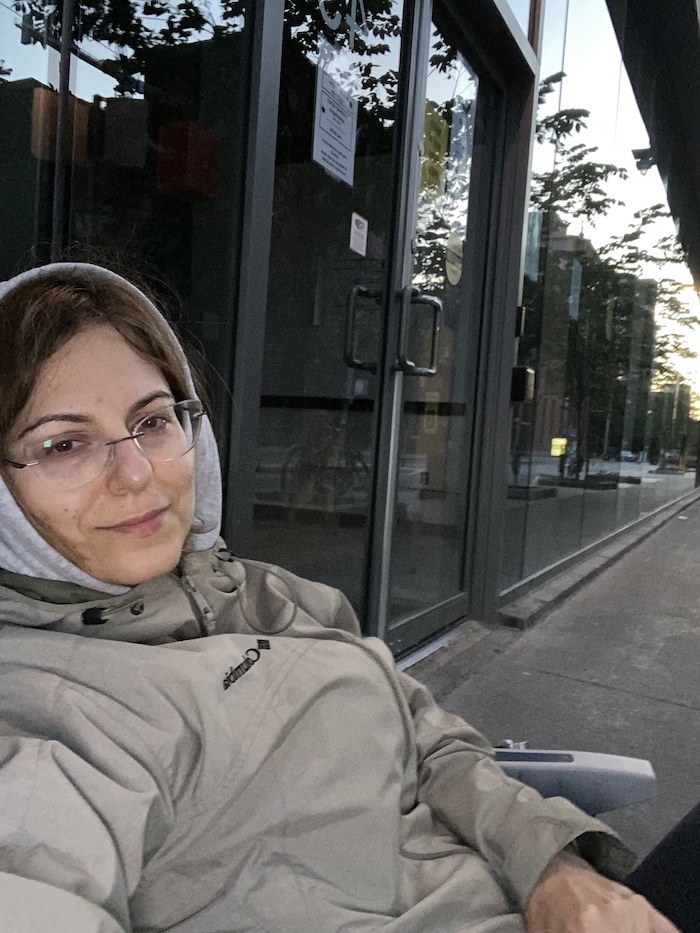
I took a small suitcase and packed a camping chair and a change of clothes. The clinic opens the doors only at 7am, and I just didn’t want to stand on my feet on the street for two hours. That’s what the chair was for.

I sat in the camping chair outside the clinic in the early morning hours and was hoping I wouldn’t be taken for a homeless person. A few passersby walked by and didn’t even look in my direction. Seems like camping in downtown Toronto is a usual thing. Another usual thing is bike races at 5-6am. I saw a lot of cyclists who passed by.

I finished my appointment around 9am and was able to get to the office around 9:40. That’s how long it takes to get from one end of the downtown (Distillery District) to another (Yonge and Bloor) That was enough time for me to get changed and get ready for the meeting with my boss at 10am. However, my boss didn’t show up at 10am. The night before the company had a big party for the execs and my boss had a good time at that party. He was still sleeping at the hotel when I was ready to meet him at 10am. He did show up 45 min later with a bad headache but had to leave in 20 min to catch his flight back to New York. Although this was my very first in-person encounter with my boss, I was not upset as I know he is a very nice person just not very experienced in partying and consuming strong alcohol drinks.

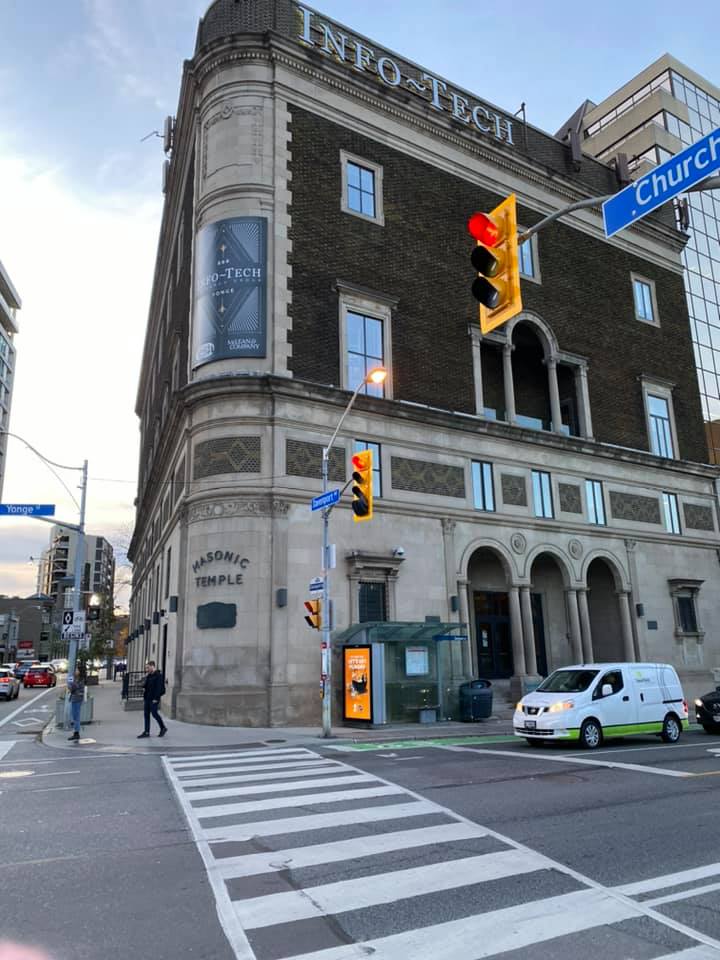
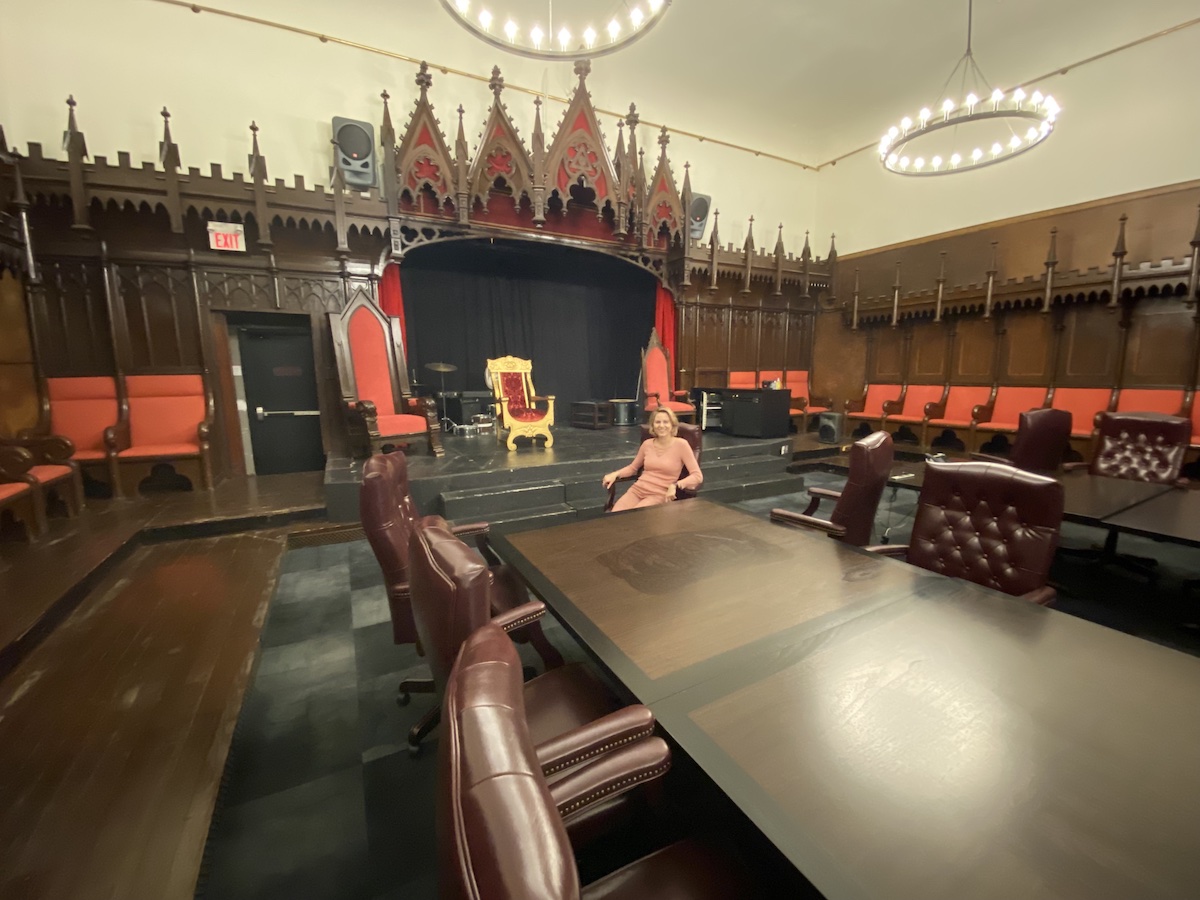
My other trips to the office were not very remarkable, however the office itself is very entertaining. I can’t imagine how people work in this office since it looks like a museum. More than a hundred years ago this building also referred to as Masonic  Temple, open its doors to house a group of  Mason lodges and chapters.


In 1950-90s this building had been the home of the Concert Hall that featured appearances of many famous performers including Frank Sinatra, Led Zeppelin, Iggy Pop, Tina Turner and others.

In 2013 our company bought this building for 12.5 mln and got it renovated for the office space. The concert venue still exists and our company uses it to host its own  events and also rents it out for musical events of all kind.

There is a famous Red Room where Masons used to gather. The room has authentic 100 year old furniture and employees are allowed to sit in these thrones.


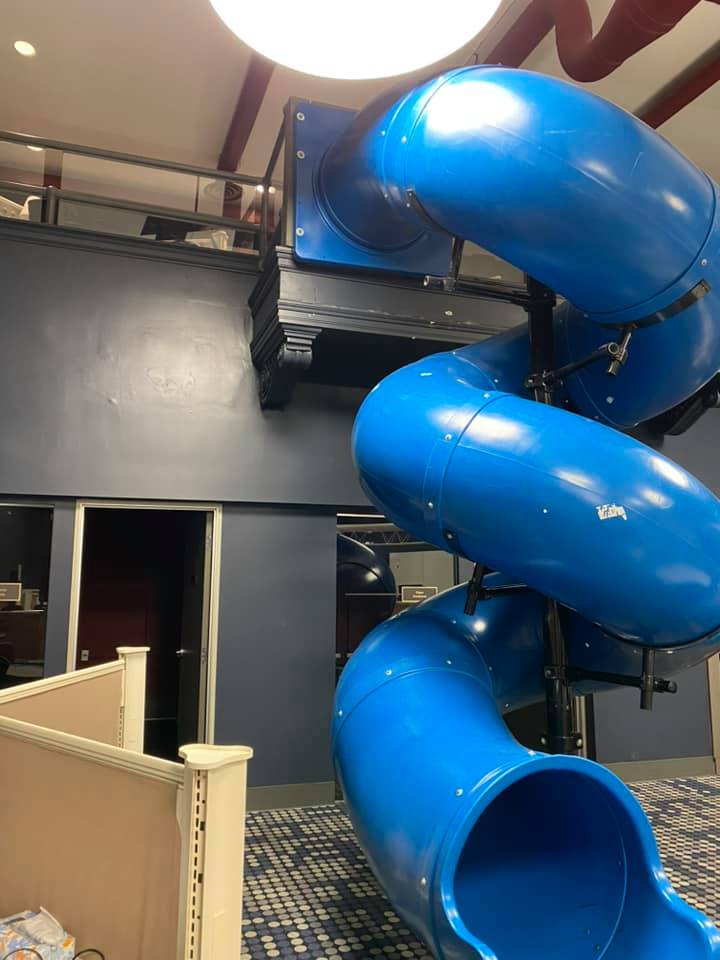
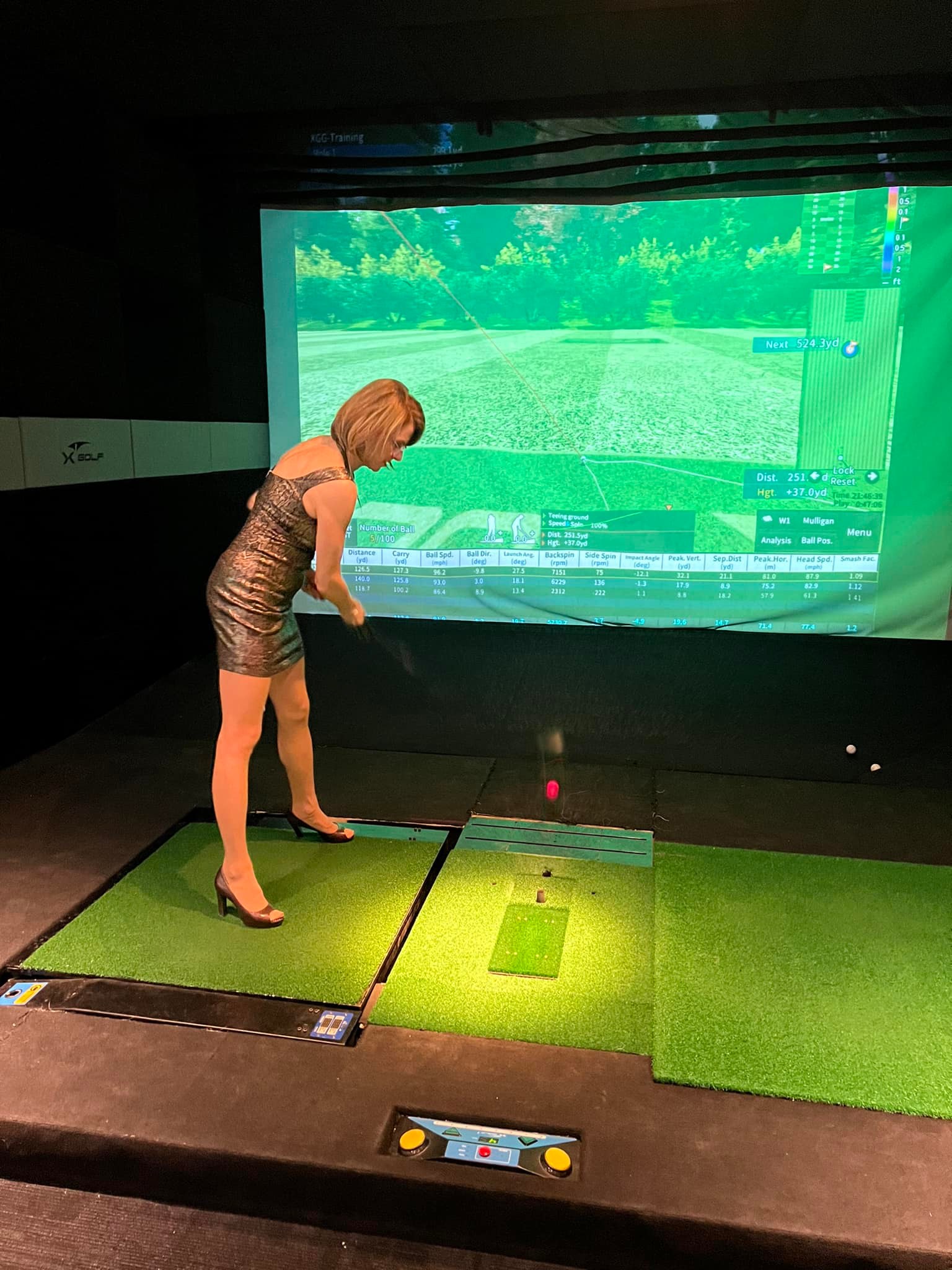
There is a spiral slide installed between two floors, glass wall conference rooms, a white room with walls fully used as white boards (this used to be the marketing department room during pre-Covid times), a room with a glass floor that has a spot that marks the centre of the building, a unique hundred year old elevator, a gym, a virtual golf simulator and many other cool things.

So I wonder how people actually work in this office and don’t get distracted, especially with so many meetings during the work day.

In fact, this is my first job where I have to be in so many meetings in one day. Sometimes meetings start at 9am and end at 5pm, with a short break for lunch. This can be really exhausting. Especially since every meeting has a different topic and my brain needs to switch from one subject to another every half hour. Also not all of my coworkers have good communication skills. Some people tend to talk a lot, going into a lot of details and since my brain is more wired to digest information visually, I sometimes zone out and lose the thread of a conversation. But I am now in that age and position that I don’t feel shy to ask for clarification and the young people who work with me are all very nice and don’t mind to clarify and repeat things to me.

I do try to encourage them to use visuals in presentations as much as possible. I find that my colleagues who are of my age and generation are all visual learners like me, while the younger staff are really good at listening, making notes, and logical thinking. Well, especially the ops people, not the marketing folks.

I now have 5 of such technical marketing ops people reporting to me and they are all just  too smart,   hardworking and dedicated . I try to spend enough time with each person and make everyone feel important and valued. I think that’s the most important quality of a good team lead. I also have to check their work, help them solve their problems, give them advice, and ensure they make progress in their work. As you can imagine, all I do now is talking to people (not just my team but also other teams and team leads). I think the main thing I learnt in this job is leadership skills. Since I need to be able to manage other people, I almost constantly  have to demonstrate confidence,  composure, and contentment. And as a result I learnt to be relaxed in this job… On the other hand I miss doing hands-on work, which is one of the reasons I decided to create this site.

So is working from home good or bad? Well, it’s kind of a love-hate relationship. On one hand, I  feel safe and comfortable. If I ever get fired, I won’t have to make a shameful exit through the office back door. I will just get unplugged from the corporate network. Another thing I like about WFH is being seen just as a team member and nothing extra. When I worked in the office people used to notice details about my looks (what i wear, my figure, the length of my legs etc) Remote staff are just talking heads and nobody cares about the rest parts of their bodies.

On the other hand being stuck in the house can be really depressing and getting out is always very exciting. When I get out, I feel motivated to look great. And when I meet people in person, I feel like I have been living out in the woods and it’s my first time in the town.

According to some research, people who WFH can be very productive but also very unhappy. The challenge is setting boundaries between the home and the job. Switching from a work routine into a home routine and vice versa. Sometimes I can stay up really late at night to finish a presentation and then find it very hard to get up in the morning especially if my meetings don’t start at 9am.

Canary Islands: Hot love and volcanic passions

Those lands, as everyone knows, were one of the last creations of the Lord … work on them was completed on Friday, late in the evening, which is why clouds of smoke still escaped from the bowels of the earth. The earth seething with life. Mixing of metals. Huge sea animals. Mineral vapors. New lush vegetation, greedily absorbing the fresh moisture of the earth. Palm trees that grow in six weeks.
 Abel Posse “Dogs of Paradise”

The plane dived into the gray cotton wool of dense clouds, then surfaced again, and the gray rocks encircling the island became visible. We were not allowed to land right away, so we made a big circle around the island, which took another half an hour, and then finally dived back into the gray cotton. When we landed, all around was a solid moving fog and gusty wind. Tenerife North Airport is located in the mountains – it is always cool and cloudy here.

We got to the hotel by taxi. The driver was quite experienced and all the way to Adeje we famously flew along the hot highway along the coast at almost 150 km/h. In Adeje itself, the taxi driver got confused, he did not understand English, and did not heed our requests to call the hotel by phone. Circling around the place, he asked all other taxi drivers we met on our way about the whereabouts of the Sunset Bay Club hotel. All his colleagues gave him different instructions, which completely confused him. Finally, he reached the Sunset Beach Hotel and, as per our advice, went to ask the concierge. Since these two hotels belong to the same chain, the last instruction finally led us to our destination.

The Sunset Bay Club was a cluster of 4-storey white buildings scattered over a large area on the side of a mountain. All staff spoke excellent English with a British accent. As we found out later, only Brits in their 40s stayed at this hotel. Small restaurants located directly under our window offered traditional English and Irish cuisine, which we got bored of on the first day. Since our room was on the 4th floor, just above the restaurants that were buzzing and smoking until two in the morning, we had a very quiet and secluded spacious terrace, with a nice view of the entire resort town.

When you go to Tenerife, there is no point in purchasing an all-inclusive vacation, since you’d want to get a chance to try the food in local restaurants. There were so many restaurants that any time it was time to have lunch or dinner, we couldn’t decide where to go. But anywhere we went, they had low prices and good quality. Local beer was cheaper than bottled water – 1 euro per half liter.


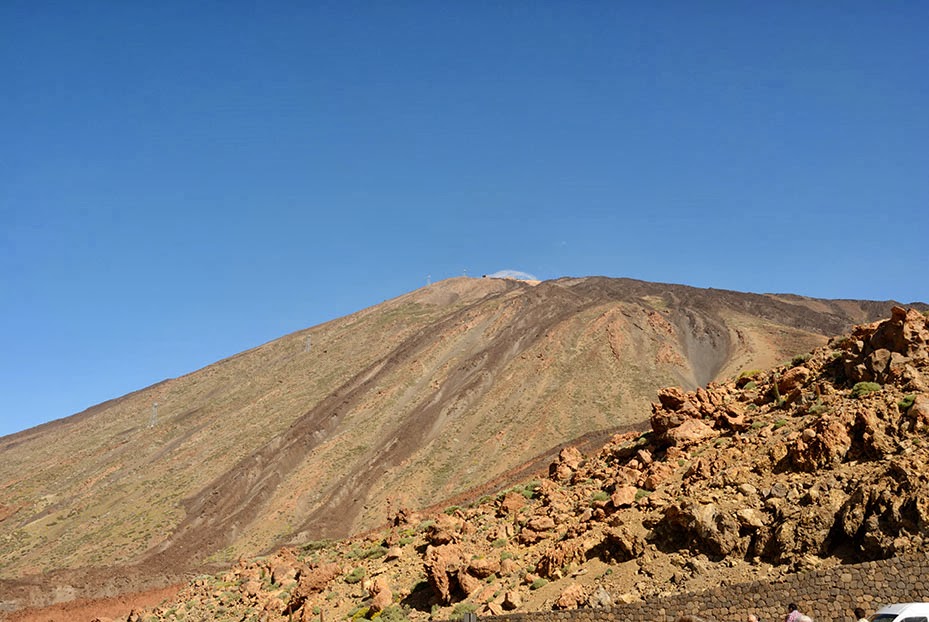
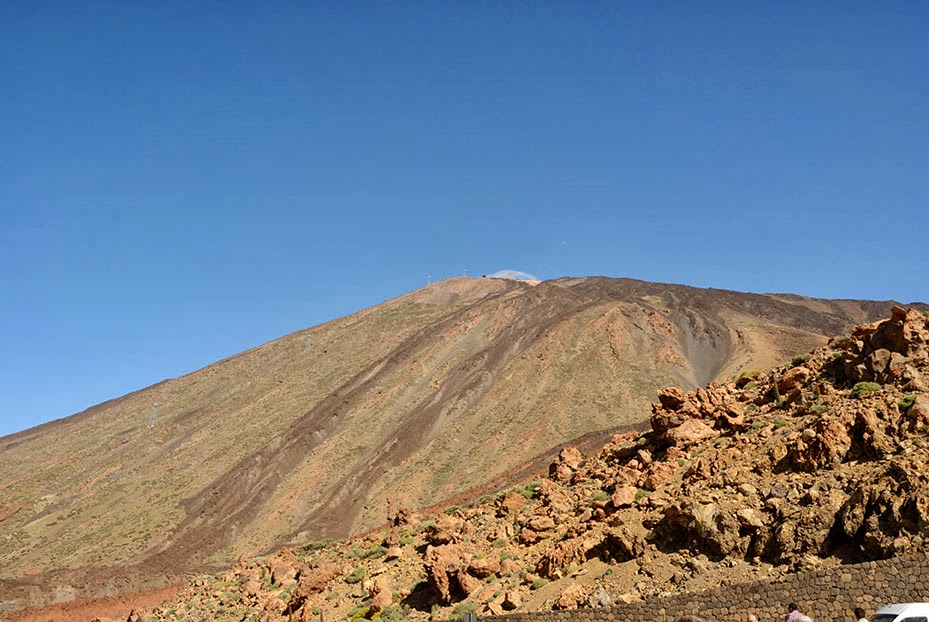
Soon upon arrival, we took a tour to the Teide Volcano. Unfortunately, the cableway was closed that day, and we couldn’t go all the way up the mountain. Although the volcano has not been active for a long time, vapors of some gases are constantly present above the crater. As a result, the peak of the mountain is covered with a light white cloud that looks like a scarf. According to the guide, the temperature of the magma inside the mountain is 600°C. The last eruption here happened a hundred years ago when a smaller volcano erupted (not the main one). The Canary Islands were formed as a result of the eruption of magma from the bottom of the sea. Everything here is made of volcanic rock – mountains, sand, stones. There is also unique vegetation, but more on that below.

The Teide Volcano is surrounded by the “lunar” valley, covered with solidified lava. Among the plants that manage to grow here are carrot-shaped turrets with small purple flowers that bloom once a year. We just caught them blooming.

Then we drove to the Chinchado rocks, a cluster of bizarre shaped massive stones. There were two Russian girls wearing a night club makeup sitting just behind us in the bus who apparently spent a whole night at some bar. Despite that fact, they were gobbling up sandwiches on the road and bravely climbing the rocks in miniskirts and platform shoes, to the admiration of local dudes.

Watch a video about Teide here.

Playa Torviscas and Playa Fanabe are considered one of the best beaches in Tenerife. Hot gray volcanic sand, calm, mirror-like sea, and majestic sunsets. Unlike other popular places, such as Las Americas (Playa de las Americas), known for its buzzing nightlife, Adeje is very quiet. It’s dominated by couples with kids and teenagers, as well as older tourists. 99% of vacationers are Europeans, mostly English, Spaniards, Germans, Russians, Scandinavians. Most shops and restaurants speak good English, although there are some where only Spanish is understood.

Our most memorable excursion was the trip to the Island of Gomera, located just 30 min from Tenerife by ferry. The huge ferry loaded with passengers and cars departs every hour from the port of Los Cristianos. It was too windy at stern of the ferry so we stayed mostly inside the passenger cabin which had toilets, a bar, and comfortable seats. I was fine on the way to Homera, but on the way back, after a whole day in the hot sun, I ended up being sea sick. I sat grasping the seat handles, my head between my knees, like a goose.

Gomera has many legends. The tour starts from the capital of the island, San Sebastian, where Columbus house is located. He stopped here before going to discover America. Here he was received by the Spanish aristocrat Beatriz Bobadilla, who became his mistress. Our guide Maria told us some interesting stories about the inhabitants of Homera, none of which could find online either in English or in Russian. For example, how Beatrice was widowed before meeting Columbus. Her husband, who was granted possession of the island by the Spanish queen, was a great lover of women. Bobadilla and her husband brutally killed local residents, the Guanches, who did not want to obey the Spanish invaders who captured their lands.
avno that to enter into a relationship with his own sister).

In search of materials about this legend, I came across a book by the Argentine writer Abel Posse “Dogs of Paradise”. This book is about the life path of Columbus, about how he decided to become a navigator and go in search of new lands, which he considered paradise, about his meeting with the Castilian queen Isabella, who made him an admiral and, of course, about Columbus’s erotic adventure on the island Homer :-))))), visiting the sexual maniac Bobadilla.

““She lived alone in the Tower… She kept wolves and lions. She ate the meat of wild boars and deers shot high in the mountains. Sometimes she ordered shark fins and rays to be delivered to the Tower and cooked them the Japanese way – in a bitter lemon marinade. Thick soups were cooked from this, they helped her in love affairs. About the devilish lust of Beatrice was fame throughout the district. If the fishermen happened to approach the island of Gomere at night, they listened to the desperate cries of her hapless lovers. Blocks, whips, stocks, spiked leather belts, cypress rods soaked in brine and vinegar. Servants in hoods pulled over their faces. Love is red or yellow, Beatrice’s love was dark brown. Almost all of her lovers – fishermen, lost sailors, captured Guanche leaders, overly nimble church servants – at the end of the night were thrown down into the sea, through the north window of the Tower. But it also had its own attraction. Despite the terrible rumors, it was hard not to accept the invitation of the famous beauty. In the era of severe prohibitions on any sensual impulses, who will miss the opportunity, who will refuse to endure torture from a naked woman? In addition, everyone must have hoped to tame her temper with soft tenderness, to arouse reciprocal love …”  This is how Beatrice Bobadilla is described by Abel Posse. Having read this book before my trip to Homer’s Island, I would probably look at this unremarkable medieval tower, which today is about a hundred meters from the seashore, with different eyes.

But on the day of the tour, I didn’t know anything about it. However, there were many other exciting experiences on Homer….

After visiting a small garden with bulk papayas and plantains (small bananas), we went to a shop where we bought several national souvenirs – palm syrup ( obtained from local palms and considered by the locals as an energy healing drink), almagrote sauce and homeron – palm syrup combined with grape vodka, recommended by our guide as a natural viagra. Then we were taken to a restaurant where they served pumpkin soup with the same almagrote sauce. Both the soup and the sauce were the same orange color, and they were suggested to be eaten together for piquancy. However, this sauce went well with both bread and chicken, and since it was very tender and spicy, I certainly ate more than necessary … For those who are planning to go to the Canary Islands, keep in mind that the food here is very tasty everywhere, but the sea shakes a lot, so control your appetite so that you don’t have to regret it later :-))).

In the same restaurant, we were shown the unique language of silbo whistling  . According to the guide, in ancient times, this language was the main means of communication on the island, as the rocks transmit the sound of the whistle well. With the help of this whistle, the Homerians could transmit messages from one end of the island to the other (without any special devices, mind you!) According to one hypothesis, the ancient Romans pulled out the tongues of the inhabitants of North Africa, whom they took out on ships to sell into slavery, and they learned to communicate without language – with the help of a whistle. Some of these ships could end up on Homer. The Homerians whistle, indeed, without using their tongue, putting their fingers into the genus. So that the whistle language does not die out, it is officially taught in local schools. You can listen to the whistle here .

In the afternoon we visited Garajuan National Park , whose name comes from the names of Princess Gara and Prince Juan, Canarian Romeo and Juliet, whose wedding was prevented by a volcanic eruption, interpreted by their families as an unkind sign from above. Juan sailed to Gara from Tenerife to Gomera, where they joined and threw themselves off the highest mountain of the island. This mountain and the forest surrounding it were named Garajuan. Garajuan Park is unique and included in the UNESCO World Heritage List. It is believed that this is the remnant of an ancient forest that covered most of Europe in the Tertiary period (more than 2 million years ago). There are many endemic plants and animals (that is, those that are not found anywhere else in the world), for example, tree-like chamomile and tree-like dandelion.

In general, despite the heat (it was 37 degrees that day), motion sickness on the ferry and on mountain serpentines, the trip to Homer Island justified itself, and I would not hesitate to go there again.

The Real Price of Social Media, or Why I Am Addicted to Facebook

I want to share a secret about myself – I am addicted to Facebook.

Every morning, when I wake up, the first thing I do is I reach for my phone and open Facebook. I spend at least 15 min first of all checking how many likes I got on the last photo I posted and from whom. Secondly, I scroll through the news feed to see what other people posted – pictures of cute kids, cats, dogs, happy faces, weird faces, and sometimes very disturbing stuff.

Question – why do I keep doing this every morning when I know very well that it’s a waste of time?

I decided to do some research on this subject. Turns out, I am not the only one wasting my precious morning time. 80% of smartphone users do the same thing – they check the social apps on their phones before brushing their teeth.

We all know how Facebook started – as a social network site for students at Harvard. It had only 4,000 users at that time. Now it’s used by 1.6 billion people across the world.

Maybe it would never grow beyond the size of a student network if smart marketers didn’t figure how to take advantage of it.
Why do so many people use Facebook?

There is this type of people who post 5-6 selfies of themselves in a day. I used to do that too. “Hey, here is me, driving my brand new car to work”, “Me, working so hard at my desk”, “Gym time – Can you believe I just did 20 sit-ups? Look at my abs”. What else? A Duckface Selfie. The list goes on.

The success of social media is based on humans’ need for attention. People simply don’t get enough attention in their real life. It’s abnormal to seek constant attention in real life. But it’s absolutely normal in social media – everyone does it. Facebook and Instagram create an ideal environment for obsession with self-image. The popularity of one’s image in social media is measured by the number of “likes”, “followers” and comments. It becomes a competition – who’ll get the most number of likes?
Guess what? It was all designed on purpose by some clever people who invented this “sharing” culture. They encourage us to tell more about our private lives. You open Facebook and the first question you see is “What’s on your mind?” or “Where are you right now?” or “Who are you with?”

All details of our personal life that we share through the social media is a goldmine for advertisers. They pay a lot of money to get access to that data. The more we share about ourselves the easier it is for them to market to us their goods.

We think it’s free to use social media. But the cost of this gigantic platform, the salaries of developers, the data centers space are all paid by the dollars we’ll spend later on movie tickets, clothes, restaurants and vacations advertised to us. That’s what makes the social media profitable and fuels its growth.

The second reason why social media is so popular is Curiosity… that killed the cat.

Nowadays humans’ attention span has become very short. In fact, a recent study found a goldfish has a longer attention span than humans. Why? It’s all thanks to smartphones and information overload.

Nobody wants to read a long article, especially if there are no big colorful pictures in it. No-one wants to watch a YouTube video if it’s longer than two minutes or if it doesn’t make us laugh or cry every 10 seconds.

And if you think about this, the content these days is not really about the message, it’s about the presentation.

Everything we see on social media is fascinating, exciting, eye-popping. The stories compete for our attention. Eventually we become satiated, desensitized. And we also very quickly forget everything we read or watched on social media.

Remember the photo of a dress that went viral? The dress that divided the entire planet? Half of the world was saying the dress was white and gold, and the other half claimed it was blue and black. Couples were breaking up because they couldn’t agree. Newspapers forgot about politics and focused on the dress. Scientists were doing studies about the dress color. The buzz around the dress lasted for a couple of weeks. And then everyone forgot about it.

What does this example teach us? The most viral content gets forgotten.
If I wake you up in the middle of a night and ask you what was the story of Romeo and Juliette all about, would you be able to tell me right away?

And if I wake you up in the middle of a night, and ask you to share with me any of the “45 incredibly amazing facts that you didn’t know can blow your mind” that you yesterday read about on Facebook, would you remember any of them?

Exactly.

The stories on social media are like fast food. They look, smell and taste really nice the moment we consume them. But do they leave those good nutrients in our system that make us happier and smarter?

Does the social media encourage us to explore the world, ponder, analyze, seek answers and finally create something of our own?

No, all it does is make us want more fun. Addictive fun.

And that is why I am addicted to Facebook.